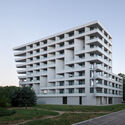
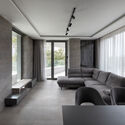
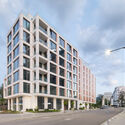
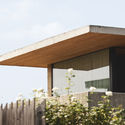
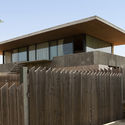
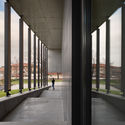
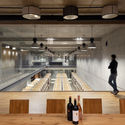
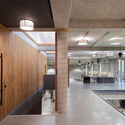
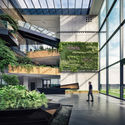
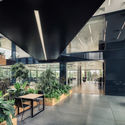
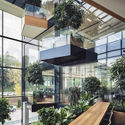
Collider Activity Center Competition Entry / Radionica Arhitekture

Courtesy of

Situated in the large fun park in the suburbs of Sofia, Radionica Arhitekture‘s proposal for the Collider Activity Center, which won one of five first prizes, is a small artificial ‘mountain’. When external conditions are favorable, the facade opens and the internal atmosphere becomes external. The second layer is the hall, a kind of a “cytoplasm”. The space between the façade and the climbing surface.This is the place of entrance, where the building and the park mix, the site of overlapping where all paths intersect. More images and architects’ description after the break.

Collider Activity Center Competition Entry / INDEX

Courtesy of INDEX

Located in the rapidly urbanizing Mladost area on the edge of central , the new Collider Activity Center, designed by INDEX, draws on the process of the tectonic movement and operations of geological forms as an organizational system to create architecture. The center will be one of the first new buildings to occupy the quasi Greenfield site and the broader urban structure plan for the area will eventually play host to a variety of new facilities, capitalizing on the latent potential of as an emerging economy. More images and architects’ description after the break.

Collider Activity Center Competition Entry / Ignacio Gias, Jesús Lorenzo Garvín, Ana Vida

Courtesy of Ignacio Gias, ,

Located between two very different poles that have a great tension between them, architects Ignacio Gias, Jesús Lorenzo Garvín, and Ana Vida (Fissure Team), designed the building of the Collider Activity Center to appear as a flow connector in the territory. In doing so, they create a transition from the urban to nature, from the stability to the unpredictable, from colonized to wild territories. It is broken by an organic geometry, by the adventure, by the representation of the natural world, that cuts the building and makes the users ‘break it, break it through, to the other side’ as a door to adventure. More images and architects’ description after the break.

Collider Activity Center Competition Entry / SO-AP Architects

Courtesy of

By creating a space which is open onto the city and welcoming for visitors, the proposal for the Collider Activity Center  by SO-AP Architects intends to be a place of importance in the city of . The objective is to propose a building designed to meet the expectations of a wide audience motivated by the challenge and keen on using a place offering multiple combinations of sports and rest, while being able to enjoy views on the city and its surroundings. More images and architects’ description after the break.

Collider Activity Center Competition Entry / STRATO

Courtesy of

Designed by STRATO, the project proposal for the Collider Activity Center has two primary objectives: visual identity and vitality. Conceived as a sort of natural formation, the entire building is emphasized by the folding panels of the walls, the placement of the volumes and the power that this arrangement represents. Since it is placed in a context of ongoing evolution, their version of the activity center aims to be the driving force of the transformation of the whole district of , Bulgaria by becoming a symbol for the entire city. More images and architects’ description after the break.

Four Faces: Collider Activity Center Competition Entry / Atelier WHY

Courtesy of

Designed for the Collider Activity Center competition, Atelier WHY‘s ‘Four Faces’ proposal presents a diversity of images rather than one unified experience. With the building containing many different activities, the architects were interested in branding activities with different concepts.  They focused on how to convey the variety of activities happening inside to those who are outside though the shape of the building. More images and architects’ description after the break.

Collider Activity Center Competition Entry / Gojko Radić + Nataša Stefanović

Courtesy of Gojko Radić +

Inspired to create a landmark in Sofia for the Collider Activity Center, the form of this building volume emerges from the striking rock columns, which are planted underneath the layer of earth and extend up into the open landscape. Instead of literally being rocks, this design by Gojko Radić and Nataša Stefanović metaphorically has an analogy in this natural Bulgarian setting around its stunning cliffs. More images and architects’ description after the break.

‘Wallcano’: Collider Activity Center Competition Entry / Zohar Architects

Courtesy of

Walltopia, a global leader in the design and manufacturing of artificial climbing walls and grips, organized the Collider Activity Center competition located in , near the foothills of Mount Vitosha – one of Bulgaria’s most popular tourist destinations. The proposal by Zohar Architects is a 100% climbable structure: a donut-shaped courtyard building informed by the diversity of context. Its volume is extruded using ‘grafts’ of the world’s most famous mountains as formwork to create a patchwork of alpine geo-diversity, with a perfect cast of Abraham Lincoln’s nose from Mount Rushmore prominently positioned to satisfy curious climber fantasies. More images and architects’ description after the break.

‘The Crown of Septiemvri’ Soccer Stadium Proposal / Gras Arquitectos

Courtesy of

Located in the old plot of the Olympic stadium of Sofia, , the proposal for the new soccer stadium by Gras Arquitectos aims to create a new mixed complex, keeping as much as possible the green and central qualities of the plot. Designed to seat around 15,000, the plot itself works as a central park of the neighborhood. More images and architects’ description after the break.

Architecture, Art and Collaborative Design: Harry Seidler Exhibition

Berman House, Joadja, New South Wales, 1996-99 © Eric Sierins

Celebrating the ninetieth anniversary of the birth of Harry Seidler, the leading Australian architect of the twentieth century, the ‘Architecture, Art and Collaborative Design’ traveling exhibition will take place January 10-February 10 in , at the VIVACOM Art Hall. The exhibition traces Austrian-born Seidler’s key role in bringing Bauhaus principles to Australia and identifies his distinctive place and hand within and beyond modernist design methodology. The exhibition was developed by curator Vladimir Belogolovsky of Intercontinental Curatorial Project in New York with Penelope Seidler and Harry Seidler & Associates in Sydney and sponsored by Seidler Architectural Foundation. More information on  the exhibition after the break.

|CON|Temporary Library Installation / Studio 8 ½

© Architect Vladislav Kostadinov /

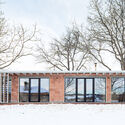
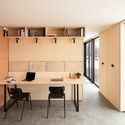
Already built in the Center for Contemporary Art, based in the old Turkish bathhouse in Plovdiv, , the |CON|Temporary Library Installation by Studio 8 ½ contains solely books of contemporary art. It provides many comfortable places to sit/lay, bookcases, magazines and newspapers’ shelves, as well as a computer with very rich and detailed multimedia and video archive of contemporary artists.Built using wood, the entire installation is created with a tremendous respect for its surrounding area, since without it, this effect would not be as strong. More images and architects’ description after the break.

Metro Station 20 Proposal / NC-Office

Courtesy of

Designed by NC-Office, the Metro Station 20 competition proposal establishes an identity as a market street station connecting the above ground activities with skylights down to platform levels while allowing for concentrated density and a transit oriented development. In this way, nature differs from ‘the tower in the park’ typology. The development of a mid-rise density in between Druzhba1 and Druzhba 2 stitches together the two neighborhoods. The intent of the project is to anchor the station entrances at major pedestrian traffic locations – on the plaza and near the pipeline park. More images and architects’ description after the break.

Graffiti Cafe / Studio Mode

© 3 in Spirit

Architects: Studio Mode
Location: , Bulgaria
Completed: 2011
Area: 300 sqm
Photographs: 3 in Spirit

‘The Lantern’ Metro Station and Public Arena / ShaGa Studio + MaDG

Courtesy of w/Doro Dietz Arch.Visualization

ShaGa studio, in collaboration with MaDG, shared with us their proposal for The Lantern, a new metro station and public arena for the future extension of Metro Line 1 in Sofia, . Shortlisted from over 130 entries in the Station20 competition, their design fluctuates between scales, creating a strong iconic image towards a southern public plaza while providing a soft landscape link as a northern station entrance. More images and architects’ description after the break.

Passive House International Design Competition

Courtesy of Passive House

Passive House Bulgaria recently launched an International Design Competition for a Passive House near , Bulgaria. The main goal with this competition is to challenge the architectural community to design a schematic design proposal for an affordable, low energy, single-family houses, to focus the public attention to this new type of energy efficient buildings, and to promote the design and construction of Passive Houses in Bulgaria. Registration is open until the competition deadline on on March 16. For more information, please visit here.

Metro Station 20 Proposal / ZNA

Courtesy of

’s new Metropolitan Station 20 on line 1 connects the nearby historic city with a modern and developing city center. It creates an underground world inspired by the cities’ culture and modern day aspirations. The design strategy by ZNA (Zeybekoglu Nayman Associates, Inc.) seeks to take advantage of the overlapping relationship between Obikolna Street and the proposed station below. The design of a centralized median, which moderates traffic, becomes the glass spine of the station. Composed of high angled walls in white architectural concrete the station is formed to capture natural light. More images and architects’ description after the break.

Station 20 Proposal / Peter Ruge Architekten

view from main plaza

The Metro Station 20 proposal by Peter Ruge Architekten on Metro Line 1 in , acts as a primary metro connection between Sofia’s city center and the airport, and the hub of a major commercial redevelopment plan. Their design seeks to establish clear pathways, form active connections and harmonize architecture and landscape. More images and architects’ description after the break.

Metro Station 20 / MSB Architects

Courtesy of

The proposal for the Metro Station 20 by MSB Architects aims to create passing spaces, with the creation and delineation of structures and trees that provide the amenities for this occupation. Assuming that the city will grow to this area, this project may be structured in this new area of the city through the creation of common spaces – above and below ground – with a philosophy of unity at a visual and functional language. More images and architects’ description after the break.

New Otets Paisiy Public Library / Studio 8 1/2

Courtesy of Studio 8 1/2

Architects: Studio 8 1/2
Location: ,
Project Year: 2011
Photographs: Courtesy of Studio 8 1/2

Metro Station 20 Competition

Courtesy of Municipality and Architecture Week

Sofia Municipality and Sofia Architecture Week invites all architects to participate in a competition for preliminary architectural design of Metro station 20 in Sofia, Bulgaria.

The project should be a proposal for a comprehensive sustainable architectural concept for the metro station and the public space above it. It should be designed according to the specific requirements of the underground rail transport system as well as the contemporary principals of urbanism.

The authors of the project that wins first prize will enter into an agreement with Sofia Municipality and Metropolitan EAD for commissioning the working documentation for this project. More information on the competition after the break.

In Progress: Red Apple Apartment Building / Aedes Studio

rendering

The surrounding neighborhood consists mostly of apartment blocks that date back from the 70’s. The buildings are large with enough space in-between and plenty of greenery. Because the whole area is built in relatively short period of time and not very long ago, it lacks the typical historic layers of the city center. Here the connection to nature is direct enough, the access to all city-conveniences – fast enough and easy, what makes the area nice to dwell. In spite of that it still lacks history, (memories of) the past and atmosphere.

Architect: Aedes Studio
Location: , Bulgaria
Photographs: