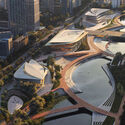
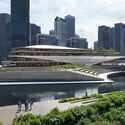
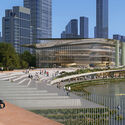
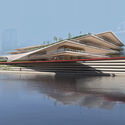
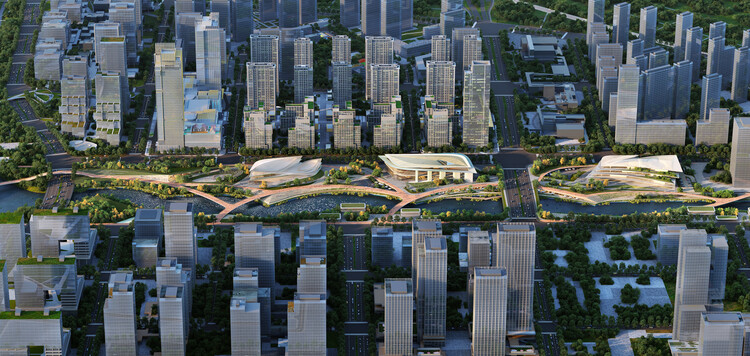
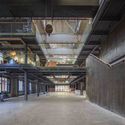
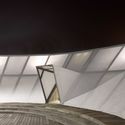
Zaha Hadid Architects has released images of its design for the redevelopment of the waterfront along the Zhedong Canal in Hangzhou's Xiaoshan District, China. The Qiantang Bay Central Water Axis project envisions a sequence of landscaped parklands, terraces, and gardens along the canal basin, proposing the transformation of former industrial areas into a green corridor extending toward the city center. The proposal adds to other recent design initiatives in the area, including Snøhetta's Qiantang Bay Art Museum, planned at the confluence of the Qiantang River and the Central Water Axis, as well as Zaha Hadid Architects' Grand Canal Gateway Bridge, a pedestrian bridge intended to connect the firm's 800,000-square-meter Seamless City masterplan on the east and west banks of the Grand Canal.
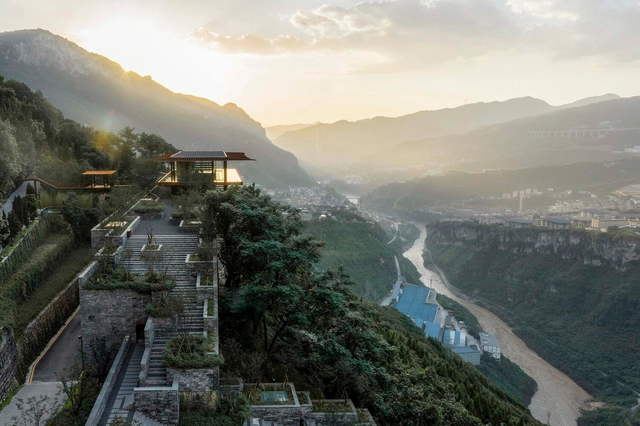
The 2025 Pritzker Prize has been awarded this year to Chinese Architect Liu Jiakun. Born in Chengdu in 1956, he grew up in the densifying city, before attending and graduating from the Chongqing Architecture and Engineering College (Chongqing University) in 1982 with a Bachelor of Engineering degree in Architecture, and becoming one of the first college graduates to be tasked with rebuilding the country during the Chinese transition period. However, it wasn't until many years later that the architect understood that "the built environment could be used as a medium for personal expression". It was then that his endeavors and career took off, with Liu Jiakun starting his practice in 1999, and participating in more collaborative works across China and Europe. Based on his experiences, his works are anchored in his understanding of reality and a respect towards China's multi-traditional history and internal diversity; all while achieving a seamless balance between architecture and nature, tradition and modernity.
These concepts do not obstruct his consciousness of human needs and the importance of community spaces. Through his projects, Liu Jiakun proves that spaces can affect human behavior and become positively evocative. A public space such as those he's created can be conducive to a benevolent atmosphere that provides rest and collaboration. "such as my pursuit of narrative and poetry in design." The comprehensiveness of Liu Jiakun's works makes it easy not to be constrained by stylistic or aesthetic limitations or requirements. He just follows what the site, natural landscape, pre-existing urban frame, and citizen needs might require. The physical result is a mix of all of these with the predominant vernacular traditions.
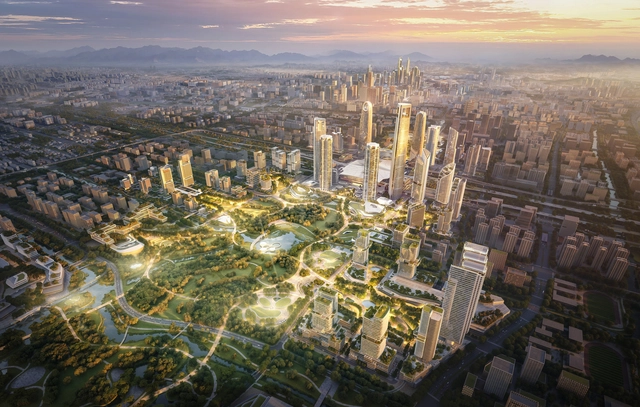
Skidmore, Owings & Merrill (SOM) and GAD have been chosen to design the Hangzhou Science and Technology Innovation Central Business District (CBD) in Hangzhou, the capital of Zhejiang province, China. Their proposal outlines a versatile regional hub that merges advanced transit systems with the traditional Jiangnan landscape, establishing a framework that promotes creativity and the growth of the tech sector.
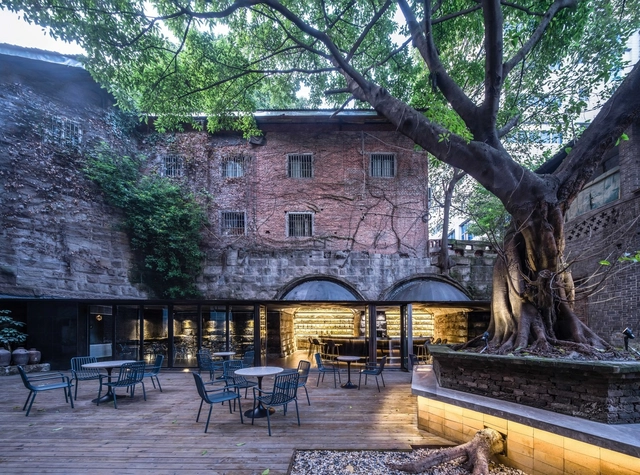
Both tea and alcohol in traditional China were similarly aestheticized, and both influenced the language of literature and art. People used to exchange alcohol as a gift in a way that they later would with tea. Today, more and more cities in China have embraced this drinking culture that passed down from generation to generation, and reinterpreted with a new contemporary fashion, which is constantly evolving in the urban cafes and bars.
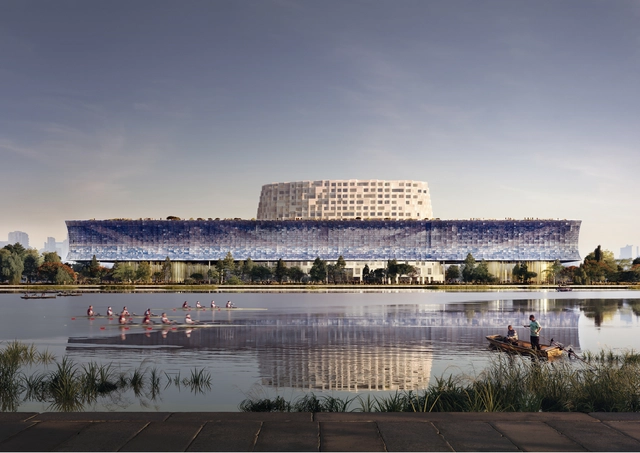
Waterfront View. Image Courtesy of Herzog & de Meuron
The Grand CanalMuseum Complex in Hangzhou, China designed by Herzog & de Meuron reflects on the importance of this area in Chinese cultural and natural landscapes. The project illustrates the story of the Grand Canal, through a continuous dialogue between the water and the museum.