Architects and LEGO® Bricks. For many, it was love at first sight.However, playing with LEGO at the office - fun as it may be - is not exactly something you can justify doing (at least not everyday).
Well, no more. For your procrastination pleasure, Google Chrome and LEGO® have paired up and created "Build With Chrome," a game that lets you play with LEGO online. Good-bye productivity.
In a brilliant article for Der Spiegel, "The New Monuments to Digital Domination," writer Thomas Schulz not only rounds up our reigning tech giants' oddly-shaped offices - from Apple's "spaceship" to Amazon's "biodomes" - but also pinpoints what they have in common: horizontality. And why? Because an "open creative playground" without boundaries (like floors or walls) is "the perfect ideas factory: the ideal spatial environment for optimally productive digital workers who continuously churn out world-changing innovations." And while this means that privacy has gone out these workspaces' proverbial windows, Schulz isn't too surprised - after all, "people have no right to a private life in the digital age." Check out this must-read article here.
A mysterious construction project in the San Francisco Bay has been making waves for the past couple of weeks. Moored off Treasure Island, locals apparently refer to it as 'the secret project' - and, until now, that's about as much as was known about it.
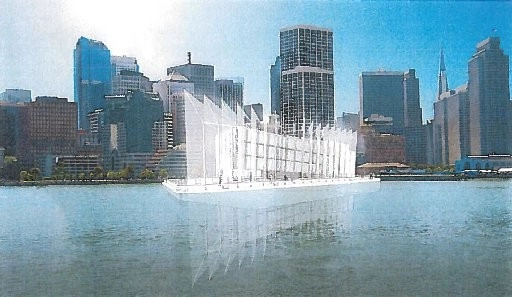
Despite months of rumors and complete radio silence from Google, spokespeople have finally released a statement on the project, stating: "Google Barge … A floating data center? A wild party boat? A barge housing the last remaining dinosaur? Sadly, none of the above. Although it’s still early days and things may change, we’re exploring using the barge as an interactive space where people can learn about new technology."
While it's a shame about the dinosaur, Google's expansion into technology retail is possibly even more intriguing, as it's entirely new turf for the company: retail design.
More info and an artist's rendering of what the barge could look like, after the break...
https://www.archdaily.com/446791/barge-of-shipping-containers-to-become-google-glass-showroomKatherine Allen
Google's secret development department, Google X (responsible for Google's very cool, although non-core initiatives, such as Google Glass and driverless cars) is reportedly working on a new technology that could transform the construction industry - as well as architecture itself. It goes by the name of "Genie."
According to Globes, a report from Genie's development team, addressed to Google co-founders Sergey Brin and Larry Page, describes the invention as a cloud-based collaboration platform with "planning applications to help architects and engineers in the design process, especially for skyscrapers and large buildings. The platform includes planning tools of expert architects and engineers and advance analytics and simulation tools."
The report also emphasized Genie's potential to transform the conservative construction industry, one of the most profitable and the most wasteful, by making it more efficient and environmentally friendly at the level of design, construction, and maintenance. The report suggests the invention could save 30-50% in construction costs and 30-50% of the time spent between planning and market; moreover, it could generate $120 billion a year.
Videos
This satellite image of Bolivia shows dramatic deforestation in the Amazon Basin. Courtesy of Google.
NASA, in cooperation with TIME and Google, has unveiled startling timelapse images of Earth from orbit collected by NASA's Landsat program since 1984. This program, created not for spycraft but for monitoring the way in which humans are rapidly altering the surface of the planet, consists of eight satellites that have collected millions of pictures in the course of two generations. When sifted through, cleaned up and stitched together, these pictures come together to create a high-definition slideshow that reveals some of the drastic changes our planet is undergoing - most notably through widespread urbanization.
And this week's "punniest" title award goes to Fast Company (there was no contest, really). Beside the pun, of course, the article itself is pretty cool, outlining how Google Street View has followed-up on their latest intrepid capture of the Burj Khalifa with the 1889 classic: the Eiffel Tower. Read the article here and check out the fun video above!
"Most social movements become social moments when they appear in a public square," says Seyla Benhabib, a professor of Political Science at Yale University, in the video above. "These are informal spaces of deliberation and communication."
A few days ago, Google+ released the short video above about these digital spaces, what they call the "virtual public square". Of course, the physical places that people use to express themselves are certainly no less important; however, it is interesting to consider the vital role social media and virtual communication now play in the unraveling of political events.
Jane Jacobs revered the West Village. It was a bustling neighborhood enlivened by its social, spatial, and functional diversity. It had different building types and functions, which meant that people were always in places for different purposes; it had short blocks, which have the greatest variety of foot traffic. It had plenty of old buildings with low rent which “permit individualized and creative uses;” and, most importantly, it had all different kinds of people. As a result, West Villagers could establish casual and informal relationships with people that they might not have had the opportunity to otherwise.
Without these necessary characteristics, Jacobs felt “there is no public acquaintanceship, no foundation of public trust, no cross-connections with the necessary people – and no practice or ease in applying the most ordinary techniques of city public life at lowly levels.”
By simply changing a few words, it’s not hard to imagine Jacobs’ writing describing offices instead of cities. Buildings are different internal spaces, like individual offices or gathering spaces; desks are homes; sidewalks are hallways or circulation space; etc.
If the office is a small microcosmic city, then suburbia is the cubicle-strewn office, and Google might be the West Village. And ‘people analytics,’ the statistical and spatial analysis of interpersonal interaction, is the office’s urban planning.
To find out what creative work environments can learn from the composition of cities, keep reading after the break...
https://www.archdaily.com/367700/can-architecture-make-us-more-creative-part-ii-work-environmentsJonathan C. Molloy
Videos
High Line Park smells wet / Photo by Marcin Wichary / http://www.flickr.com/photos/mwichary/. Used under Creative Commons
We know a good idea when we see it. That's why as soon as we heard about Google Nose we decided to call our friends at Google and work something between both of us. Google has the power to bring you the scent of food, animals, and all sort of things. But what about buildings? That's were we come in.
One thing Google has become known for is their spectacular work environments. From playful employee lounges to environmentally sensitive design, the multifaceted internet giant has successfully transformed hundreds of existing spaces from around the globe into casual work environments that spawn innovation, optimizes efficiency, and boasts employee satisfaction. Much like many other California-based corporations, Google has been toying with the idea of building their own office space from scratch. Well, this dream will soon be realized, as the company has teamed up with Seattle-based NBBJ to expand their current, 65-building “Googleplex” in Mountain View, California, by adding a 1.1-million-square-foot complex known as “Bay View” on a neighboring 42-acre site.
Last year, Google founder Sergey Brin demoed Google Glass a new technology from the big G that puts an augmented reality display in front of your eye. The device is scheduled for early release to developers and creatives (in order to get feedback before the $1,500 product finds its way to the general public) in just a few weeks, but it has already been highly acclaimed by the media (including Best Inventions of the Year 2012 by Time).
Greenbuild, the world’s largest conference and expo dedicated to green building has commenced in San Francisco with an interesting announcement from the main stage. Google has granted $3 million to the U.S. Green Building Council (USGBC) in an effort to transform the building materials industry and accelerate the creation of healthier indoor environments.
“Healthy, non-toxic building materials are a critical component in green building,” said Rick Fedrizzi, President, CEO & Founding Chair, U.S. Green Building Council. “Fostering awareness of the materials we put into our buildings is of paramount importance, since many materials can link to a host of environmental and health issues. Working with Google enables us to broaden our efforts in the materials industry as we prepare for the next version of the LEED green building program, LEED v4. This updated rating system will paint a more complete picture of materials and products, enabling project teams to make more informed decisions.”
From the archeological areas of Stonehenge to the Hiroshima Peace Memorial, Google’s World Wonders Project is dedicated to digitally preserving and virtually sharing the World’s Heritage Sites. Users can explore some of the world’s greatest places through panoramic images, 3D laser scanned models, videos and informative text. Although Google World Wonders is a new and ongoing project, they already have more than 130 sites in 18 countries featured. The project is also an educational resource, allowing students and scholars to use the materials to discover some of the most famous sites on earth. A selection of free educational packages are available to download for classroom use.
Google World Wonders is made possible through the partnership of Google, UNESCO, the World Monuments Fund and Cyark, with a shared mission to preserve world heritage sites for future generations.
A report released by the Center for an Urban Future has positioned New York City as the fastest growing tech sector in the country, outpacing Boston to become the U.S.’s Tech Hub (only behind Silicon Valley).
Its rapid growth – a 28.7% increase of tech-related jobs in five years and a 32% increase in venture capital deals (compare that to the national average of -11%) – has been attributed to the diversification of its startup tech companies, focused not on creating new technologies, but on providing technological solutions to existing industries.
However (as we noted earlier this week in “The Next Silicon Valley(s)“) there is another “key” factor to the city’s burgeoning innovation and entrepreneur scene – the city itself.
Read More on how New York City’s Urban lay-out is encouraging its technological boom, after the break.
HP, Apple, Google – they all found their success amongst the peach groves and Suburban houses of California. But why? What is it about Silicon Valley that makes it the site of technological innovation the world over?
It’s tempting to assume that the Valley’s success must be, at least in part, due to its design. But how does innovation prosper? What kind of environment does it require? In a recent interview with The Atlantic Cities, Jonah Lehrer, author of Imagine: How Creativity Works, suggests that creativity is sparked from casual exchanges, the mingling of diversity, the constant interaction with the strange and new. In short, and as a recent study corroborates, innovation flourishes in dense metropolises.
Seemingly then, Silicon Valley, a sprawl of highways and office parks, has become a hotspot of creativity in spite of its design. But let’s not write off design just yet.
As technology makes location more and more irrelevant, many are looking to distill the magic of Silicon Valley and transplant it elsewhere. The key will be to design environments that can recreate the Valley’s culture of collaboration. The future Valleys of the world will be microsystems of creativity that imitate and utilize the structure of the city.