Our latest movie in our Films & Architecture series is another ’60s classic, this time by the master filmmaker Alfred Hitchcock. In North by Northwest we see a New York in the heyday of its architectural glory, with one scene taking place at a newly constructed United Nations building. In fact, the last scene takes place in a “house” that, under Hitchcock’s instructions, was meant to seem designed by Frank Lloyd Wright (in reality, the house was just another set design). The film shows a variety of urban spaces, and puts special emphasis on the contrast between the densities of urban and rural realms.
With many museums worldwide seeking to extend, to accommodate larger collections, Athens-based Oiio Architecture Office have asked: “What if we decided we needed a little more of Guggenheim?”
Their solution is to stretch Frank Lloyd Wright’s original building skywards, by continuing its iconic ramp, creating an additional 13 floors.
LEGO® aficionados, the wait is over. LEGO® has announced the details of their first edition to the 2013 Architecture series! Who better to kick off the new year than LEGO® Architecture staple Frank Lloyd Wright with his Imperial Hotel in Tokyo.
The most celebrated of Wright's six Japanese buildings, the Imperial Hotel was designed in the, then very chic, Mayan Revival style and constructed largely of stone and reinforced concrete. It was lauded for having survived a sizable earthquake shortly after its opening, however in reality portions of the building sunk leaving residents navigating its wobbly corridors. Eventually it was decided to completely demolish the building in 1968 to make way for the high-rise building that stands on the site today.
But fret not, now instead bemoaning the loss of one of Wright's great works, for between $90-$100, big kids and little architects can reinstate this landmark building on their very own living room floor with 1,188 glossy miniature blocks.
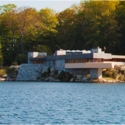
Petre Island (sometimes called Petra Island)is an 11-acre, heart-shaped island 47 miles from Manhattan. While Wright hand-picked the site himself in 1949, and drew up plans for a 5,000 square foot "dream house" the following year, budget concerns forced him to scale down his vision, resulting in the construction of a smaller guest cottage.
Fast-forward 53 years later, and the island's new owner, John Massaro, decided to make those long-sitting plans reality; he hired architect and Wright scholar Thomas Heinz, who used ArchiCAD to model aspects of Wright's design that weren't obvious from the original renderings and updated the house with some modern amenities.
While the Frank Lloyd Wright Foundation refuses to accept the house as authentic (they even tried to sue Massaro for claiming so), that hasn't stopped AHALife, the web site featuring the island for sale, from proudly selling the "spectacular Frank Lloyd Wright-designed house" for $19,900,000 USD.
More images and info on this Wright-designed island, after the break...
Just when we thought the saga was over, a whole new chapter has begun.
The David Wright House, an unusual home in Arizona that Frank Lloyd Wright designed for his son, has been in danger since July, when the developer-owners announced their plans to tear it down and split the lot in two. After considerable hubbub caused by preservationists, and an online petition that received thousands of votes, enough pressure was put on the Pheonix City Council to delay demolition until they could vote on whether or not to confer Landmark Designation on the house (this would delay demolition for another three years, but not safeguard the house from demolition).
After months of following the David Wright House's brushes with demolition, we're happy to report that an anonymous, preservation-friendly buyer has bought the house.
On October 9th, the Arizona Planning Commission met to discuss the proposed landmark designation for the house, an event which attracted over 100 people. According to The New York Times, only 3 people voted against the designation, including the house's current owners, the developers of 8081 Meridian, John Hoffman and Steve Sells.
When the pair bought the house back in June for only $1.8 million (from the pair the Wright's granddaughters had sold the house to for $2.8 million), they thought it was "too good to be true." The property alone could make up to $1.4 million; the pair hoped that by splitting the lot they could make even more.
Unfortunately, the developer, John Hoffmann of 8081 Meridian, says that really doesn’t matter to him.
According to yesterday’s New York Times article by Michael Kimmelman, Pheonix city policy requires owner consent before designating any building for historic preservation. Since “8081 Meridian never gave its consent, and has no intention of doing so, Mr. Hoffman says he rejects the landmark process outright.”
Hoffman’s demolition permit has been voided by city officials, but he maintains that the permit is legal – it just expires today.
The Museum of Modern Art, Columbia University and The Frank Lloyd Wright Foundation have announced that the vast archives of American architect Frank Lloyd Wright (1867-1959) have been jointly acquired by the University and the Museum and will become part of their permanent collections. The archive, which includes some 23,000 architectural drawings, 44,000 historical photographs, large-scale models, manuscripts, extensive correspondence and other documents, has remained in storage at Wright’s former headquarters – Taliesin (Spring Green, WI) and Taliesin West (Scottsdale, AZ) – since his death. Moving the archives to New York will maximize the visibility and research value of the collection for generations of scholars, students and the public.
“The Frank Lloyd Wright Foundation takes seriously its responsibility to serve the public good by ensuring the best possible conservation, accessibility, and impact of one of the most important and meaningful archives in the world,” said Sean Malone, CEO of the Frank Lloyd Wright Foundation. “Given the individual strengths, resources and abilities of the Foundation, MoMA and Columbia, it became clear that this collaborative stewardship is far and away the best way to guarantee the deepest impact, the highest level of conservation and the best public access.”
Continue after the break for more images and an informative video.
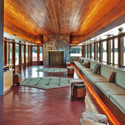
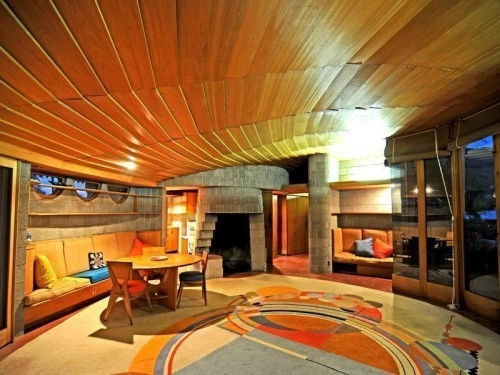
While any Frank Lloyd Wright deserves to be preserved in our opinion, this quirky house, which Neil Levine, architectural historian and Harvard professor, went so far as to describe as “one of Frank Lloyd Wright’s most innovative, unusual and personal works of architecture” offers us an important glimpse into Wright’s development. Because of its circular spiral plan (completed six years before the Guggenheim), concrete-block detailing, and interior design, the house was (and still is) considered to be one of Wright’s most “remarkable and praiseworthy” efforts since Fallingwater.
Although the situation is dire, work done by the Frank Lloyd Wright Building Conservancy has awarded a temporary demo delay while the City of Phoenix decides whether to bestow historic preservation and landmark designation upon the house. This is where you come in. An online petition to the City of Phoenix has been set-up; as of right now, they’re 360 signatures short of their 1,000 person goal.
For almost 40 years no intact Wright building has been intentionally demolished.Let’s make sure we don’t start with this one. Sign the online petition (and then share it on Facebook, twitter, etc.), now!
For more information or to get involved, check out the SAVE WRIGHT page. For more images (including sketches) of the David Wright House, check out the gallery after the break…
The relationship between social dynamics and architecture has always been intimate. It is a constant dialogue between social norms and politics, stylistic trends and aesthetic choices, individual preferences and the collective good. The Modernist Period was a time when architecture took on the challenge of many social problems. In all the arts – architecture, design, music and film – the period was highly politicized and the choices often gave way to a utilitarian ideal that was a hybrid of efficiency, simplicity and comfort. Jake Gorst’s new film Modern Tide: Midcentury Architecture on Long Island, supported by Design Onscreen, is a message of preservation that takes us through the history of the modernist housing boom that took place on Long Island, NY in the period between the Great Depression and the 1970s.
In 1953, six years before the Frank Lloyd Wright-designed Solomon R. Guggenheim Museum opened to the public, two of his structures—a pavilion and model Usonian house—were built on the future site of the museum to house a temporary exhibition displaying the architect’s lifelong work. From July 27, 2012, to February 13, 2013, the Sackler Center for Arts Education at the Guggenheim Museum will present A Long-Awaited Tribute: Frank Lloyd Wright’s Usonian House and Pavilion, an exhibition comprised of selected materials from the Solomon R. Guggenheim Museum Archives, highlighting the first Wright buildings erected in New York City. Text Courtesy of: The Solomon R. Guggenheim Foundation (SRGF). More information on the exhibition after the break.
Not that many films can have the amount of high-end architecture as location for their scenes. In “The International” the characters goes to a secondary position – through architects’ eyes - since the movie is a showroom of well known buildings and cities.
The mythic Guggenheim Museum in New York by Frank Lloyd Wright serves as the space for one of the main scenes, jumping to the Phaeno Science Center by Zaha Hadid in Wolfsburg, Germany. Cities where the movie was filmed include Istanbul, Berlin, Lyon, Milan, and New York, showing us an impressive catalogue of “international” architecture.
Let us know your thoughts about the movie and international architecture. What does this concept mean today? Or was it only an utopian modern movement?
Quite possibly the most well-loved architect of our time, Frank Lloyd Wright was known for his “organic” architecture that harmonized with its surroundings (See the AD Classic: Fallingwater House). He would have turned 145 today.
Two weeks ago we started proposing films relevant to our field for you to primarily enjoy and also to encourage its discussion. First with “The Belly of an Architect”, and then “Blade Runner”, this week is the turn for a slightly more contemporary movie written and directed by Andrew Niccol, Gattaca. The film presents a future were the human condition is already defined in DNA, therefore human’s opportunities for life development are pre-established. Beyond the interesting ethical issue, the architecture where this story occurs is carefully selected in order to fit the director’s image of the future. Locations include the Marin County Civic Center by Frank Lloyd Wright and the CLA Building by Antoine Predock.
PBS has released their selections of the top ten buildings that have changed the way Americans live, work and play. From Thomas Jefferson’s 224-year-old Virginia State Capitol to Robert Ventui’s postmodern masterpiece the Vanna Venturi House, each building on the list will be featured in a new TV and web production coming to PBS in 2013. Continue after the break to view the top ten influential buildings and let us know your thoughts!
We found this great image from The All Nighter – a tumblr dedicated to students who want to share and prospective students who would like to know about the architecture studio experience. The ArchDaily team would like to wish you a wonderful holiday season and a happy new year!
In celebration of the 75th anniversary of Taliesin West, Frank Lloyd Wright’s winter home, studio and architectural campus in Scottsdale, Arizona, Phoenix Art Museum presents Frank Lloyd Wright: Organic Architecture for the 21st Century. The exhibit will explore Wright and his relevance today through a survey of more than 40 projects shown through rarely seen drawings, models, furniture, films and photographs.
The Arizona exhibit will be open to the public from December 18th, 2011 to April 29th, 2012 at the Steele Gallery in the Phoenix Art Museum.