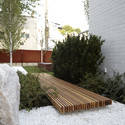
Courtesy of Michael Van Valkenburgh Associates, Inc.
Chicago is set to be the next U.S. city to park-ify on one of its abandoned rail-lines. First proposed back in 1997, the 2.7 mile, 13-acre Bloomingdale Trail and Park is proposed for a stretch of abandoned railway trestle dating from 1910, which has been lying unused since the turn of the century. And, even though it is already being compared to New-York'sHigh Line, the planners are adamant that the park will be an entirely different animal to its New York cousin.
Read more about Chicago's unique proposal after the break...
Mayor Rahm Emanuel and Growing Power, a Chicago-based urban agriculture organization, announced recently the formation of Farmers for Chicago, a program that will transform vacant south-side Chicago lots into productive urban farms. The program will make available up to five acres of city-owned vacant lots for urban farming activity and "help expand the supply chain for local neighborhood-level food production and wholesale," "improve community access to healthy food, help participants to supplement their incomes, and to foster workforce training."
Read more about Farmers for Chicago after the break.
When emigrating from Germany in 1938 to head Chicago’s Armour Institute, Ludwig Mies van der Rohe was challenged with two tasks: first reform the schools curriculum to his “back-to-basics” approach and then develop plans for a newly expanded 120-acre campus for the creation of Illinois Institute of Technology, a product of the Armour Institute and Lewis Institute merger. Mies was able to exceed both challenges and the outcomes have had a lasting influence on Chicago and modernism for the past 75 years. In celebration of this legacy and Mies’ 127th birthday, IIT was complied this comprehensive video that features Mies’ contribution to the modern landscape of their campus and city.
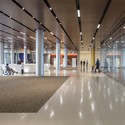
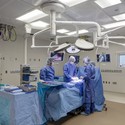
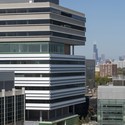
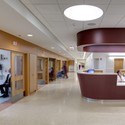
Currently being constructed adjacent to Advocate Illinois Masonic’s existing hospital, the SmithGroup designed Center for Advanced Care is the first of a planned two-phase building program that will add 156,000-square feet dedicated to cancer care, digestive health, and ambulatory surgery services. With completion expected for early 2015, the architects are striving for a building that is a response to the needs of their community. Not only does this building reflect the personality of their organization, but it will give them a platform to transform how they deliver care to their patients. More images and architects’ description after the break.
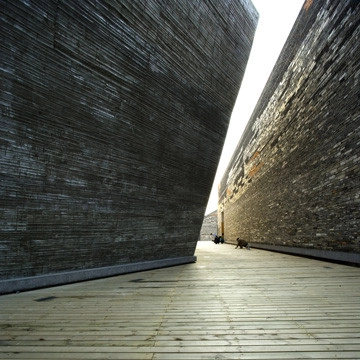
Amateur Architecture Studio. Ningbo History Museum, 2003-2008. Ningbo, China. Photo by Lv Hengzhong.
The Architecture & Design Society at the Art Institute of Chicago is presenting the Butler-VanderLinden Lecture on Architecture featuring Wang Shu: 2012 Pritzker Architecture Prize Laureate and co-founder of Amateur Architecture Studio, founded by him and his wife, Lu Wenyu, in 1997 in Hangzhou, China. They are known for a keen dedication to handicraft, a penchant for sustainable building methods, and thoughtful projects that are contextualized within Chinese culture and history. The firm’s work has been described by the Pritzker Prize jury as “timeless, deeply rooted in its context, and yet universal. The event will be held in the Rubloff Auditorium on March 28th from 6:30pm-7:30pm. For more information, please visit here.
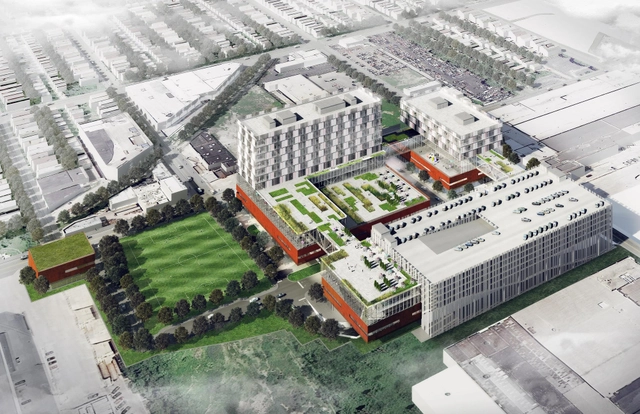
Located in one of the most vibrant yet blighted neighborhoods in Southwest Chicago, HDR Architecture's proposal for the Focal Point Community Campus represents how hospitals can no longer be hermitically sealed from their surroundings; rather, they must embrace the communities in which they reside. Offering a supreme opportunity for this type of change, their concept follows a breakthrough model, which will make it a financially self-sustaining community campus. The vision for the project was developed by Chicago's Saint Anthony Hospital and will be brought to life under The Chicago Southwest Development Corporation, the not-for-profit organization established to develop and maintain the Focal Point property. More images and architects' description after the break.
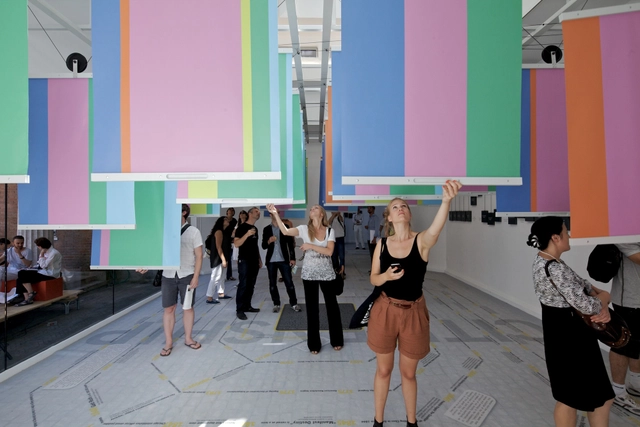
Spontaneous Interventions: Design Actions for the Common Good, the official U.S. representation at the 13th International Architecture Exhibition at the Venice Biennale (2012), will travel to Chicago in May 2013, and is seeking new projects—urban interventions realized in U.S. cities in the past two years—with an emphasis on those based in Chicago and the Midwest region. The exhibition will be on view through Summer 2013. The exhibition in Chicago will feature a site-specific adaptation of the original exhibition design and will include many of the projects featured in Venice alongside dozens of new projects selected as a result of this open call for submissions. Submissions are due no later than March 6th. For more information, please visit here.
1960’s Chicago: cars zooming down Lake Shore Drive, crowds heading into the Opera House, people observing artworks in the Art Institute, and Chicagoans laying around Grant Park on a sunny day. These are just a few of the scenes captured by amateur filmmaker Margaret Conneely in her filmThe City to See in ’63. The people, neighborhoods, and architecture of Chicago are all captured in this well-crafted 12-minute, 16mm color film taped in 1962.
Conneely captures some key architectural sites in Chicago, including the construction of Marina City. In addition, there are clips of a few buildings that no longer exist such as the Chicago Sun-Times building, demolished in 2004; White Sox Park, demolished in 1991; and the first McCormick place, wrecked in 1967.
The film also covers different neighborhoods of Chicago including Lincoln Park, Logan Square, Garfield Park, and old Maxwell Street.
As shown in the film, Chicago has always been known for its spectacular array of architecture. To see more current architectural sites in Chicago, view our Architecture City Guide: Chicago.
In response to the Commission on Chicago Landmarks’ decision to reject landmark status to Prentice Woman’s Hospital for the second time in three months, the two preservationist groups challenging the City of Chicago have withdrawn their lawsuits. This eliminates the last barrier standing in Northwestern University’s way to demolish the historic, Bertrand Goldberg structure for a new biomedical research facility.
“We felt that we had done as much as we possibly could to demonstrate the significance of the building and ways to reuse,” stated Christina Morris, a senior field officer for the National Trust for Historic Preservation. “We just couldn’t see that we’d have any other outcome.”
For many, this news is disheartening as architects and preservationists from around the globe have fought in solidarity for much of the past year in an attempt to illustrate the importance of this one-of-a-kind structure.
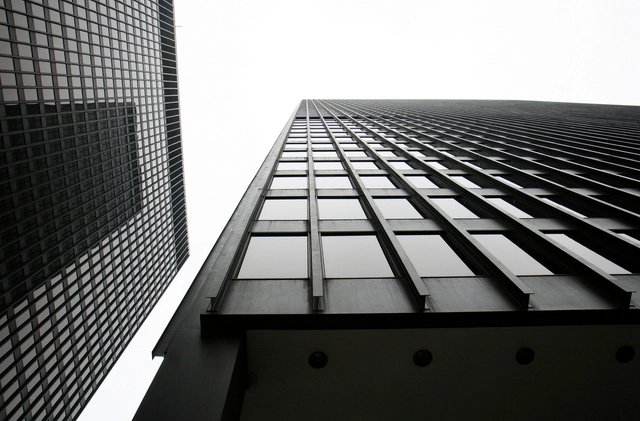
The Chicago Federal Center, designed by Ludwig Mies van der Rohe and completed in 1974, actually consists of three buildings which are arranged around and define the Chicago Federal Plaza. On the eastern side of South Dearborn Street sits the 30-story Everett M. Dirksen U.S. Courthouse. On the western side, the 42-story John C. Kluczynski Federal Building and the single story Post Office define the plaza.
For the past several years the Chicago Park District and the City of Chicago have been working on appropriate uses for Northerly Island, a 91-acre man-made peninsula in Chicago, Illinois. The lakefront site branches off from Museum Campus, a section along Lake Michigan that is home to the Field Museum, Shedd Aquarium, and Adler Planetarium. Serving as an expansion to these cultural programs, Studio Gang Architects have created an innovate design that integrates educational, cultural, social, and recreational activities into Northerly Island.
Read more about Northerly Island's future after the break!
Cook County, Illinois, recently brought the elimination of construction waste to a new level by creating the first demolition debris ordinance in the Midwest. This groundbreaking ordinance requires most of the debris created from demolition to be recycled and reused instead of being sent to the landfill. The ordinance helps contribute to Cook County’s zero waste goal, part of the Solid Waste Plan Update.
The new law states that at least 7 percent of suburban construction and demolition debris must be recycled, and an additional 5 percent must be reused on residential properties. This new legislation will have a great impact as it affects about 2.5 million suburban Cook County residents.
The Graham Foundation of Chicago will host a book presentation and signing of Wiel Arets: Autobiographical References, a new book edited by Robert McCarter and designed by Irma Boom exploring the notion of ‘A Wonderful World’. The event will take place Friday, February 1st at 6:00pmCST. The evening will begin with a discussion and debate between Arets and McCarter, introducing the book’s origins as well as the work of Wiel Arets Architects, after which signed copies of the publication will be available for purchase. More information after the break.
Amidst the longstanding, heated battled to save Bertrand Goldberg’s iconic Prentice Woman’s Hospital, the results of the 2012 Chicago Prize Competition: Future Prentice have been announced! Presented by the Chicago Architecture Foundation, in collaboration with Chicago Architectural Club and the Chicago Chapter of the American Institute of Architects, the international competition intended to act as a platform for public debate about the future of the controversial Chicago landmark.
More information and the winning proposals after the break…
Cook County Judge Neil Cohen has granted Bertand Goldberg’s Prentice Woman’s Hospital a temporary reprieve after preservationist filed a lawsuit against the city and the Chicago Commission on Public Landmarks yesterday afternoon. Plaintiffs, Landmarks Illinois and the National Trust for Historic Preservation claim that the commission “acted arbitrarily and exceeded its authority,” after granting and subsequently revoking Prentice landmark status in just a short afternoon on November 1. These proceedings, which typically takes months, followed Mayor Rahm Emanuel’s decision to publicly support Northwestern University’s plan to demolish the vacant icon.