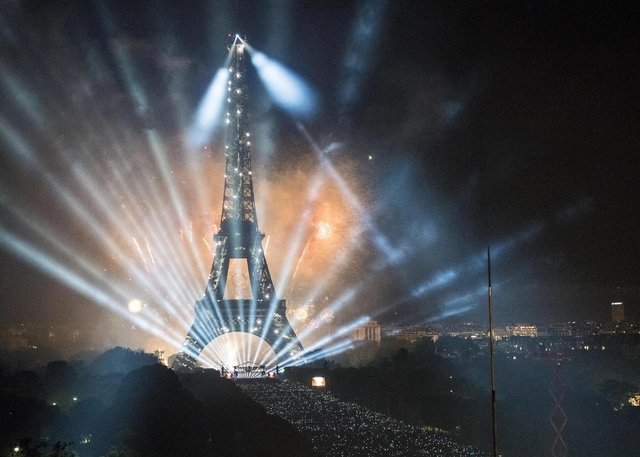
Thanks to their loud, brash, and nocturnal nature, rock concerts are often held in dark bars and nightclubs designed to withstand the abuse of rowdy fans and guitar-smashing rockers. But as musicians earn a following, they eventually graduate from beer-soaked basements to prestigious theaters, outdoor amphitheaters, arenas, and stadiums. For performers and music fans alike, playing or attending a show in a space like Carnegie Hall, the Royal Albert Hall, Madison Square Garden or Colorado’s Red Rocks Amphitheater can be a momentous, once-in-a-lifetime opportunity that ties together the sublime power that great music and architecture can both evoke. As rare as these opportunities are, an exclusive group of iconic musicians have managed to reach an even higher level of prestige by organizing one-off performances amid humanity’s most treasured historical sites—from the Acropolis and ancient Mayan cities to the Colosseum and the Eiffel Tower.
While these special concerts have given fans the chance to experience music history firsthand, many have also been mired in scandal as local officials and residents have raised concerns about potential damage to the sites or inappropriate commercial misuse of treasured cultural landmarks. Despite these legitimate and often justified concerns, these nine iconic sites have hosted some of the most ambitious concerts in the history of popular music:
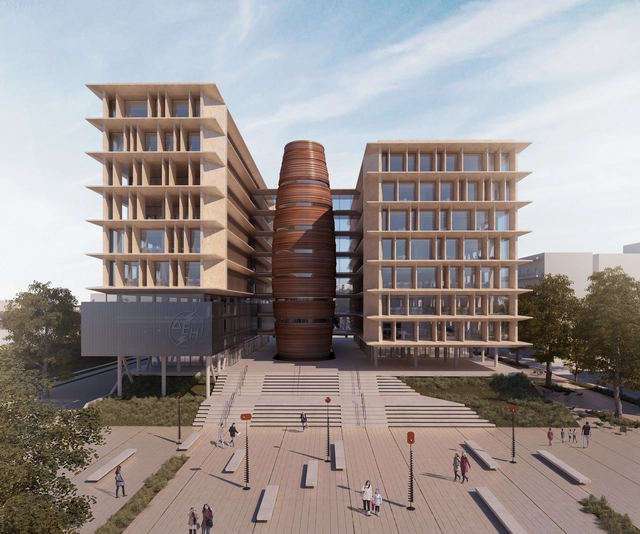
Micromega’s winning proposal for the new Public Power Corporation HQ in Athens seeks to define the company’s public character in creating an integrated urban park around and under the structure. The site which held the steam-powered station is to become a contemporary landmark for the city whilst establishing a dialogue with the historical complex and the existing old electricity factory.
Through Micromega’s design, PPC’s commitment to sustainable forms of energy will be established by three main “topoi” (spaces) that educate and express the company’s renewable sources – sun, wind, and water. In the creation of the new urban park, the architects hope to activate environmental awareness, reminding the public of the alternative clean sources available.
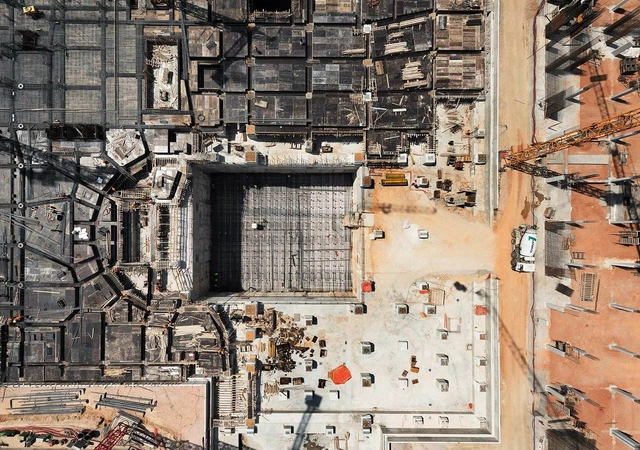
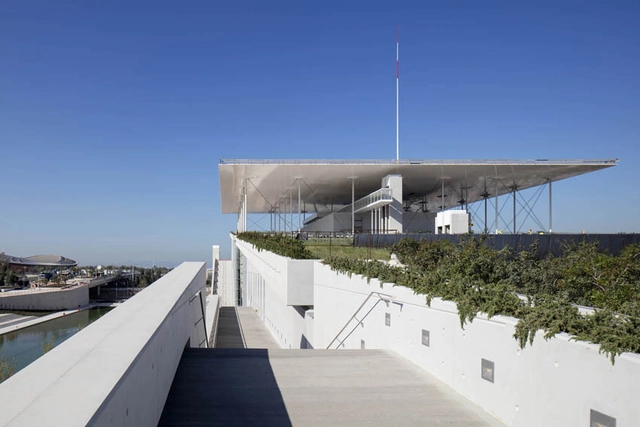
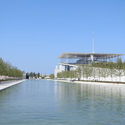
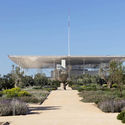
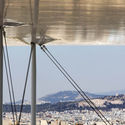
From Greek architect and photographer, Yiorgis Yerolymbos comes a book which captures the construction process of Renzo Piano’s Stavros Niarchos Foundation Cultural Centre in Athens, Greece. Yerolymbos carefully documented every moment where the superfluous Olympic parking lot became a cultural center and sloping park with waterfront views. For almost a decade, and from every angle, the photographer watched the site transform. Birds-eye imagery proved to be some of the most captivating. As photographs, they manage to possess the characteristics of an architectural drawing.
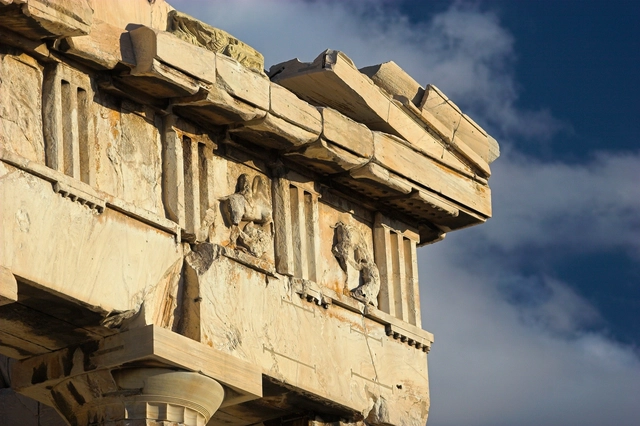
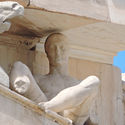
The Parthenon, unquestionably the most iconic of the Ancient Greeks' Doric temples, was built between 447 and 432 BC. Located on the Acropolis in Athens, for many architects, it is one of the first buildings we analyzed when beginning our studies. Designed by Ictino and Calícrates, it displays a unique repertoire of architectural elements that can be fully appreciated individually, or for the role they play in forming a complete and magnificent whole.
Simply described, the 69.5 x 30.9-meter building is erected on a stylobate of three steps, with a gabled roof raised upon a post and lintel structure formed by Doric columns—17 on its sides and 8 on each end—which support an entablature composed of an architrave, a frieze, and a cornice. On each gable were triangular pediments with sculptures that represent the "Birth of Athena" on the East and the "Contest Between Athena and Poseidon" on the West.
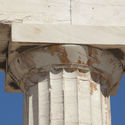
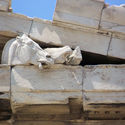
Take a look at some of these elements in detail, through this set of high-resolution images.
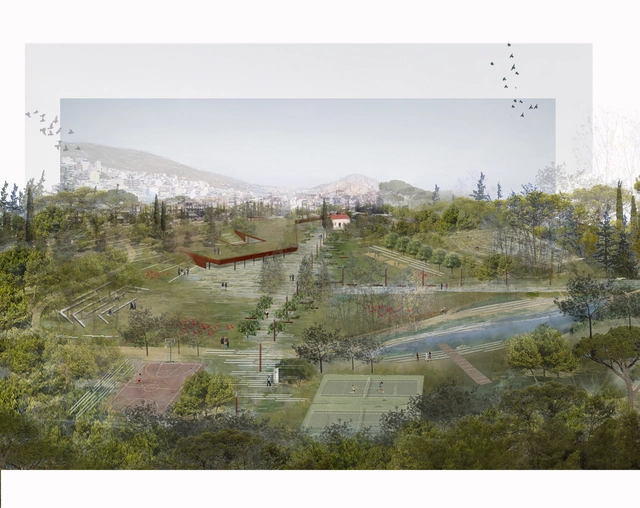
A competition for the transformation of a former cemetery in Nikea, just west of central Athens, has been won by Greek firm Topio7, with a proposal that creates a revitalized public park as a result of “a mutual osmosis between the park and the city”. A number of green buffer zones – “the elastic limit” – are utilized to frame a procession-like journey from the bustle of the city to the calm of the park’slandscape.
Highlighting the importance of the site’s previous use, the architects explain that the “main objective of the project is the creation of an open, accessible public space, a contemporary urban park with ecological-bioclimatic character, with special emphasis on the social dimension and the site’s memory.”
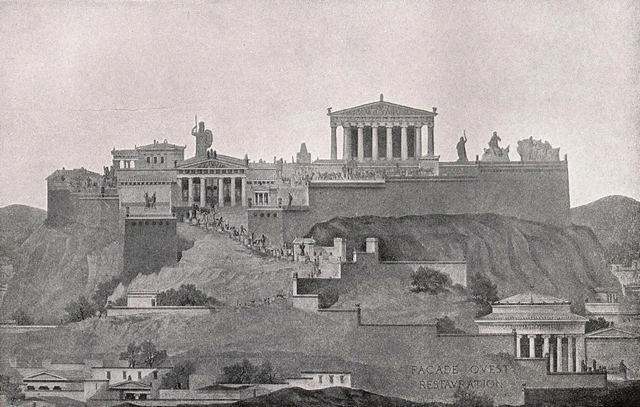
An elevation of the entire Acropolis as seen from the west; while the Parthenon dominates the scene, it is nonetheless only part of a greater composition. ImageCourtesy of Wikimedia user Quibik (Public Domain)
The Parthenon, perhaps the most celebrated example of Classical Greek architecture, was only the first of a series of remarkable buildings to be constructed atop the Athenian Acropolis in the wake of the Persian Wars. Led by the renowned statesman Pericles, the city-state embarked on an ambitious rebuilding program which replaced all that had been razed by the Persians. The new complex, while dedicated to the gods and the legends that surrounded the Acropolis, were as much a declaration of Athens’ glory as they were places of worship – monuments to a people who had risen from the ashes of a war to become the most powerful and prosperous state in the ancient world.
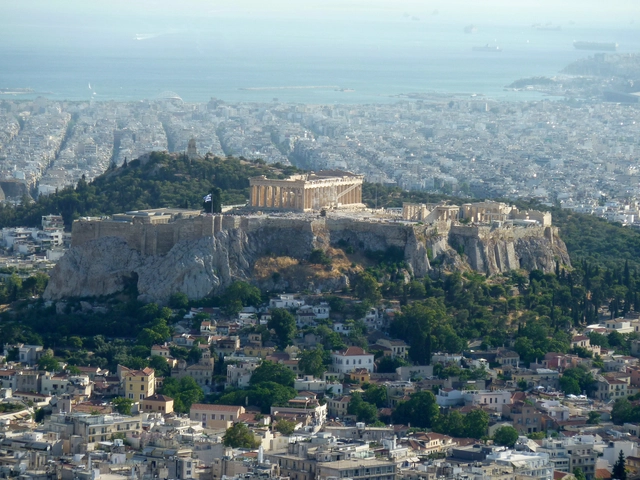
The Acropolis, the plateau on which the Parthenon stands, served as a fortified citadel in Athens’ Mycenaean past. ImageCourtesy of Flickr user Konstantinos Dafalias (licensed under CC BY 2.0)
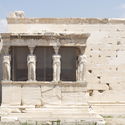
It is unsurprising that Athens, the city widely considered to be the cradle of Western civilization, would have made as celebrated a contribution to architecture as it has to countless other human pursuits. Built on a hilltop above the contemporary city, the weathered marble complex known as the Acropolis stands as a faded remnant from the former city-state’s ancient glory years, surrounded by the products of the centuries that followed. The greatest of these landmarks, the Parthenon, captures an age long past when Athens was the wealthiest and most powerful city-state in Greece and beyond.
New City, Animated Skyline Series, Liam Young, 2015
How will everyday life evolve in the cities of tomorrow? What kind of changes will smart systems, technologies of automation and constant connectivity bring? Which new economic models might emerge and what will the role of the particularities of different geographical areas be? How will the development of the future cities affect the environment and the natural resources of the planet?
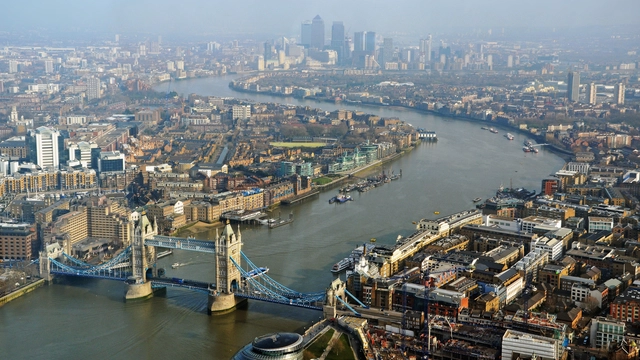
River Thames, London. Image Courtesy of Monocle 24
For this edition of The Urbanist, Monocle 24's weekly "guide to making better cities," the team report from the two-day CityLab summit, which "gathered the world’s top mayors and urban leaders for a series of chats on how to to make our cities a better place." They explore the vision for London’s transport infrastructure, discover how Rio de Janeiro is gearing up its digital strategy ahead of the 2016 Olympic Games, and find out how to create a smart city through data. On top of that, they chat to millennials in Washington and "sit down for a very honest chat with the mayor of Athens."
With this year marking the 50th anniversary of Le Corbusier’s death, the team of organizations is seeking “contemporary interpretations concerning multidisciplinary approaches over Modernism and specifically over Le Corbusier’s work, while [exploring] possible themes and directions of the memorial representation” in present day. Designs should emphasize commentary, rather than a tribute to Le Corbusier.