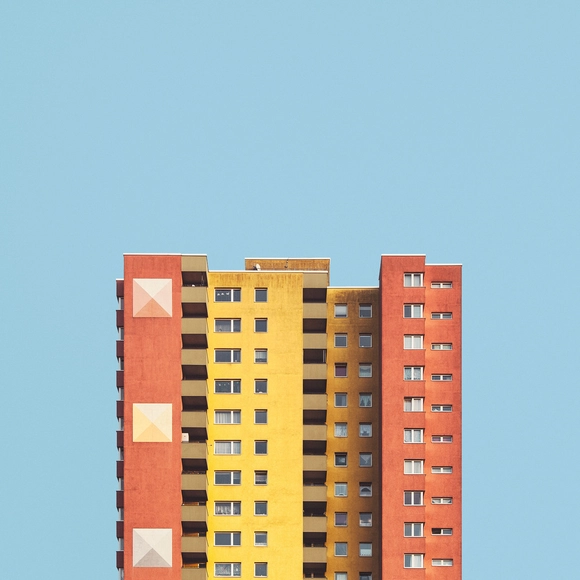
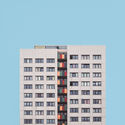
In this series, entitled Stacked, photographer Malte Brandenburg takes a closer look at the architectural merits of Berlin’s post-war housing estates. Captured against a flat blue sky, the images seek to strip away the historical and social burdens carried by the buildings, presenting them instead as pieces of pure architecture.
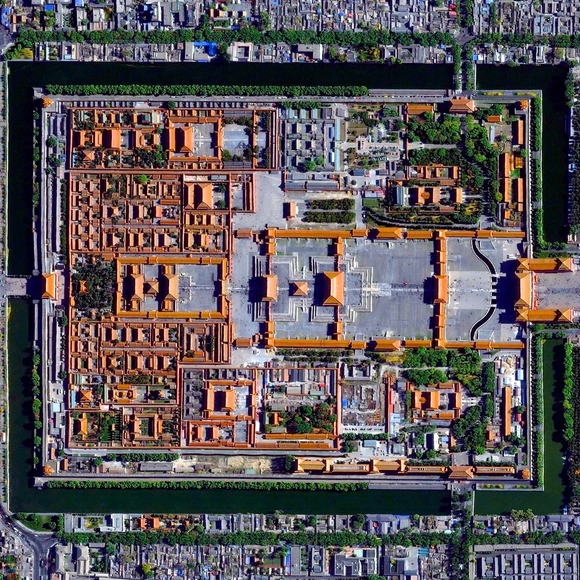
As recently as a century ago the idea of viewing the world from above was little more than a fantasy: the airplane was still in its infancy, with rocketry and satellites still decades into the future. Those who could not take to the air had no recourse but drawing in order to represent their world from an aerial perspective. This limitation is difficult to imagine today when access to plan photography is never further than the nearest Internet connection. Anyone with a smartphone has, in essence, the entire world in their pocket.
Earlier this week, the Supreme Court of Sweden ruled against Wikimedia Sverige in a landmark case over “Freedom of Panorama,” a ruling which The Wikimedia Foundation has “respectfully disagreed with” in a blog post. The Swedish Supreme Court’s ruling, in short, states that Wikimedia Sverige is not entitled to host photographs of copyrighted works of art on its website Offentligkonst.se, which provides maps, descriptions and images of artworks placed in public spaces in Sweden.
The concept of freedom of panorama describes a provision in copyright law which extends the right to take and to disseminate photographs of copyrighted works provided those photographs were taken in public spaces. Most people who own a camera (in other words, most people) have probably given very little thought to their freedom of panorama, or any restrictions that may have been placed upon it. But the reality of this little-known copyright-related oddity is something that many people, and architects especially, should find very concerning indeed.
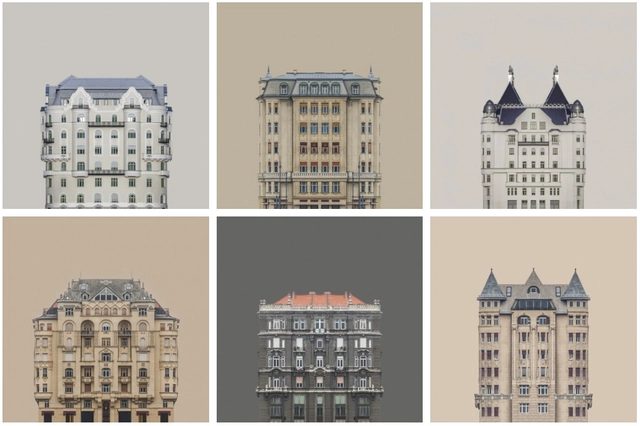
Budapest-born printmaker and photographer Zsolt Hlinka has created Urban Symmetry, a Wes Anderson reminiscent photo series depicting perfectly-symmetrical buildings on the banks of the Danube River. Using partial photos of the buildings, Hlinka creates fictitious compositions through reflections, resulting in new personalities and character in the portraits.
One of the most controversial stories to hit the architectural news last week was the revelation by Blair Kamin of the Chicago Tribune that one of the winners of the AIA Chicago chapter's Design Excellence Awards was given on the basis of an image in which unsightly elements of the building's design had been removed in Photoshop.
The "war on reality" (as one commenter ironically referred to it) is a topic that polarizes even the most level-headed people, with many arguing over the effect that such Photoshop trickery has on our perception of our world. However, with many people unaware of what goes on behind the scenes, we decided to reach out to some photographers for a candid look at exactly what role Photoshop has in the everyday processes of architectural photography, and where they draw the line regarding the ethical documentation of buildings. Read on to find out what they had to say.
Without a doubt, it’s among the most famous houses in Los Angeles. The house is easy to describe: a steel framed L-plan, divided into bedrooms and the communal living spaces, all wrapped around a turquoise pool seemingly impossibly poised above the city. But words don’t do it justice. Julius Shulman’s 1960 photograph of Pierre Koenig’s Case Study House 22, perhaps better known as Stahl House, changed the fantasies of a generation.
https://www.archdaily.com/778021/a-virtual-look-into-pierre-koenigs-case-study-house-number-22-the-stahl-houseMadlaina Kalunder and David Tran, Archilogic
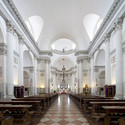
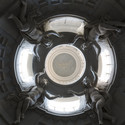
With its hundreds of churches, Rome has a developed a rich history of domes. Inspired by this heritage, Jakob Straub has photographed the city's most remarkable rotundas from the ancient Pantheon up to Pier Luigi Nervi's modern sports arena. His neutral photo perspective, taken looking upwards from the center of the rotunda, opens a new view for the underlying concepts where the architecture yearns for the firmament. For Elías Torres, these “zenithal-lit” spaces constitute an important method for daylight architecture, where the exterior is also transformed into a fascinating distant reality.
Torres has analysed numerous strategies for lighting architecture effectively with daylight from above. In his book “Zenithal Light,” illustrated with an abundance of striking photos, he came to the conclusion that “Amongst the representations of the sky in the interior of architecture, the one that depicts the sun shining from above with a circular form has been the favoured one for many cultures.”
The Ian Potter Centre: NGV Australia. Federation Square - photo Bob Munro
From photographer Bob Munro comes a new project called Tectonic Poetry. Resulting from an ongoing interest in urban scenes, architecture and the built environment, it focuses on the architectural surrounds of Melbourne’s Federation Square Atrium.
Here's a story you might recognize: you save up and book a week's holiday for a long-anticipated pilgrimage to your favorite architectural landmark. Finally the day arrives and you take your best camera, with an empty memory card, to make sure that nothing prevents you from getting that one shot - that perfect shot - which you will treasure forever. But when you arrive, that perfect shot is blocked by hundreds of oblivious tourists, wandering around, pointing, or perhaps even doing their best Power Rangers impersonation. You're left with two options: either abandon your souvenir, or spend hours Photoshopping intruders out of your photo.
Soon though, this kind of inconvenience could be a thing of the past. As reported by The Verge, at their MAX conference hosted last night, Adobe demonstrated an experimental project for smartphones known as "Monument Mode" that can remove tourists from a photograph in a few minutes on site, rather than a few hours back home.
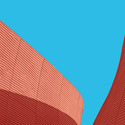
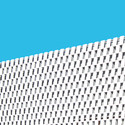
Mid-way through the 2015 Milan Expo, Italian photographer Lino Russois offering the world a fresh look at the exposition with a series of abstract images that backdrops parts of the colorful pavilions with the sky.
"The subject highlights the decontextualization of places and architectural spaces in order to alter the natural structure," says Russo, referring to these images as his second "Skymetric" series. "These places considered have in common the fact to be all completely square, regular and schematic, so achieving geometric shots in a minimalist context, where the simplicity and cleanliness reign supreme."
"Every picture tells a story" - at least, that's according to that great philosopher of our time, Rod Stewart. But what about the stories behind the pictures themselves? At ArchDaily we know that a great image requires not only great architecture but also a skilled photographer, so to celebrate World Photo Day we decided to find out more about the most popular images on ArchDaily. We've taken the ten most bookmarked images in My ArchDaily, and contacted some of the photographers to find out more about their images - read on to see the top ten, and to find out the stories behind six of them.
https://www.archdaily.com/772022/world-photo-day-2015-the-10-most-saved-images-in-my-archdailyAD Editorial Team
"The Rendering View," is a new monthly column on ArchDaily by PiXate Creative founder Jonn Kutyla which will focus on hints, tips, and wider discussions about architectural rendering.
As an architect you have spent countless hours designing, modifying, and refining what you believe to be the very best possible layout for a building. The numerous projects you have imagined, designed, and then seen as a finished building have given you the ability to visualize it with incredible accuracy. Unfortunately, your clients often lack the ability to visualize a space before it is built.
3D rendering seeks to solve that problem by accurately depicting what a building will look like with photo-realistic quality long before it exists – but there is a huge difference between showing your building and selling the concept of your building. Showing your building does just what the name implies: generally the camera is pulled back and the focus is on the entire building. When you want to sell the concept of a building you want to focus on a very small aspect of the building that is incredibly interesting to look at.
Explore how architectural photographers see the cityscape in this dynamic session suitable for beginner and intermediate photographers alike. During this intimate exploration of Boston’s Fort Point and Financial District neighborhoods, you will learn to produce memorable images that convey a sense of place, an expression of the architect’s ideas, and a connection to landscape and surroundings. Professional photographer Emily O’Brien will help you and other enthusiastic photographers see Boston in a whole new way. Take your photography to new heights!
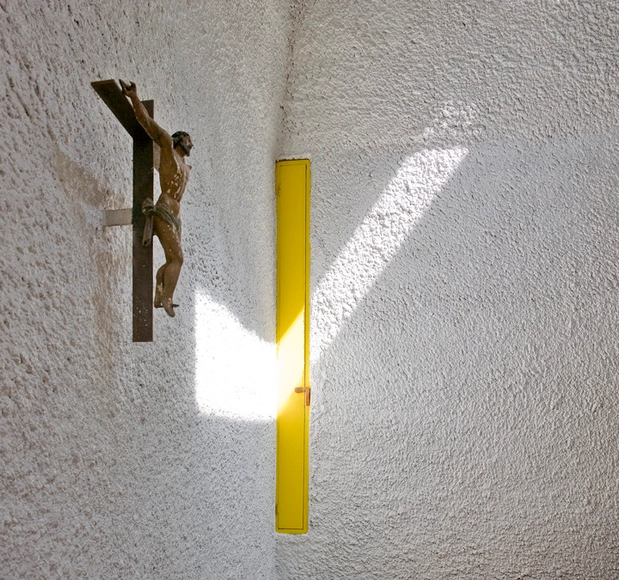
Architecture professor and photographer Henry Plummer has heightened the transformative power of daylight with his cameras and published several remarkable books about light and architecture. His deep interest in light, and his lyrical writing perspective, were formed through his contact with the designer and art theorist György Kepes while studying at MIT. Within his numerous photo journeys Plummer has documented the various facets of daylight in Japan and the Nordic Countries, and of masters like Le Corbusier and Louis Kahn. As a Professor Emeritus of Architecture at the University of Illinois at Urbana-Champaign Plummer also still has ambitious plans for future book projects. In the second part of this interview, Plummer reveals how changing technologies have affected his photography, and discusses his thoughts on phenomenology and developing a poetic language of light.
If you missed it, you can read part one of this interview here.
Architecture professor and photographer Henry Plummer has heightened the transformative power of daylight with his cameras and published several remarkable books about light and architecture. His deep interest in light, and his lyrical writing perspective, were formed through his contact with the designer and art theorist György Kepes while studying at MIT. Within his numerous photo journeys Plummer has documented the various facets of daylight in Japan and the Nordic Countries, and of masters like Le Corbusier and Louis Kahn. As a Professor Emeritus of Architecture at the University of Illinois at Urbana-Champaign Plummer also still has ambitious plans for future book projects. In the first part of this interview, Plummer shares a variety of insights about understanding light and approaching buildings for photography.
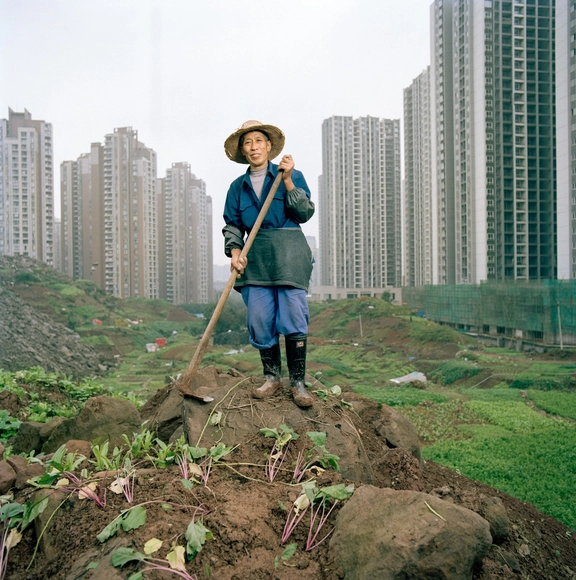
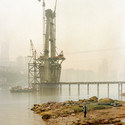
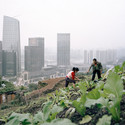
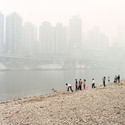
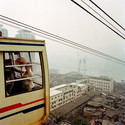
These days, many of China's largest urban areas are easily recognizable to people from all over the world, with the skylines of coastal mega-cities such as Shanghai and Beijing taking their place in the global consciousness. Far less known though is the inland city of Chongqing - another of China's five top-tier "National Central Cities" - where in 2010 the Chinese government embarked on a plan to urbanize a further 10 million of the region's rural population, with around 1,300 people now moving into the city every day.
Since his first visit to the city in 2009 photographer Tim Franco has been on a mission to document the rapid change in what he believes is "maybe the most widely unknown megacity in the world." The result is Metamorpolis, a forthcoming photographic book by Franco with text by British journalist Richard Macauley, which documents the colossal scale of development juxtaposed against the people of Chongqing - many of whom still live an incongruous rural lifestyle among the concrete sprawl. Read on after the break for more images from the book and an interview with Franco about the experience of documenting one of the world's fastest-growing cities.
“Nestled into the desert landscape that defines Nevada’s visage, Ascaya feels as if it were shaped by the elements. [...] Where stone rises up to meet the sky, there is a place called Ascaya.” - The Ascaya promotional website
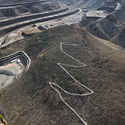
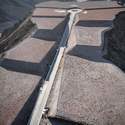
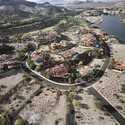
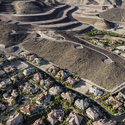
Not quite, according to Michael Light’s soon-to-be released book, Lake Las Vegas/Black Mountain. Covering the advance of suburban Nevada into the desert, this two-part book looks at Lake Las Vegas, a then-abandoned victim of the 2008 real estate crash which has since emerged from the other side of bankruptcy, and nearby Ascaya, a high end housing estate that is still in the process of being carved into Black Mountain. Light’s photography doesn’t so much question the developers’ summary as it does, say, blast it, scar it, terrace it and then build a large housing development on the remains. Featuring beautifully composed aerial shots of the construction sites and golf courses covering the desert, the book is a clear condemnation of the destructive and unsustainable development in Nevada. Much more than that, though, Light is highlighting a wider philosophy behind developments like Ascaya and Lake Las Vegas that fundamentally fail to connect American society with the American landscape in a non-destructive way.
This week in our Architectural Photographers series, we look at Spanish architect Montse Zamorano, who after living in Shanghai for a year decided to photograph architecture. She is currently based in New York, where she is studying for a Masters in Branding at SVA as a Fulbright student. Montse works internationally as a freelance photographer and videographer for studios such as Foster and Partners, Álvaro Siza and Héctor Fernández Elorza.