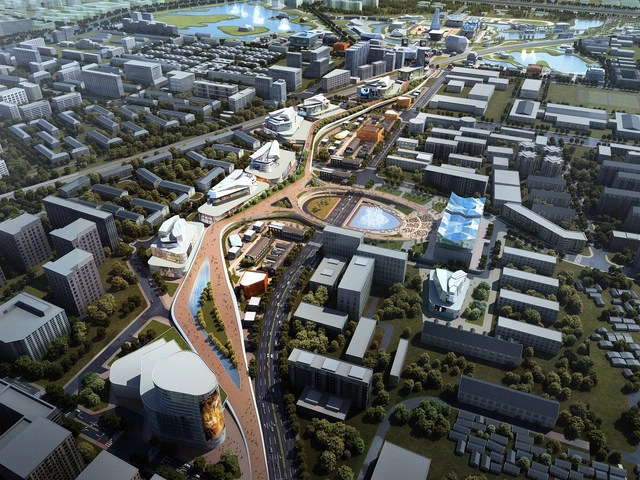
Designed as a sustainable master plan, the concept of water, waste, and energy management are integral to the concept of the Kanpur Riverfront Development project. Proposed by Studio Symbiosis, conservation of energy on the basis of transport management has been designed as an active design element in the master plan, which is a part of an overall scheme for rehabilitation of the Ganga river and the Ganga riverfront. More images and architects’ description after the break.
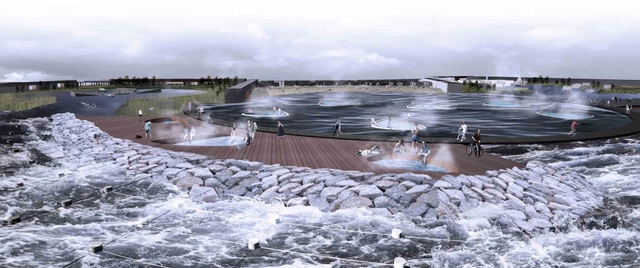
Instead of perceiving water as something to defend against, The Open Workshop took on the challenge of repositioning the water as a performative feature that connects across the obstructions currently on Arvene East of Far Rockaway. Taking the logic of the stabilizing rock jetties, the 'Recon-Figure' proposal utilizes a series of nested figures to augment the existing coastline. The figures engage the water, functioning as groynes and breakwaters that also offer recreational spaces, stabilize the coast, and concentrate wave action and associated energy capture. More images and architects' description after the break.
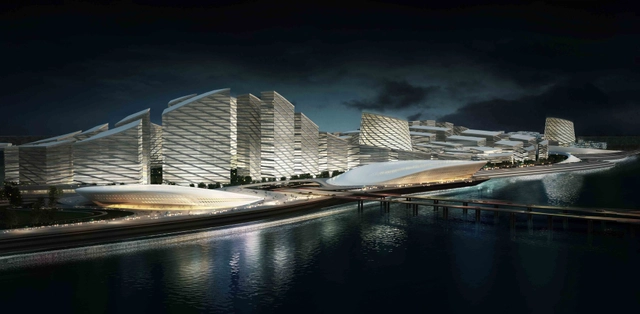
Aedas recently unveiled their master plan proposal for the CTS Temple of Heaven Performance Zone. Located in Beijing, their concept consists of a trio of urban, garden and lake environments while aiming to become the capital’s core cultural and commercial district and establish an international modern city life standard. More images and architects’ description after the break.
Having made his name with the Centre Georges Pompidou and the Lloyd's building, Richard Rogers - who turns 80 today - was commissioned in 1980 to design the Inmos microprocessor factory in Newport, Wales. The factory's design was targeted for the delicate process of microchip assembly, which requires a clean and controlled space. Built at the time of the computer-chip boom, construction had to be completed within one year, a factor which would greatly influence the design.
Rogers's response, based on his previous high-tech designs, was to move the services to the outside of the building and split the interior into 'clean' spaces for microchip assembly and 'dirty' spaces for other tasks. Moreover, Rogers opted for an off-site prefabrication of parts, which not only increased the speed of construction, but would also allow for the factory to be easily replicated as a model.















_-15__17.04.2013-.jpg?1374159665&format=webp&width=640&height=580)
_-15__17.04.2013-.jpg?1374162038 "© Fernando Gomulya")
_-15__17.04.2013-.jpg?1374160584 "© Fernando Gomulya")
_-15__17.04.2013-.jpg?1374160166 "© Fernando Gomulya")
_-15__17.04.2013-.jpg?1374160178 "© Fernando Gomulya")
_-15__17.04.2013-.jpg?1374159665)