

-
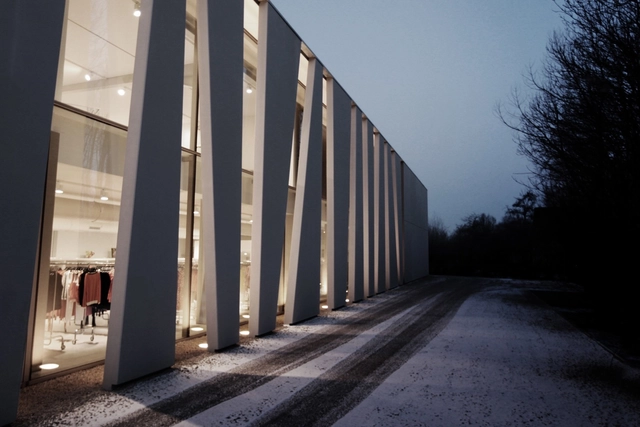
Architects: Govaert & Vanhoutte Architects
- Year: 2011
-
Manufacturers: Alfa CT, Bouwgroep VandeWalle




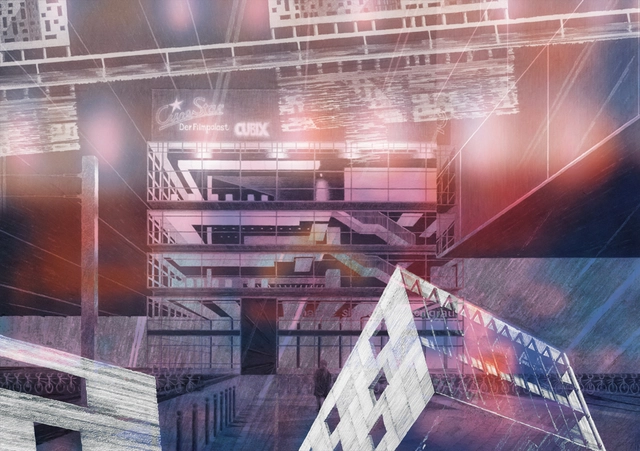
Towering like an infinite mountain of stone, a building devoid of windows and doors is hand-drawn in the tradition of the old masters. Elsewhere, colored strips of tape address the same project, visualized as a sequence of stacked layers. In yet another image, this time presented in a more realistic style, the cityscape is framed by two men gazing out at the viewer with a grin.
It’s a daring experiment that Tchoban Voss Architekten undertake in their exhibition “Images from Berlin.” Instead of presenting their projects with the usual means, they have delegated this task to 11 visual artists. The aforementioned works stem from a confrontation by Gottfried Müller and Valery Koshlyakov with the Museum for Architectural Drawing. Meanwhile, the Living Levels are approached by the duo Vrubel & Timofeeva as an everyday urban environment.

.jpg?1484934632&format=webp&width=640&height=580)
Employing the latest in aluminum and metals innovation, Ben van Berkel and UNStudio have erected the ALPOLIC fair stand at BAU 2017, the world’s leading trade fair for architecture, materials and systems. Emphasizing the inherent strength of the ultra-light material, the parametric design utilizes geometric principles to create a self-supporting semi-private stand for gathering and the display of products.

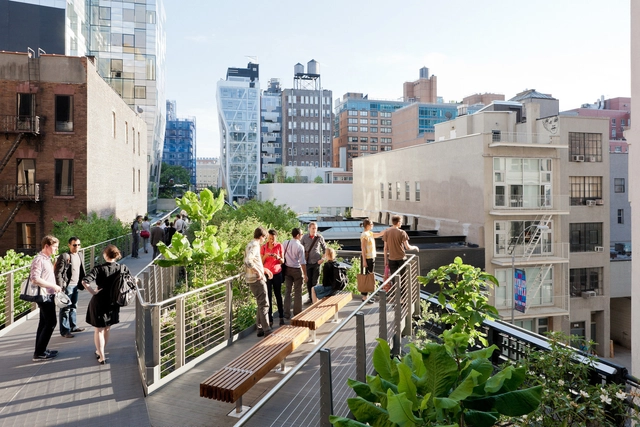
Continuing in her firm’s tradition of blurring the lines between architecture, art and environment, Elizabeth Diller, founding partner of Diller Scofidio + Renfro, is producing an opera for the High Line. Dubbed the “Mile Long Opera,” the production will be set along New York’s new favorite attraction, which was designed by DS+R with James Corner and Piet Oudolf and opened to the public in 2009.


This article, originally titled "DC’s Museum Of African American History Is The City’s Greenest," was originally published on Lance Hosey's Huffington Post blog. It is part of a four-part series about the Smithsonian National Museum of African American History and Culture.
Fifteen years ago, when I worked on the design of a high-performance museum, the concept was considered so unusual that the media questioned the very idea. The US Green Building Council (USGBC) had only very recently introduced its Leadership in Energy and Environmental Design (LEED) rating system, so much of the public wasn’t familiar with the concept. Over the following decade, it became more and more popular in every building type, including museums. A watershed year was 2008. The Water + Life Museums in Hemet, CA, became the first LEED Platinum museum, quickly followed by the California Academy of Science, which has been called “the world’s greenest museum.” The same year, the Grand Rapids Art Museum became the first LEED-certified art museum. By 2016, International Museum Day could highlight ten LEED-certified museums in the US alone.
Now the Smithsonian has completed its first LEED Gold project, the National Museum of African American History and Culture (NMAAHC). (The Silver-rated National Museum of the American Indian [NMAI] was the first Smithsonian project to become a certified green building, although it wasn’t designed to this standard and didn’t achieve it until seven years after opening in 2004.) By many measures, the NMAAHC is easily the greenest museum in Washington.

What makes a city different from a town? What is the distinction between these two seemingly similar collections of buildings and streets? Why can we trace towns back to the Stone Age, while the first city remains a mystery? Although a village and a city can be considered similar, the city has a unique and innovative element that makes it stand out: the citizens and civitas.
While villages were merely an efficient urban system for groups of people that live together, the foundation of a city entails the institution of a very concrete idea of society, of a commitment between individuals to organize the world based on shared criteria.
The civitas is precisely this idea of social order, the accumulation of traditions, laws, principles and beliefs that gave rise to the civil community. Urbs is the urban model especially dedicated to institutionalizing this idea of society. Be aware that we’re not talking about streets or houses here, but of the moment of the establishment, that is, of the foundation of the city. As Fustel de Coulanges would say, while the civitas is a time-honored inheritance accumulated over centuries, the urbs is founded in one day. Filling it with streets, houses, and shops as a consequence.

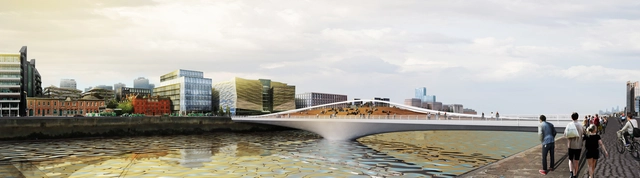
A team composed of Feng Xue, Helen Chan, and Oscar Reyes (FOH) has won Director’s Choice Award in the AC-CA competition to design a contemporary footbridge in Dublin, Ireland. Entitled The Catalyst, the team’s proposal aims to become “a dynamic link which stimulates diverse urban activities and facilitates a spectacular cityscape.”
Designed around the idea of enhancing the surrounding Dockland neighborhood and Dublin as a whole, The Catalyst acts as both a physical link, as well as a new vantage point, encouraging passers-by to pause and reflect on the city.
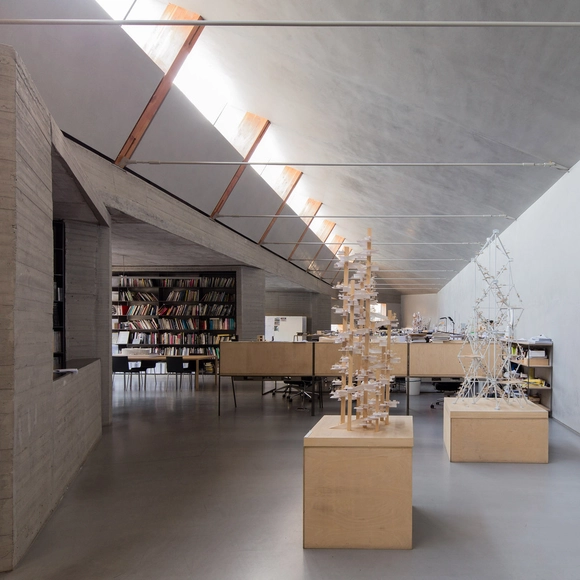
Architectural photographer Marc Goodwin has recently completed the third collection of his "ultra-marathon of photoshoots" – this time in Beijing. Following his unique insight into the spaces occupied by Nordic architectural offices (based in Oslo, Stockholm, Copenhagen and Helsinki) and his look at studios both large and small lived in by London-based practices, Goodwin has turned his lens to the burgeoning number of offices in the Chinese capital. From MAD Architects' magnificent old printing works to ZAO/standardarchitecture's purpose-built studio, here is a view into the places that architectural offices call home.








.jpg?1484934664 "© Laurian Ghinitoiu")
.jpg?1484934679 "© Laurian Ghinitoiu")
.jpg?1484934695 "© Laurian Ghinitoiu")
.jpg?1484934710 "© Laurian Ghinitoiu")
.jpg?1484934632)