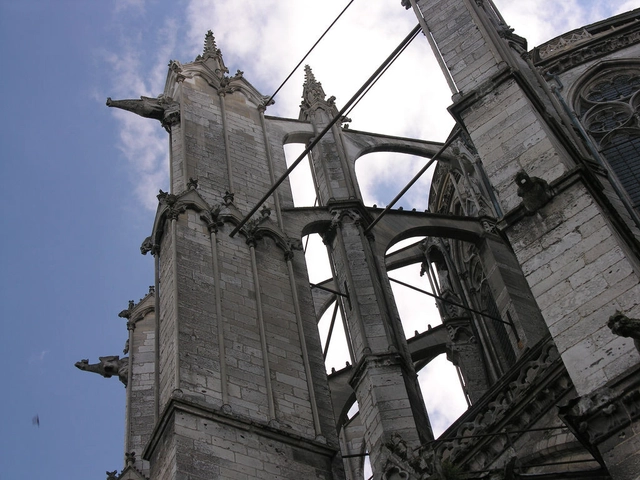
The Gothic cathedrals of the middle ages have long been respected as sites of significant architectural and structural experimentation. Hoping to reach ever closer to God, the master masons of the period took increasingly daring structural risks, resulting in some remarkably durably buildings that are not only timeless spaces for worship but miraculous feats of engineering. However, according to new research by a team of French archaeologists and scientists, we still haven't been giving these historic builders enough credit.
Though iron components feature in many Gothic buildings, often forming structural ties to stabilize tall stone buttresses, it was previously assumed that these were later additions to shore up precarious structures. However, thanks to a highly sophisticated carbon dating technique, the team consisting of the Laboratoire archéomatériaux et prévision de l'altération, the Laboratoire de mesure du carbone 14 and "Histoire des pouvoirs, savoirs et sociétés" of Université Paris 8 have shown that iron fixtures were an integral part of cathedral construction techniques from as early as the late 12th Century - meaning that many buildings from the period were essentially hybrid structural systems.