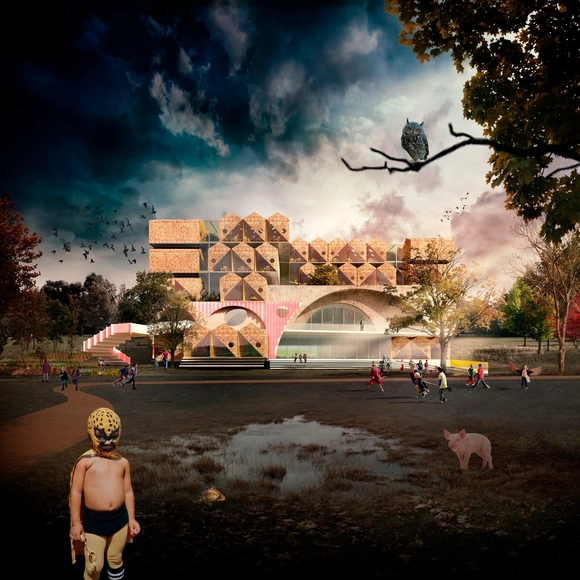
Andres Jacque / Office for Political Innovation has released their design for the Reggio School in Encinar de los Reyes, Madrid. Promoted by the Reggio Center for Pedagogical Research and Innovation, the project is based on the idea that architectural environments can evoke in children the desire for exploration and inquiry.
https://www.archdaily.com/921802/andres-jaque-office-for-political-innovation-unveil-experimental-madrid-schoolNiall Patrick Walsh
Past, Present, Future is an interview project by Itinerant Office, asking acclaimed architects to share their perspectives on the constantly evolving world of architecture. Each interview is split into three video segments: Past, Present, and Future, in which interviewees discuss their thoughts and experiences of architecture through each of those lenses. The first episode of the project featured 11 architects from Italy and the Netherlands and Episode II is comprised of interviews with 13 architects from Spain, Portugal, France, and Belgium.
The goal of the series is to research these successful firms and attempt to understand their methods and approaches. By hopefully gaining a clearer picture of what it means to be an architect in the 21st century, the videos can also serve as inspiration for the next generation of up-and-coming architects and students as they enter the field.
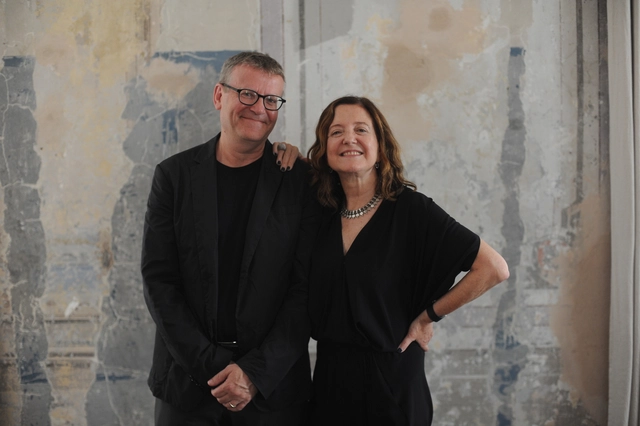
Andrés Jaque is an architect, academic director, and author, who founded the international architecture firm Office for Political Innovation in 2003. Award-winning OFFPOLINN is based in New York and Madrid, and works on projects of different scales and media, intersecting design, research, and critical environmental practices. In parallel to his career as an architect, Jaque is the director of the Advanced Architectural Design Program at Columbia University Graduate School of Architecture, Planning and Preservation, and a visiting professor at Princeton University and The Cooper Union. The architect is acknowledged for his transectional approach to architectural design, "practicing architecture as the intervention on complex composites of relationships, where its agency is negotiated with the agency unfold by other entities".
Sharing is one of the humanity’s most basic traits; we intrinsically recognize the benefits of pooling resources within a community in order to take advantage of varied abilities and access in order to fulfill needs. Sharing is the key driver behind civilization’s move towards collective living – first in small settlements and eventually in megalopoleis. The impact of sharing goes beyond simply satisfying the necessities for survival and extends itself into the social and cultural dimensions of our communities. In constructing an urban commons, composed of collectively managed and shared resources, we shape our physical, social, and cultural environments to achieve some degree of shareabilty – whether of goods, services, or experiences.
GSAPP Conversationsis a podcast series designed to offer a window onto the expanding field of contemporary architectural practice. Each episode pivots around discussions on current projects, research, and obsessions of a diverse group of invited guests at Columbia, from both emerging and well-established practices. Usually hosted by the Dean of the GSAPP, Amale Andraos, the conversations also feature the school's influential faculty and alumni and give students the opportunity to engage architects on issues of concern to the next generation.
The European Space Agency's vizualisation of space debris orbiting Earth. Image Courtesy of "Are We Human" / 3. Istanbul Tasarim Bienali
The 3rd Istanbul Design Biennial, which will officially open on the 22nd October 2016 and last for four weeks, will ask the question: Are We Human? Encompassing a wide range of ideas related to The Design of the Species, from timeframes of 2 Seconds to 2 Days, 2 Years, 200 Years and 200,000 Years, the international show will revolve around one pressing provocation: that design itself needs to be redesigned. It will do so by exploring the intimate relationship between the concepts of "design" and "humanity."
Five primary venues—the Galata Greek Primary School, Studio-X Istanbul and Depo in Karaköy, Alt in Bomonti, and the Istanbul Archaeological Museums in Sultanahmet—will house more than 70 projects by designers, architects, artists, historians, archaeologists and scientists from thirteen countries. In order to "rethink design from the very beginning of humanity," the Biennial will be organised into four overlapping “clouds” of projects: Designing the Body, Designing the Planet, Designing Life, and Designing Time.
"Design always presents itself as serving the human," state Beatriz Colomina and Mark Wigley, "but its real ambition is to redesign the human." Their curatorial statement for the 3rd Istanbul Design Biennial, which will open later this year and is themed around the title Are We Human? The Design of the Species: 2 Seconds, 2 Days, 2 Years, 200 Years, 200,000 Years, brims with reflective and often prescient statements such as this. All that will be encompassed by this Biennial, they say, will revolve around one pressing provocation: that design itself needs to be redesigned.
If one thing is certain, this Biennial will not come off as a 'trade show'. Wigley (New Zealand) and Colomina (Spain)—both Professors of Architecture at US institutions (Columbia and Princeton, respectively), theorists, writers, and critics—have exerted a profound influence on architectural discourse and pedagogy over the course of their careers. This Biennial, on the other hand, serves as their first formal foray into the world of 'design' – a field which few architects actively engage with.
In this exclusive interview with ArchDaily the curators discuss their intentions, criticise the traditional 'Biennial' model, and describe how they—alongside Andrés Jaque and the Office for Political Innovation—intend to spatialise the show against the backdrop of Istanbul – one of the great nexus of the world. Here, they also formally announce the launch of an Open Call for two-minute films.
At a media meeting this morning at the Istanbul Archaeological Museums Library, the curators of the 3rd Istanbul Design Biennial Beatriz Colomina and Mark Wigley announced the theme of next year's event, titled “ARE WE HUMAN?: The Design of the Species: 2 seconds, 2 days, 2 years, 200 years, 200,000 years.” The event, which will be held from October 22nd to December 4th next year, is intended to combine elements of both media documentary and archaeological project and according to the curators "will explore the intimate relationship between the concepts of 'design' and 'human.'"
This week COSMO begun its venture to filter more than 42,000 gallons of New York Citywater during the course of MoMA PS1's Summer Warm Up series. The 16th installation built as part of the annual Young Architect's Program (YAP), COSMO is a portable water purifier designed by Andrés Jaque / Office for Political Innovation to combat the world's clean water crisis while serving an animated backdrop to PS1's party atmosphere.





![Call for Papers: Bracket [On Sharing] - Featured Image](https://snoopy.archdaily.com/images/archdaily/media/images/5a67/49f0/f197/cc69/0100/03b7/slideshow/open-uri20180123-21405-bbfo4v.jpg?1516718559&format=webp&width=640&height=580)






_023-b.jpg?1457451333)