In East London, The Trampery on the Gantry is doubling down on the “creative” aspect of creative reuse. Part of the massive broadcast center used during the 2012 Olympic Games, the former HVAC gantry structure has been retrofitted by architecture firm Hawkins\Brown as an arts and media innovation hub.
In his monumental four-volume book, TheNature of Order, Christopher Alexander talks about an intelligent architecture, responsive to human needs and sensibilities through adaptation to existing buildings and nature. This is a new way of viewing the world—a way of connecting to it, and to ourselves—yet it is very much the same as the most ancient ways of connecting.
https://www.archdaily.com/907139/how-to-judge-a-building-does-it-make-you-feel-more-or-less-aliveNikos A. Salingaros & Kenneth G. Masden II
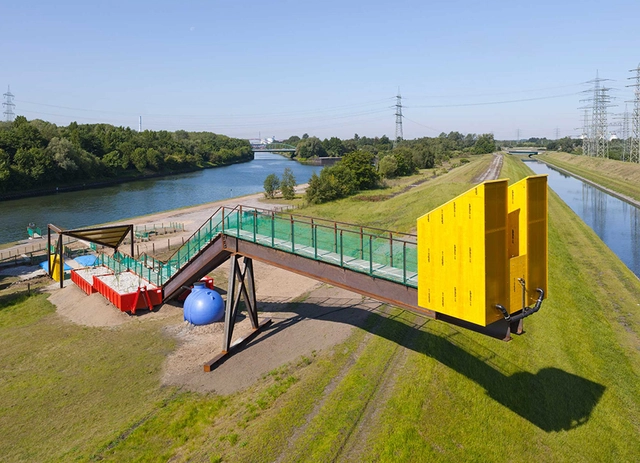
On a small strip of land between the Emscher River and the Rhine Herne Canal in Germany sits a rest stop whose colorful appearance belies its radical purpose. The structure’s artful design consists of pipes leading from two toilets and the Emscher (the most polluted river in Germany) that converge at a small community garden and drinking fountain. The garden is, in fact, a manmade wetland that collects, treats, and cleans the effluence from the toilets and river—making it drinkable.
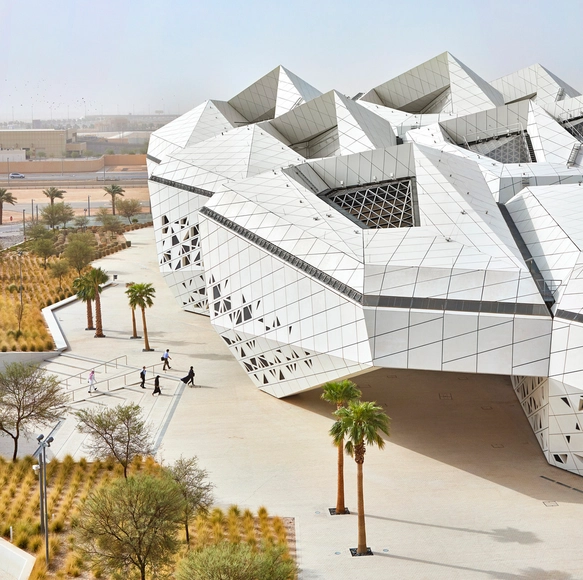
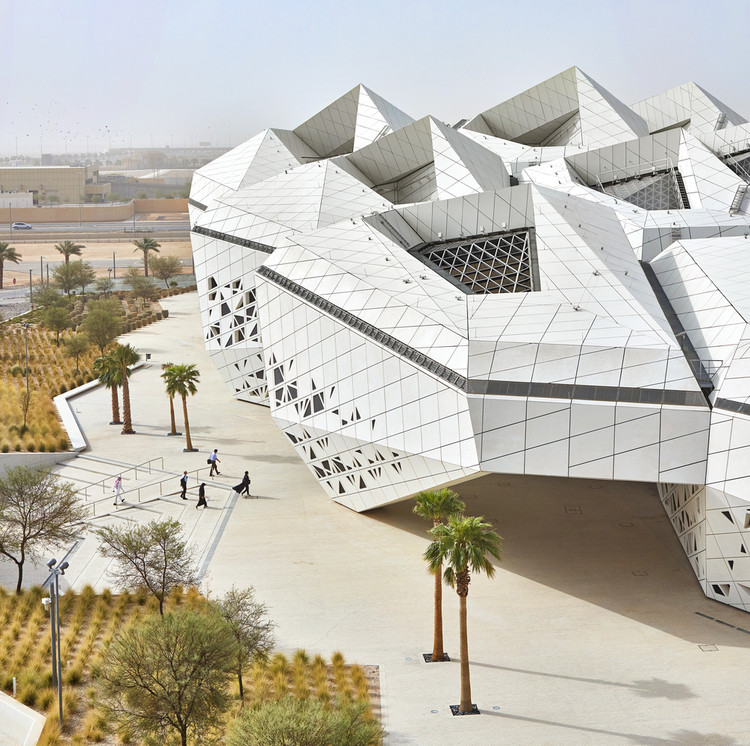
In March 2016, when world-renowned architect Zaha Hadid died of a heart attack at age 65 in a Miami hospital, the news sent shockwaves through the architecture community.
The flamboyant British designer—born on October 31, 1950 in Iraq, educated in Beirut, and known as the “Queen of the Curve” for her swooping, elegantly complex designs—was a legend in her time. She had design commissions around the world, been awarded the Pritzker Prize in 2004 and the Royal Institute of British Architects’ gold medal in 2016, and transcended the old-guard strictures of a staunchly male-dominated profession.
Our world revolves. Not just literally, as it does around the sun, but in nature’s every aspect. Seasons cycle into each other (though more erratically each year), waves trace and retrace the beaches with the shifting tide, flowers open, close, and turn to follow the path of the sun. Even we are governed by these circular natural systems. Maintenance of our circadian rhythms, a human connection to light, is so essential to our health that it is a required element in many contemporary building codes.
https://www.archdaily.com/905578/revolutionary-nature-the-architecture-of-hiroshi-sambuichiKatherine Allen
Kate Wagner grew up in rural North Carolina. As a kid, her mom, who never went to college, worked in a grocery store deli and later in childcare. Her dad had a steady government job with a pension, and his time in the military meant he had the resources and benefits needed to get a college degree. Wagner describes her economic background as “one foot in the working class and one foot in the middle class, and it was always a negotiation between those two classes.” They were, she says, “just normal-ass American people.”
Nestled in the steep gorges and river valleys of Japan’s Tokushima prefecture is Kamikatsu - a small town seemingly like any other. But Kamikatsu, unlike its neighbors (or indeed, most towns in the world), is nearly entirely waste-free.
Since 2003 - years before the movement gained widespread popularity - the town has committed to a zero-waste policy. The requirements are demanding: waste must be sorted in more than 30 categories, broken or obsolete items are donated or stripped for parts, unwanted items are left in a store for community exchange. But the residents’ efforts over the years have paid off- nearly 80% of all the village’s waste is recycled.
It's easy to feel overwhelmed by the massive production of architecture today. Scroll through ArchDaily for more than a minute and even we'd forgive you for losing track of it all. But what seems like an endless scroll of architectural production doesn't quite fit with the popular movements surrounding resource sharing and community.
Hidden among the mass production that has defined architecture in the last century is a germ - one that seems to be marching to the forefront of practice today. More and more designers seem to be taking on locally-focused and/or adaptive reuse works. Award shortlists today highlight not icons by recognizable names, but sensitive international works that are notable for their process as much as their product.
The common image of the architect may be of one obsessed with ego and newness, but practice today doesn't bear that out as much as it used to. This week's news touched on issues of reduction, reuse, and a radical rethink what architecture is in the 21st century.
https://www.archdaily.com/906505/this-week-in-architecture-reduce-reuse-rethinkKatherine Allen
Hokkaido-born Sou Fujimoto’s breakout masterpiece, the playful and cloud-like 2013 Serpentine Pavilion says a lot about who Fujimoto is and how he thinks about architecture. But even more so do the 100-plus sometimes painstakingly refined, sometimes roughly executed exploratory models that dot the minimalist gallery space of Japan House Los Angeles. This, his retrospective show, Futures of the Future, neatly reflects on Fujimoto’s career, which began when he opened his own Tokyo-and-Paris-based firm in 2000.
I taught architectural history in two schools of architecture during the 1980s and 1990s. Back then it was common for students to get a full three-semester course that began with Antiquity and ended with Modernism, with a nod to later twentieth-century architecture. My text for the middle section was Spiro Kostof’s magisterial History of Architecture: Settings and Rituals. With many centuries to cover, he spent very little effort in dealing with the twentieth century. In the last third of the course, students read texts such as Towards a New Architecture by Le Corbusier and Reyner Banham’s Theory and Design in the First Machine Age. My colleagues and I felt that we offered students a pluralistic and comprehensive review of key developments in the history of the built environment.
Architectural students of my generation—the last of the baby boomers, starting college in Europe or in the Americas in the late 1970s—had many good reasons to cherish architectural history. Everyone seemed to agree at the time that the Modernist project was conspicuously failing. Late Modernist monsters were then wreaking havoc on cities and lands around the world, and the most immediate, knee-jerk reaction against what many then saw as an ongoing catastrophe was to try and bring back all that 20th-century high Modernism had kicked out of design culture: history, for a start. I drew my first Doric capital, circa 1979, in a design studio, not in a history class (and my tutor immediately ordered me to scrape it, which I did).
Architecture as a profession today struggles with questions of relevance, with core questions surrounding the issue of whether it can create cultural vibrancy and meaning for the diverse world it serves. Within our own design community, we tend to give a lot of sway to an “exclusive tier” of architects who provide leadership and vision. While this leadership is critically important to the profession, it only corresponds to 2% of what gets built. Take it from Frank Gehry, whose 2014 comment still rings in our ears: “98% of everything that is built and designed today is pure sh*t. There is no sense of design, no respect for humanity."
If we embrace the importance and unique value of all things built on a wider range, we need to ask ourselves: how have we served and rewarded our peers responsible for creating this other 98%? Where should we set the bar for the emotional-artistic qualities of mainstream architecture?
Economics and technology affect every profession. But since World War II perhaps no profession has experienced more technological change than architecture. These shifts occurred, paradoxically, within a well-established professional model of personal development: The guild structure of learning in the academy, then becoming professional via internship leading to licensure, has been the structure of practice for almost two centuries.
Once upon a time manual drafting with graphite or ink was applied by white males, and a single sheet master was reproduced with typed specifications added, and buildings were constructed.
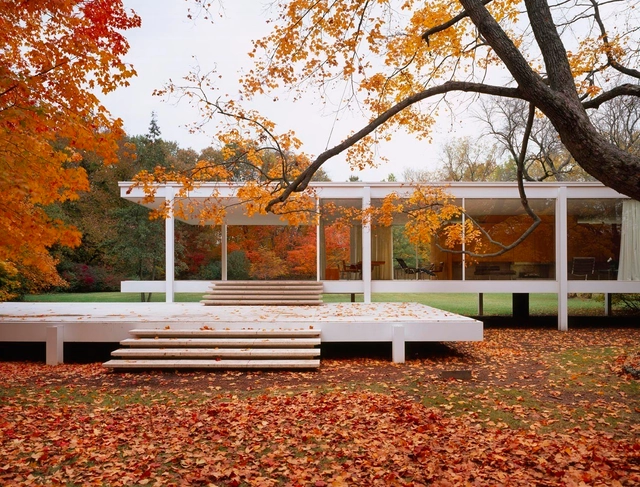
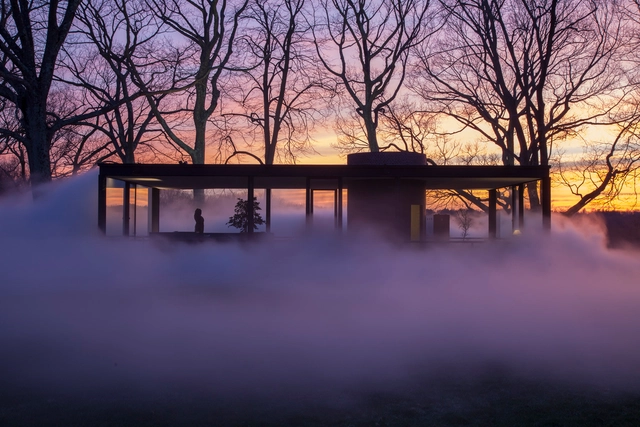
Philip Johnson lived a long and extraordinarily eventful life. He was an architect, a museum curator, a tastemaker, a kingmaker, a schemer, an exceptionally vivid cultural presence. Mark Lamster, architecture critic of the Dallas Morning News and Harvard Loeb Fellowship recipient, has now written a thoroughly engaging biography of him entitled, Philip Johnson, Architect of the Modern Century: The Man in the Glass House. I talked to Lamster two weeks ago about the book and the bundle of contradictions that was Philip Johnson.
This article was originally published on ArchDaily on 13 February 2018.
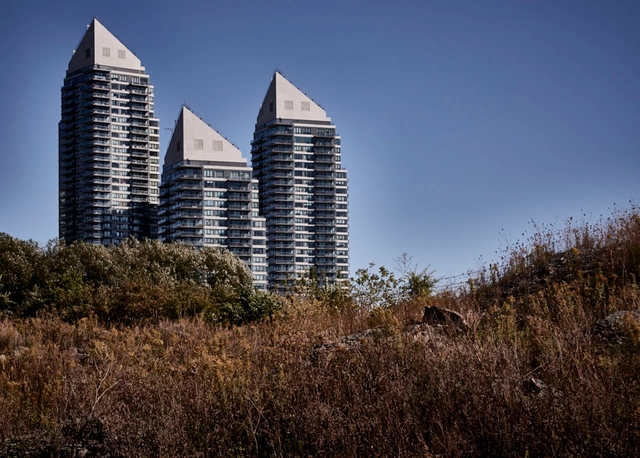
The City of Toronto has a long, fraught relationship with development and vacancy. The map of the initial Toronto Purchase of 1787 between the Mississaugas of the New Credit First Nation and the British Crown, which would later establish the colonial territory that became Toronto, conceives of the landscape as a single, clearly defined vacant lot anxious for development. Or, as artist Luis Jacob better described it, “signifying nothing but an empty page waiting to be inscribed at will.” Over two-hundred years later, as housing availability, prices, and rental shortages drive vertical condominium developments in the city, the politics of the vacant lot have never felt so palpable.
The work of an architect and urban planner can take on many forms thanks to the diverse curricular composition of most graduate courses, with subjects that deal with designing in different scales and contexts. From great urban plans to home renovations, and the metropolis to furniture design, these branches deal with different objects, however, all in common are the use of drawing and models as a tool for representation.
Whatever the project may be, drawing is the way to represent reality, ideas, speculations, and conceptions. Scale, a factor that establishes the level of reading one must make of these representations, determines the link between the real world and the dimensions of the drawing or model. For instance, the scale 1:1 is also known as “full size.”
The story of the Hastings Pier is an improbable one. Located in Hastings - a stone's throw away from the battlefield that defined English history - the pier was first opened to the promenading public in 1872. For decades the structure, an exuberant array of Victorian-era decoration, entertained seaside crowds but by the new millennium had fallen out of disrepair. In 2008 the pier was closed - a closure that became seemingly irreversible when, two years later, it burnt down.










_(1).jpg?1543159550&format=webp&width=640&height=580)
.jpg?1542631996 "© Laurian Ghinitoiu")
.jpg?1542632034 "© Laurian Ghinitoiu")
.jpg?1542631779 "© Laurian Ghinitoiu")
.jpg?1542631887 "© Laurian Ghinitoiu")
_(1).jpg?1543159550)
.jpg?1542548128&format=webp&width=640&height=580)


.jpg?1542548128)

__by_Karl_Henrik_Nostvik__1967-1973._Image_©_Iwan_Baan__.jpg?1542624862)
__by_Henri_Chomette_and_Roland_Depret__1973-1978._Image_©_Iwan_Baan__.jpg?1542624833)


.jpg?1542277528)







.jpg?1540844392 "Skjern / Johansen Skovsted Arkitekter River Pumping Stations. Courtesy of Johansen Skovsted Arkitekter")


.jpg?1540405202&format=webp&width=640&height=580)
.jpg?1540405410 "Hastings Pier / dRMM. Image © Laurian Ghinitiou")
.jpg?1540404858 "Hastings Pier / dRMM. Image © Laurian Ghinitiou")
.jpg?1540405254 "Hastings Pier / dRMM. Image © Laurian Ghinitiou")
.jpg?1540583713 "Hastings Pier / dRMM. Image © Laurian Ghinitiou")
.jpg?1540405202)