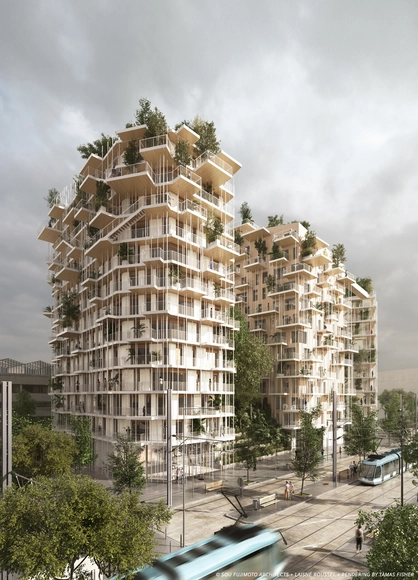
Nowadays the main building materials used in the construction industry are concrete, steel and timber. From the point of view of ecological sustainability, there are four important differences between these three materials: first, timber is the only material of the three that is renewable; second, timber needs only a small amount of energy to be extracted and recycled compared to steel and concrete (but the implementation of its potential is not as developed yet); third, timber does not produce waste by the end of its life since it can be reused many times in several products before decomposing or being used as fuel and; and fourth, timber traps huge amounts of carbon from the atmosphere – a tree can contain a ton of CO2 [1] – and the carbon absorbed remains embedded as long as the wood is in use.
Considering the fact that 36 percent of total carbon emissions in Europe during the last decade came from the building industry,[2] as well as 39 percent of total carbon emissions in the United States,[3] the materiality of construction should be a priority for governments’ regulations in the future as measurements against global warming. The amount of CO2 in the atmosphere and the level of carbon emissions of the big economies across the globe are big issues that need to be solved with urgency in order to avoid larger, more frequent climate catastrophes in the future. The current regulation in several countries of the EU, which is incentivizing the use of renewable materials in buildings, is showing the direction the building industry in many other parts of the world should follow. And if these measures are adopted across the EU and beyond – if other countries start to follow this tendency as well – there will be significantly more wood in cities.
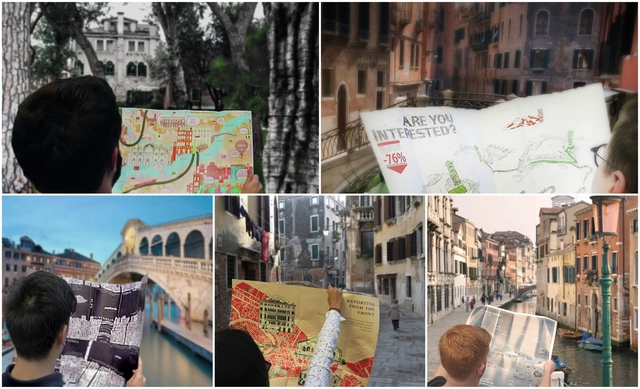
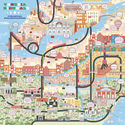
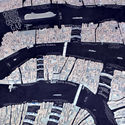
This article, by David Neustein and Grace Mortlock of Otherothers, explores a key paradox of the 2016 Venice Biennale: the disconnect between the geography of the topics on show and the geography of the Venice Biennale itself. With maps created by their students at the University of Technology, Sydney, they suggest new ways to explore the Biennale with Aravena's theme in mind.
In announcing his theme for the 2016 Venice Architecture Biennale, “Reporting From the Front,” Biennale director Alejandro Aravena declared that “architecture is about looking at reality” and that “any effort to tackle relevant issues has to overcome the increasing complexity of the world.” Aravena has envisioned a sweeping exhibition of architecture’s “frontiers” and “margins,” as if he were a general surveying the global battlefield from above.
The greatest impediment to this admirable ambition is the architecture of the Venice Biennale itself. Marooned on its tourist island, the Biennale is an idealized world-in-miniature, free of the realities, confusions and conflicts of the world-at-large. The environment is timeless, picturesque, serene: hardly representative of the world’s “increasing complexity.” Within the Biennale gardens (Giardini), former Colonial powers occupy prominent permanent pavilions while other countries, including those of present-day significance, are consigned to the periphery, relegated to temporary off-site spaces, or else absent altogether.
As part of ArchDaily's coverage of the 2016 Venice Biennale, we are presenting a series of articles written by the curators of the exhibitions and installations on show.
You are part of another’s shadow. —Sverre Fehn in conversation with Per Olaf Fjeld
A central impetus for this exhibition is to acknowledge the presence of the ‘ghosts’ of Nordic architecture – those architects, theorists and educators—the most famous of which are often described as ‘Modern Masters’—who continue to exert influence on contemporary practice and pedagogy. Indeed, one of the most prominent of these gures, the Norwegian Sverre Fehn, designed the Nordic Pavilion. This exhibition addresses a common challenge faced by Finns, Norwegians and Swedes today: how can a building (or an exhibition, in this instance) exist in a dialogue with its setting when that setting is so charged? For us, this ties into a broader question: how can architecture occupy a legacy while still making progress?
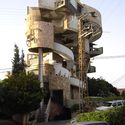
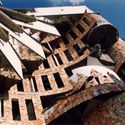
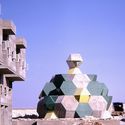
Throughout the course of his career, the forms present in Zvi Hecker's work have undergone significant changes – from the rigidly geometric shapes of his early work such as his Ramot Polin housing and Synagogue in the Negev Desert, to his more freeform recent works like the Jewish School he designed in Berlin. Hecker, though, sees all of his works as both consistent with each other and individual, describing himself as “an artist whose profession is architecture.” In this interview from his “City of Ideas” column, Vladimir Belogolovsky speaks with Hecker about his inspirations and the ideas that underpin his career.
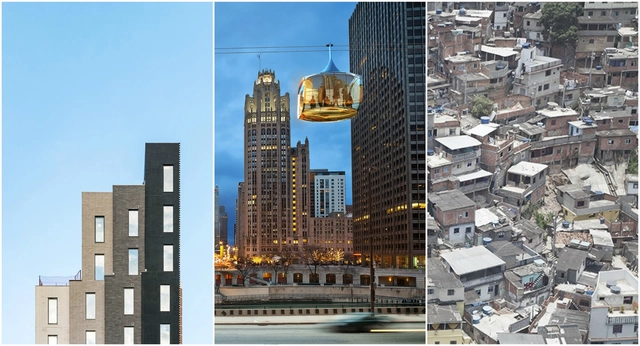
The past month has seen a variety of potential topics of discussion - but when it comes to the most thoughtful comments, it seems ArchDaily users have been preoccupied with one theme: quality of life. From a discussion about micro-apartments, to a critical take on the supposedly "romantic" portrayal of favelas, and even to a prediction that soon the design of virtual reality will take precedence over the design of actual reality, it seems our readers have been thinking a lot about living conditions in many spheres of life. Read on to find out what they had to say.
Alejandro Aravena and the jury for the 15th International Architecture Exhibition at La Biennale di Venezia have just announced the winning participations.
The Golden Lion for Best National Participation went to Spain for UNFINISHED. The jury cited Carlos Quintáns & Iñaqui Carnicero's "concisely curated selection of emerging architects whose work shows how creativity and commitment can transcend material constraints."
"Architecture is about giving form to the places where we live. It is not more complicated than that, but also not easier than that." - Alejandro Aravena
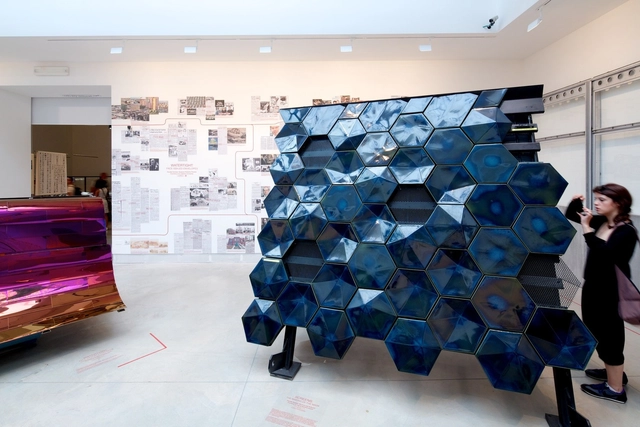
On the first day of the vernissage 15th International Architecture Exhibition at La Biennale di Venezia, ArchDaily is pleased to show you a preview of the exhibitions and installations that were hand selected by Alejandro Aravena and his firm Elemental. Separate from (but in dialogue with) the National Pavilions, "Reporting From the Front" celebrates work that "address[es] a problem that matters and for which quality architecture made a difference."
In an exhibition whose aim is to share the "success stories" where architecture is making a difference, Alejandro Aravena has convened offices and practitioners from across the globe to show—"in the simplest possible terms (without trivializing)"—projects that demonstrate innovation, resolve and quality problem-solving abilities.
The resignation itself was demanded* by Princeton University President Christopher Eisgruber after Zaera-Polo was accused of plagiarizing parts of a text he produced for the “Elements of Architecture” exhibition curated by Rem Koolhaas at the 2014 Venice Biennale. From the start, Zaera-Polo has denied that his texts violate Princeton’s academic code of conduct, but nevertheless agreed to Eisgruber’s demand. In the documents leaked Tuesday, Zaera-Polo criticizes the actions taken by Princeton both before and since his resignation, arguing that they have damaged his reputation. He is thus suing them on four charges: “breach of contract,” “breach of the implied covenant of good faith and fair dealing,” “tortious interference with contract and prospective economic advantage,” and finally “trade libel.”
The story will undoubtedly receive a lot of attention, given that it involves a controversial dispute between an internationally renowned architect and a university with an international stature. But the real story behind the dispute is not about Alejandro Zaera-Polo’s academic conduct or Princeton’s handling of its staff contracts; instead, it has everything to do with our expected standards for architectural research.
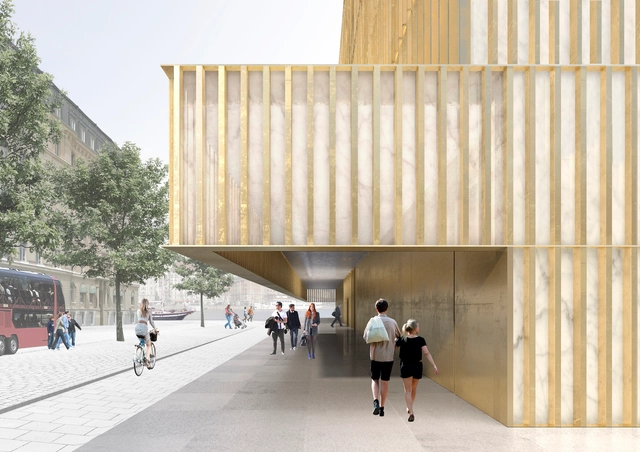
David Chipperfield Architects has made further refinements to the design for the Nobel Center in Stockholm. First revealed in October 2013, the project received harsh criticism for being an incongruous presence in the city’s historic center, which lead to a reduction in size amidst other changes in September of last year. Building on the 2015 revision, a more finalized version of the design has now been revealed in new exterior and interior renderings.
The Victoria and Albert Museum has unveiled its latest installation: the Elytra Filament Pavilion, a project displaying the culmination of four years of research on the integration of architecture, engineering, and biomimicry principles, in an exploration of how biological fiber systems can be transferred to architecture.
The 200-square-meter structure is inspired by lightweight construction principles found in nature, namely "the fibrous structures of the forewing shells of flying beetles known as elytra," states a press release.
In the newest video by architects Wahyu Pratomo and Kris Provoost of YouTube’s #donotsettle, the duo visit MVRDV’s "The Stairs" installed outside Centraal Station in Rotterdam. The project commemorates the 75th anniversary of the city’s reconstruction after World War II by devising the staircase now attached to the Groot Handelsgebouw, a landmark and one of Rotterdam’s first post-war buildings. In the video, Pratomo and Provoost discuss the idea of temporariness, experience-driven architecture, context, and symbolism inspired by MVRDV’s intervention, all the while asking other visitors for their own reactions to the spectacle.
Growing out of the success of coworking, the latest big phenomenon in the world of property is coliving. Like its predecessor, coliving is predicated upon the idea that sharing space can bring benefits to users in terms of cost and community. And, like its predecessor, there are already many variations on the idea with numerous different ventures appearing in the past year, each tweaking the basic concept to find a niche.
There are a lot of existing accommodation types that are “a bit like” coliving—depending on who you ask, coliving might be described as either a halfway point between apartments and hotels, “dorms for adults” or “glorified hostels.” And yet, despite these similarities to recognizable paradigms, countless recent articles have proclaimed that coliving could “change our thinking on property and ownership,” “change the way we work and travel,” or perhaps even “solve the housing crisis.” How can coliving be so familiar and yet so groundbreaking at the same time? To find out, I spent a week at a soon-to-open property in Miami run by Roam, a company which has taken a uniquely international approach to the coliving formula.
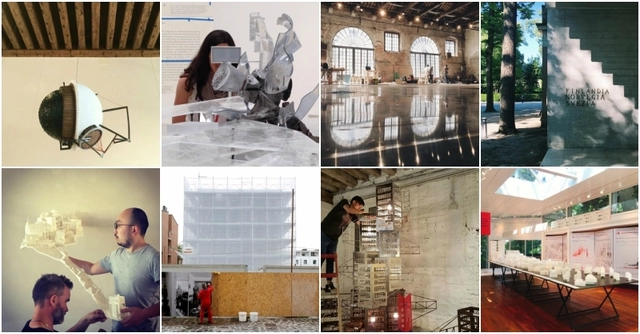
As the 2016 Venice Biennale is set to begin this upcoming Saturday, May 28th, the first glimpses of the pavilions have begun to roll in through the social media wires. In addition to the event’s main exhibition, curated by this year's Pritzker Prize winnerAlejandro Aravena, there will be 63 exhibitions held in country pavilions throughout the grounds responding to this year’s theme of “Reporting From the Front.” We've taken to Instagram to round up the best sneak peeks of the exhibitions coming together at architecture’s preeminent event—read on to take a look.
In this new collaboration, originally titled "Architecture for the system and systems for architecture," Spanish architect and cofounder of the blog MetaSpace, Manuel Saga, reflects on the experience of developing (and taking on) a game where architecture plays a key role for the designer, and for the player. The case studies? No less than four major titles of our times: Starcraft, Age of Empires, Diablo and Dungeon of the Endless.
On MetaSpace we have introduced a general overview of the challenges that video game designers face when creating buildings, cities and even maps. This time we will go one step further: what happens when a game doesn’t offer a narrative or a fixed, open map, but rather an architectural system that the player can take control of? How does a design team respond to something like that?
One of the most significant buildings of the late modernist style, Le Corbusier’s Convent de la Tourette exemplifies the architect’s style and sensibilities in the latter end of his career. Built between 1956 and 1960 on a hillside near Lyon, France, the priory dominates the landscape, with its strict, geometric form.
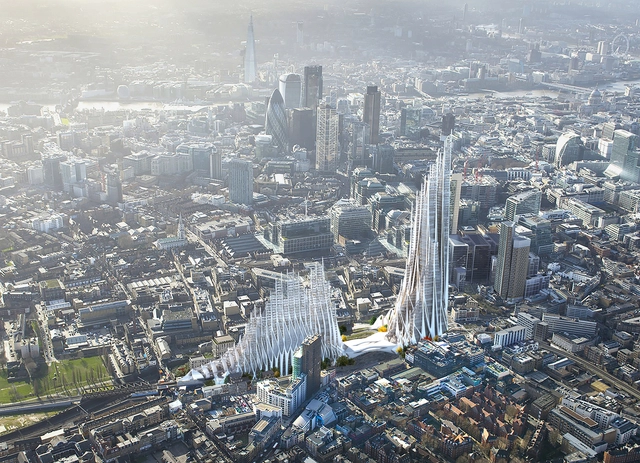
In their semester-long project at Zaha Hadid’s final studio course at the Yale School of Architecture, students Lisa Albaugh, Benjamin Bourgoin, Jamie Edindjiklian, Roberto Jenkins and Justin Oh envisioned a new a high density mixed-use project for London's Bishopsgate Goodsyard, the largest undeveloped piece of land still existing in central London.
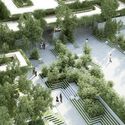
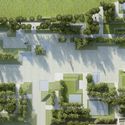
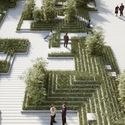
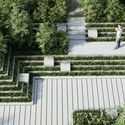
Penda has designed a landscape for Hyderabad, India, inspired by the country's stepwells and water mazes. When completed, the 8,000 square meter (85,000 square foot) Magic Breeze Landscape will serve 145 apartments in a development by Pooja Crafted Homes. Some of the landscape's signature features will be its bamboo coves, flower gardens, water displays, and built-in benches. The steps found throughout the landscape will double as planters for flowers, herbs, and grasses, that will serve as a communal garden for residents.
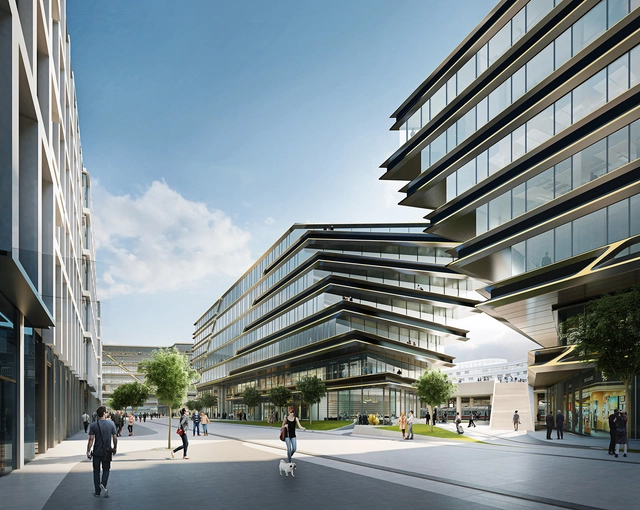
In a city as renowned for its historic buildings as Prague, urban change can often be hard to come by – which is why the announcement earlier this month that Zaha Hadid Architects will be designing a large complex of buildings around a railway station close to the city's historic center was big news. But is this the design that Prague needs? In this interview, originally published in Czech by Česká televize, Michaela Polakova speaks to Martin Barry, the Chairman of Prague-based NGO reSITE, for his analysis of how the design will impact the city's future.
Michaela Polakova: What is your opinion on the new Zaha Hadid Architects building in Prague?
Martin Barry: To me, it seems is too early to comment on the aesthetics of the buildings. We should focus on how the collection of buildings enhances the urban character of the city, and how they can improve the urban condition around the buildings. The city is a collection of buildings; the spaces between are what influence people’s lives; not so much the materials and forms of the architecture. That being said, this is a major development site and relatively large footprint of buildings from ZHA adjacent to the historic center of the city. So, we should pay close attention to how the designs develop. At present, it is clear that it is early and they need work.







.jpg?1464397199&format=webp&width=640&height=580)
.jpg?1464398167 "The pyramid, built from Swedish pine, represents an inhabitable installation – an urban artefact in a very public pavilion. Image © Laurian Ghinitoiu")
.jpg?1464398454 "Intimate \"Rooms Without Walls\" sit next to the main installation. Image © Laurian Ghinitoiu")
.jpg?1464398583 "The pyramid is a \"discourse machine,\" designed to allow people to critically discuss the issues at the heart of the exhibition in an open air environment. Image © Laurian Ghinitoiu")
.jpg?1464398159 "The pyramid exists in dialogue with the building. Here, it's relationship with the existing staircase is made apparent. Image © Laurian Ghinitoiu")
.jpg?1464397199)



.jpg?1464428401&format=webp&width=640&height=580)


.jpg?1464428401)

.jpg?1464273616 "© Laurian Ghinitoiu")
.jpg?1464273639 "© Laurian Ghinitoiu")
.jpg?1464273508 "© Laurian Ghinitoiu")
.jpg?1464273743 "© Laurian Ghinitoiu")
.jpg?1464273296)



_NAARO.jpg?1463781566&format=webp&width=640&height=580)
.jpg?1464091234&format=webp&width=640&height=580)



.jpg?1464091234)