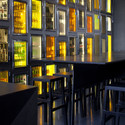
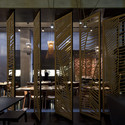
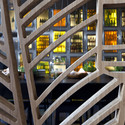
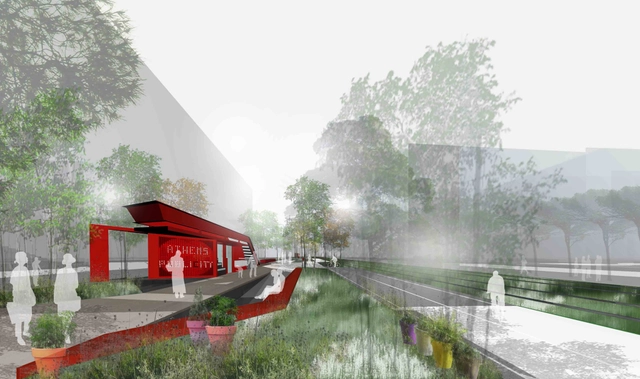
The proposal, ‘Athens PubliCity: an urban neuron for a new city center’, for the Re-Think Athens competition organizes a public space processing system which develops and expands like an “urban neuron”. Designed by Nikiforidis-Cuomo Architects, their concept becomes an entire living framework aiming to re-activate and revitalize the urban body. The system acts as a familiar, habitable and dynamic framework able to “contain” events and situations of both collective and individual actions. More images and architects’ description after the break.
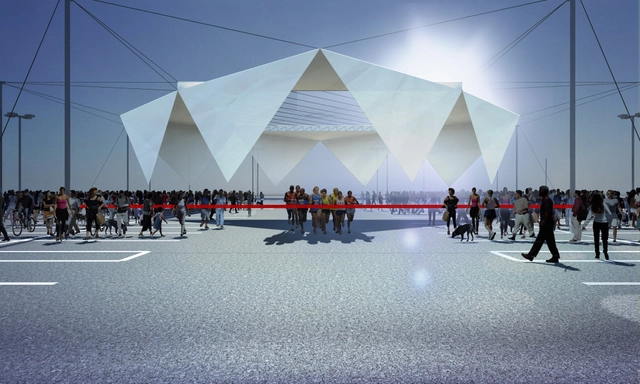
Designed by Ksestudio, their “Stage a lot” Flat Lot competition entry, which received an honorable mention, is a constantly transformative intervention that responds to the call for a temporary structure from the Flint Public Art Project. The project invents a ballet of ropes and pulleys animating four suspended rectangular pieces of white tyvek that in a neutral position hang vertically to form a topless cube. More images and architects’ description after the break.
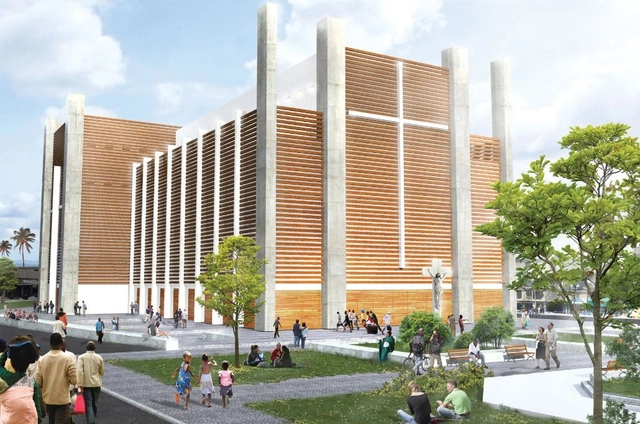
Designed by TABB Architecture, their proposal for the Notre Dame de l’Assomption Cathedral in Port au Prince optimizes resources, producing designed solutions and teaming up for a change. Designing a New Cathedral for Port-au-Prince,not only will imply a beautiful, energy saving, affordable building, but a complete strategy plan to generate the labor force in order to sustain the local economy, teaching people construction techniques to support future needs. More images and architects' description after the break.
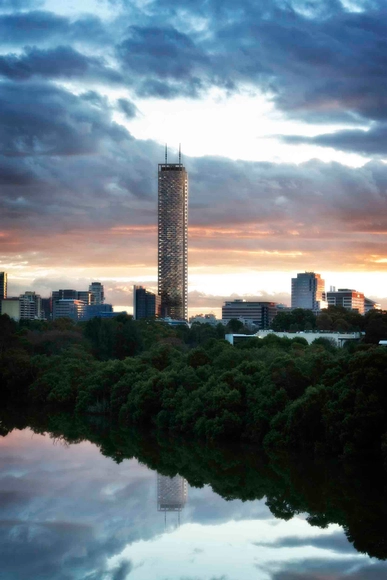
Emerging from a design excellence competition held by the Parramatta City Council, the Aspire Tower, designed by Grimshaw Architects, is a landmark mixed-use tower set to establish a new benchmark for innovative, passive-environmental design in Australian high-rise developments. Designed to act as a catalyst project for Parramatta Square, the tower provides high density, urban residential living which is not only affordable but also sustainable. More images and architects' description after the break.
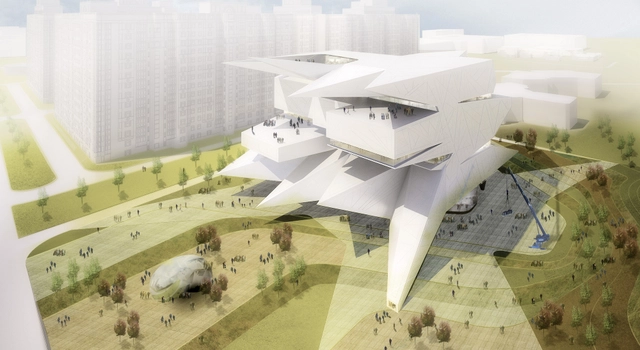
Designed by Leeser Architecture their design concept for the Polytechnic Education Center takes its cues from the rich history of modern Russian architecture of the early part of the twentieth century. Located in the Lenin Hills section of Moscow, which play an important role in the history of Moscow as a place of radical experimentation, the new institute symbolizes this incredible energy and conflation of future inventions with past achievement as a new symbol of global importance. More images and architects’ description after the break.


_ORCO-photo-by-Krzysztof-Wierzbowski_08.jpg?1366124262&format=webp&width=640&height=580)
_ORCO-photo-by-Krzysztof-Wierzbowski_09.jpg?1366124261 "© ORCO photo by Krzysztof Wierzbowski")
_ORCO-photo-by-Krzysztof-Wierzbowski_03.jpg?1366124281 "© ORCO photo by Krzysztof Wierzbowski")
_Studio_Daniel_Libeskind.jpg?1366124707 "© Daniel Libeskind")
_Aldinger___Wolf.jpg?1366124743 "© Daniel Libeskind")
_ORCO-photo-by-Krzysztof-Wierzbowski_08.jpg?1366124262)











.jpg?1366060339 "Courtesy of SIC Mostovik")

.jpg?1365783326&format=webp&width=640&height=580)
.jpg?1365783177 "© Luis Fonseca")
.jpg?1365783202 "© Ivan Brodey")
.jpg?1365783239 "© Ivan Brodey")
.jpg?1365783357 "© Ivan Brodey")
.jpg?1365783326)