
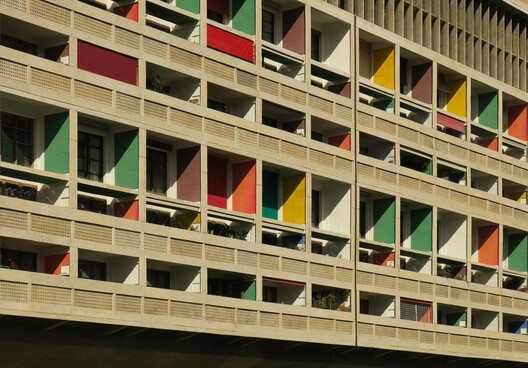
Le Corbusier's Unité d'Habitation imagined a "vertical neighborhood," a building able to integrate housing, commerce, leisure, and collective spaces within a single structural organism. Around the same time, Jane Jacobs argued that diversity of use is what produces safety, identity, and social life at the street level. Later, Rem Koolhaas, in Delirious New York, described the skyscraper as an early experiment in "vertical urbanism," capable of stacking incompatible programs under one roof. In cities like Tokyo and Hong Kong, this ambition matured into complex hybrid buildings where different uses, such as transit hubs, retail, offices, hotels, and housing, coexist and interact continuously.
Despite these visions of multiplicity, much of the 20th century shifted decisively toward functional separation, in a process shaped, paradoxically, by modernist planning heavily influenced by Le Corbusier's own ideas about zoning and programmatic order. Real-estate speculation and the growing dependence on automobiles reinforced this logic, encouraging cities to cluster similar activities together: offices in the core, housing at the periphery, commerce in designated corridors. The skyscraper, once imagined as a vessel for urban diversity, gradually evolved into a highly specialized machine dedicated mostly to office work.
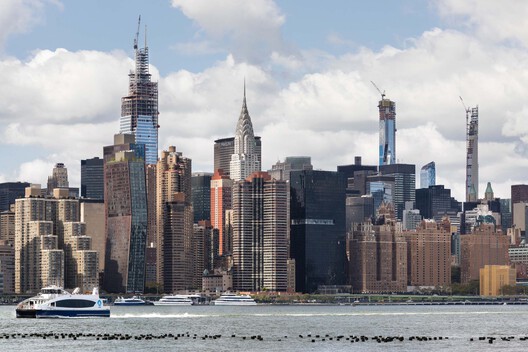
By the 1970s and 1980s, global cities had consolidated this model into their central business districts (CBDs), producing landscapes of glass towers optimized for efficiency, repetition, and corporate identity. Their technical systems, floorplates, fire codes, and vertical circulation strategies were calibrated to a single rhythm, the predictable movement of large numbers of workers at fixed hours. Buildings that could have absorbed multiple forms of life were instead shaped into single-use infrastructures, dependent on commuter flows and rigid occupancy patterns.
The COVID-19 pandemic dismantled that certainty. Remote work and hybrid schedules broke the assumption that millions of people must gather daily in the same towers, exposing the fragility and inefficiency of single-use office ecosystems. What seemed a rational urban model now appears increasingly out of sync with contemporary life, prompting cities to consider how these towers might be reused, diversified, and reintegrated into the everyday fabric of urban life. Adaptive reuse, then, is a response to an urban emergency already unfolding in major cities. According to Edward Glaeser, chair of Harvard's economics department and author of Survival of the City, and Carlo Ratti, director of MIT's Senseable City Lab and author of The City of Tomorrow, in New York alone, the equivalent of 26 Empire State Buildings' worth of office space kept empty after the pandemic signaling a structural oversupply that no return-to-office policy is likely to reverse. At the same time, Schindler states that 80% of the buildings that will exist in 2050 are already standing today. The future city will not be built from scratch, it will be transformed.

In this context, the Swiss elevator manufacturer Schindler points to a powerful premise: quality of life in future cities depends on transforming existing buildings, allowing them to accommodate new uses, new users, and more diverse rhythms of activity. Yet the ability to do so hinges on something often overlooked: vertical mobility. In single-use buildings this system is straightforward; in mixed-use environments it becomes the central constraint that decides whether a reuse is feasible.
This is the gap Schindler MetaCore system aims to close. Throughout our conversation with Dr. Florian Troesch, Head Global Digital Business, one idea appeared again and again: buildings need vertical resilience. This means the ability to adapt not once, but repeatedly, as demands shift over the coming decades. Traditional elevator design segregates functions by carving separate shafts for offices, residential units, hotels, or retail. While effective for privacy, this approach locks towers into their original uses and also takes up a lot of floor space for the designated shafts. When office demand collapses, as it has post-pandemic, these isolated elevator groups become underutilized capacity that cannot be redirected.
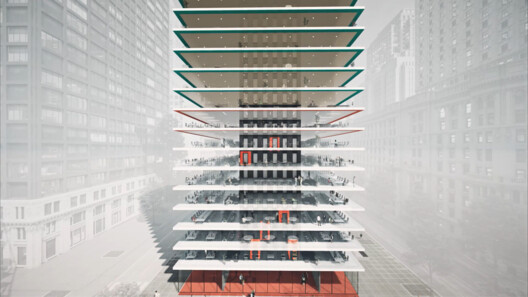
Schindler MetaCore replaces this rigidity with a single programmable core. Through software, it can manage separation, privacy, and user experience dynamically. One set of cabins serves all functions, adapting moment by moment to demand. A residential user receives a different digital interface—like call panels, cabin displays, or access credentials—as well as distinct lighting and routing, compared to the office worker who used the system minutes earlier; a hotel guest may be guided through an entirely separate path. This software-defined segregation enables the functional fluidity that adaptive reuse requires.
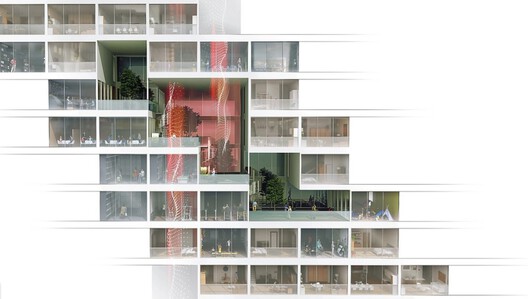
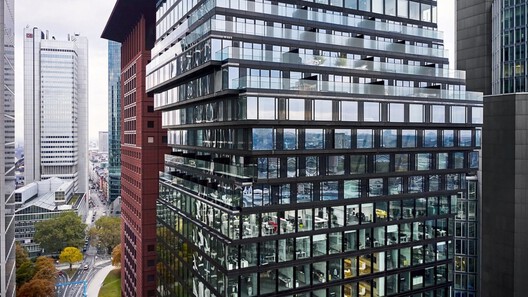
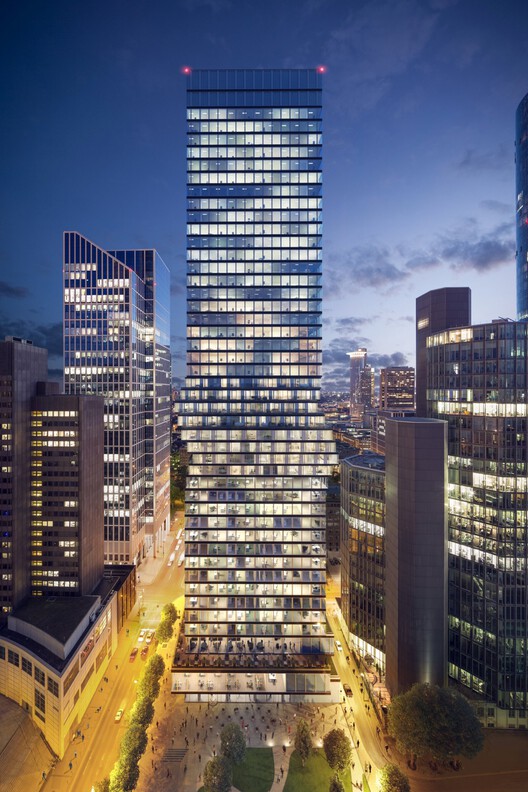
Frankfurt's Omniturm offers a clear demonstration of this logic. Offices, residences, and amenities coexist in a single tower, yet each group experiences the building as if it were designed exclusively for them. As Troesch notes, privacy is not a luxury but a condition for making mixed use acceptable and commercially viable. Vertical mobility, in this sense, becomes part of identity as much as logistics.
Schindler PORT technology operationalizes this idea. Users are recognized via app, badge, or facial recognition the moment they enter. Elevators are then algorithmically assigned based on destination and user category. What feels like a dedicated "residential elevator" is actually a shared cabin shifting modes throughout the day, preserving both efficiency and personalization.
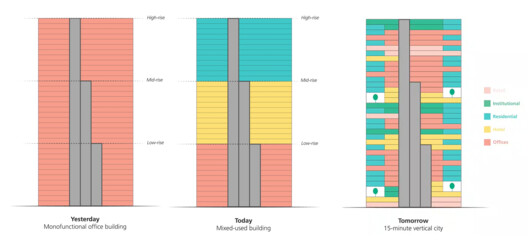
This flexibility is especially valuable in existing buildings. Many postwar office towers have deep floor plates poorly suited to residential use. Schindler's research with architects explores hybrid strategies, such as branched duplex apartments near façades with commercial or shared spaces in the core, that would be impossible with conventional elevator zoning. Schindler MetaCore programmable routing allows diverse user groups to remain separated even when sharing the same floor.
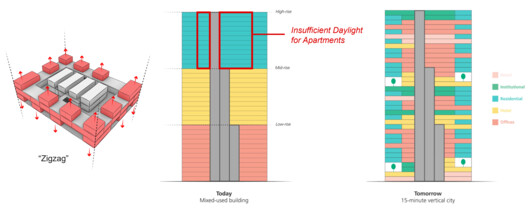
Beyond the elevator core itself, Schindler's research extends into how floorplates can be reorganized to support mixed-use life in buildings originally designed for offices. Working with architects, the company developed a catalog of floor design strategies that address a range of challenges in reuse, including access to daylight. Numerous postwar towers feature homogeneous floorplates that demand extensive redesign to support residential layouts. In the Zigzag design strategy, for example, duplex residential units branch up and down, pulling living spaces closer to the façade while creating voids that allow natural light to penetrate toward the core. While some models imagine residential or hospitality programs wrapped around a central, shared interior zone, there are another schemes that stack or interlock functions vertically, enabling offices, retail, and housing to coexist on the same or adjacent floors. These configurations reveal how mixed-use environments can be achieved updating vertical mobility but also by reinterpreting the geometry of the floorplate, turning previously homogenous office levels into more porous, livable, and adaptable spatial systems.
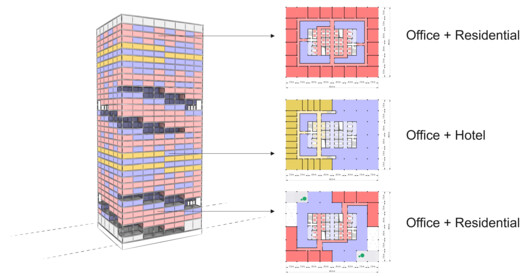
Simulation underpins this process. Before any renovation, Schindler works with relevant data of the buildings such as population, functions or flows of usage, segregation of passenger groups, elevator parameters and more. As a result of the simulation, it is possible to reveal and model travel times, waiting times, and interaction patterns across user groups. In order to separate different groups of passengers, some requirements, which reduce shared capacity, can be simulated precisely to determine how many apartments or additional functions a tower can support. Schindler MetaCore also supports financial resilience. Owners can diversify revenue streams, respond to changing markets, and extend the lifespan of assets that might otherwise become obsolete. Instead of demolishing or abandoning outdated towers, cities can reconfigure them to support housing, hospitality, coworking, or public amenities while preserving embodied carbon.
At the end, elevators, a complex component of architecture, have become a strategic element of urban transformation. Schindler reframes them as programmable infrastructure capable of absorbing uncertainty. By enabling buildings to shift uses without rebuilding their cores, Schindler MetaCore unlocks the full potential of adaptive reuse: keeping materials in place, expanding urban diversity, and ensuring that buildings remain relevant over multiple generations. Adaptive reuse is ultimately the ability to see a future within an existing shell. Solutions like Schindler MetaCore make that imagination feasible, allowing cities to reinterpret buildings not as rigid monuments to past economic models but as flexible frameworks for the evolving rhythms of contemporary life.
This article is part of the ArchDaily Topics: Building Less: Rethink, Reuse, Renovate, Repurpose, proudly presented by Schindler Group.
Repurposing sits at the nexus of sustainability and innovation — two values central to the Schindler Group. By championing this topic, we aim to encourage dialogue around the benefits of reusing the existing. We believe that preserving existing structures is one of the many ingredients to a more sustainable city. This commitment aligns with our net zero by 2040 ambitions and our corporate purpose of enhancing quality of life in urban environments.
Every month we explore a topic in depth through articles, interviews, news, and architecture projects. We invite you to learn more about our ArchDaily Topics. And, as always, at ArchDaily we welcome the contributions of our readers. If you want to submit an article or project, contact us.


