Unlike buildings, which are anchored to foundations and respond to climate from a fixed position, yachts are designed for constant movement and change. Interiors sway with the vessel, light changes by the minute, humidity is a permanent design condition, and every kilogram influences performance. Designing for the sea therefore requires architects, naval architects, engineers, and interior designers to solve questions that rarely exist on land: how can space remain calm while everything around it is in motion?
Despite being among architecture's oldest structural forms, domes continue to offer possibilities for creating large, column-free spaces and working with circular or free-form geometries beyond conventional rectangular building types. Their evolution has been closely tied to changes in materials, construction methods, and design tools. Today, digital platforms are adding another layer to this process, allowing some of the decisions traditionally developed later in a project to be explored much earlier.
Masonry is often perceived through its weight, depth, texture, and sense of permanence. Yet these physical qualities also have several implications for the performance of a building envelope. From the thickness of the mortar joint to the weight of the material, every masonry decision is connected to considerations of durability, stability, and long-term performance, while preserving the material character associated with solidity and permanence.At Summer Street Apartments, thin brick offered a way to retain these qualities while accommodating the insulation and envelope requirements of an all-electric, net-zero energy building. Just as importantly, it helped give the project the residential character the architects were looking for.
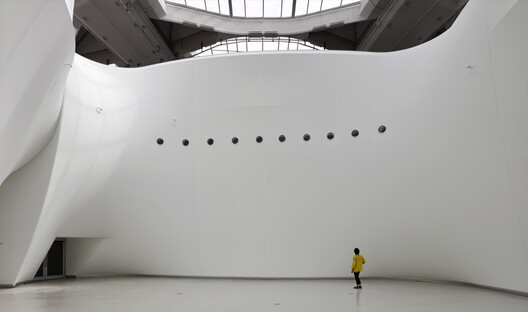
What can a textile do that glass, wood, concrete, or metal cannot? Architectural composite fabrics don't replace conventional building materials. Instead, they can complement them and often add another layer of performance to the building envelope. Their application changes with context. A composite membrane can become an exterior shading system for a tropical conservatory, an interior skin that shapes acoustics and spatial experience in a museum, or part of a facade strategy that improves the environmental performance of an existing building.
What happens when architecture is asked to create a room without boundaries? Convention halls, stadiums, factories, and logistics centers all begin with the same architectural challenge: creating large, uninterrupted interiors that can accommodate movement, visibility, and changing uses. The larger the span, the greater the structural demands, and the greater the architectural possibilities.
Long-span architecture is not a recent ambition. For centuries, architects have sought ways to enclose large public spaces, from the monumental dome of the Pantheon to the iron-and-glass halls of London's Crystal Palace. Each breakthrough expanded the possibilities of architecture, replacing thicker walls and denser structural systems with lighter, more efficient ways of spanning distance. Today, steel continues that evolution, making it possible to span distances that would be difficult to achieve with conventional structural systems while keeping large public spaces open, flexible, and adaptable. Steel's high strength-to-weight ratio makes longer spans possible with fewer columns and lighter structural systems, while prefabricated components simplify construction and reduce on-site work.
Videos
Dornbracht Atelier Edition The Knot in collaboration with AB Concept. Image Courtesy of Dornbracht
Symbols have always traveled through architecture. They appear in carved stone, woven textiles, painted ceilings and walls, door hardware, and everyday objects, carrying the beliefs, rituals, and histories of the cultures that first created them. Across contemporary interiors, designers continue this dialogue with place by revisiting historical symbols and translating them through new materials, manufacturing techniques, and architectural forms.
The Ruyi knot is one such example. For centuries, the interwoven motif has been part of the Chinese knotting tradition, symbolizing continuity, harmony, and good wishes. Its gently looping geometry has appeared across decorative objects and ceremonial crafts, demonstrating how cultural references can become part of a design vocabulary that extends far beyond ornament.
Di.Big pivot security door. Image Courtesy of Porte Blindate
What transforms a space of living into a home? Beyond ownership or shelter, a home is tied to a quieter sense of certainty: the feeling that one can retreat, rest, and momentarily step away from the world's unpredictability. Homes are where routines accumulate, memories settle into spaces and objects, and where personal identity takes physical form through occupation and everyday rituals. Yet this sense of belonging depends on another condition that often goes unnoticed until disrupted: security. To feel "at home" implies a condition of comfort and stability. When domestic environments fail to provide this, spaces designed for rest become sources of unease, subtly affecting routines and well-being.
The original promise of BIM (Building Information Modeling) went far beyond the three-dimensional representation of a building. Its ambition was to turn the model into a coordinated information structure, in which geometry, components, systems, and data remained connected as the project evolved. Changes to one element could be reflected across corresponding plans, sections, elevations, and quantities; clashes between different disciplines could be identified before construction; and information associated with building components could follow the project through different stages of its life cycle.
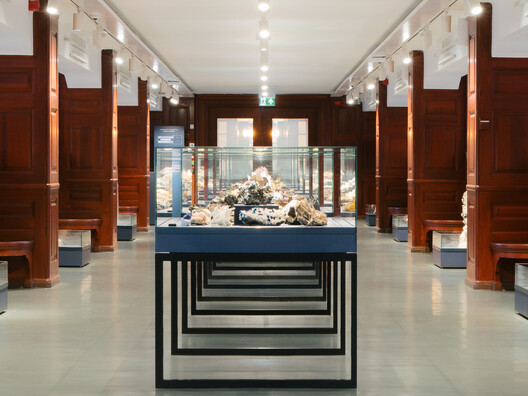
Designing a museum interior means negotiating between the needs of the collection and those of the visitor: objects must be protected and carefully displayed, while spaces need to remain accessible, legible, and engaging. Scale, circulation, security, lighting, structure, and technology all become part of the design, often working quietly in the background so that the exhibits remain the focus. So, how do you fit 4.5 billion years of Earth's history into a museum interior? The renovation of the Natural History Museum Oslo, home to one of the largest geological and anthropological exhibitions in the Nordic countries, offers a clear example of how these demands can come together within an existing architectural framework.
As a fundamental human right, inclusion requires that all people—regardless of their backgrounds, abilities, or circumstances—are recognized and respected, with equal access to the same resources and opportunities. For many people with disabilities and their caregivers, accessible washrooms still fail to provide what is most essential: a safe, private, and dignified place for assisted changing. While many facilities comply with ADA and ICC accessibility standards, conventional washroom layouts often do not accommodate users who require additional space, time, and support from caregivers. This gap has contributed to the growing adoption of adult changing facilities, which extend accessibility beyond conventional washroom requirements and respond to needs that standard fixtures cannot address.
Across architecture and the building industry, women contribute to a wide range of fields, from design practice and construction to research and leadership. Their work reflects different approaches to some of the profession's most pressing questions, including environmental performance, adaptive reuse, and the creation of healthier and more responsive spaces. However, disparities remain visible in areas that influence professional recognition. For example, women continue to be significantly underrepresented in architecture in the United Kingdom. According to the Architects Registration Board, only about 31% of registered architects are women.
The ceiling is one of the largest continuous surfaces in a space, yet why is it rarely the first architectural element people notice? Often perceived as the plane that conceals structure and building services, it quietly recedes into the background while facades, materials, structural systems, and furniture define a building's architectural identity. Yet few architectural elements influence the experience of a space as consistently as this one. The ceiling shapes how sound travels, how light is reflected, how air moves through a room, and ultimately how architecture is experienced, bringing together technical performance and architectural expression through a single continuous surface.
Danish architectural theorist Steen Eiler Rasmussen observed in his book Experiencing Architecture that ceilings shape the character of a room through rhythm, proportion, light, and atmosphere. Rather than simply enclosing space, they help organize it, defining areas and guiding movement without the need for additional walls. As buildings became larger, more open, and more dependent on integrated building services, architecture began asking more of this overlooked surface. The ceiling gradually shifted from a concealed building component into an active architectural system in which acoustics, lighting, ventilation, thermal comfort, and technical infrastructure could converge on a single plane.
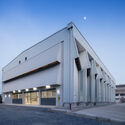
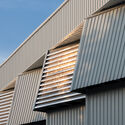
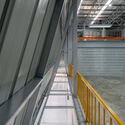
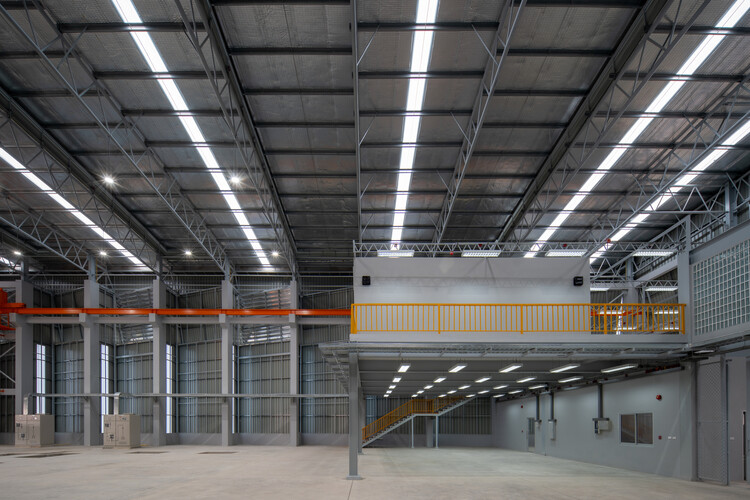
The Industrial Foundry for Marine Vessels. Image Courtesy of Naksit Wisetmora
Industrial buildings are often expected to prioritize efficiency, production, and technical performance above all else. As a result, architectural quality is frequently treated as secondary to functional requirements. Advances in material systems, however, allow industrial facilities to balance both, creating buildings that respond to climate, improve working conditions, and establish a distinctive architectural identity.
What defines the quality of a bathroom beyond its basic functions? As one of the most private spaces within the home, the bathroom is closely connected to everyday rituals and moments of pause. While fixtures, circulation, and technical requirements establish the practical foundation, the atmosphere emerges through a combination of spatial decisions: how furniture meets the floor or deliberately avoids it, how materials interact with light, how storage is integrated, and how form and proportion shape perception.
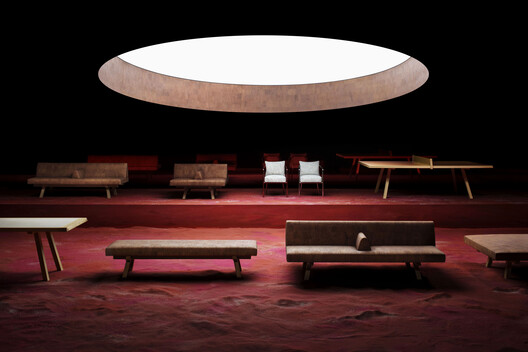
MTM—Made to Measure designed by Herzog & de Meuron for UniFor, Creative Direction by Studio Klass . Image Courtesy of UniFor
What allows a single architectural principle to generate many different outcomes? The answer lies in the systems that organize architecture: geometry, proportion, structure, and construction. Together, these can establish a set of rules that can accommodate different programs, contexts, and spatial conditions while maintaining a coherent identity. A structural grid, for example, can organize a variety of uses, just as a single construction detail can be repeated throughout an entire building without producing identical spaces. Can the same way of thinking be translated into furniture design without losing its identity? MTM—Made to Measure, developed by Herzog & de Meuron for UniFor, explores this question. Instead of designing each piece independently, the collection grows from a single structural principle that can be extended, adapted, and repeated across different functions while maintaining its internal coherence.
What will the future of steel be?How can this material build the foundation for sustainable economic development and the transition to a low-carbon society?
Steel plays an essential role in modern societies, shaping countless aspects of daily life and supporting sustainable development through its contribution to the built environment, transportation, and energy infrastructure. From automobiles and buildings to cargo ships and refrigerators, steel is a durable and versatile engineering and construction material with a distinctive strength-to-weight ratio compared with other building materials. By offering fast, durable, and flexible solutions with temperature control and resistance to extreme weather conditions, steel has become an integral part of modern construction systems. Its long-term performance also places it at the center of the debate on how to transition toward a lower-carbon world.
There is a big difference between looking at an image of a building and experiencing the space it represents. The atmosphere of a place, shaped by its light, sounds, materiality, and relationship with the surrounding landscape, has long belonged to the realm of physical experience. Today, real-time rendering technologies are beginning to narrow that gap, allowing projects to be explored and experienced before they are ever built.
Long before a building is constructed, it exists as drawings, physical models, perspectives, photographs, and, more recently, photorealistic renderings. Each new representational tool in history has sought to communicate not only the appearance of a project, but also the experience of inhabiting it.