



The first edition of the Venice Architecture Biennale took place in 1980, immediately revealing its role as a platform for images and ideas that would become essential references in contemporary architectural theory and practice. This disruptive character was embodied from the very beginning by the strangely familiar floating structure designed by Aldo Rossi, titled Teatro del Mondo. At once temporary and archetypal, the project introduced central themes that would shape Italian architectural discourse in the years that followed. To this day, it continues to inspire reflections on timelessness, imagination, and the memory embedded in cities.


It is striking to consider how such a small territory in the northern Adriatic has managed to exert such a broad and lasting cultural influence. This prominence may be attributed to the restless nature of Venice — a city shaped by water, always changing, built upon flows, exchanges, and constant reinvention. Its unique geographic and symbolic identity made it a point of convergence between East and West, the final stop of ancient trade and cultural routes that spanned continents. It is within this hybrid and transient setting that the Teatro del Mondo emerges: a temporary structure that engages with a wide range of references — from Renaissance and Elizabethan theatres to solitary lighthouses, from floating platforms that punctuate Venice’s landscape to the ephemeral structures created for eighteenth-century carnivals.
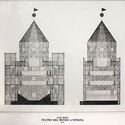
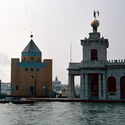
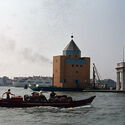
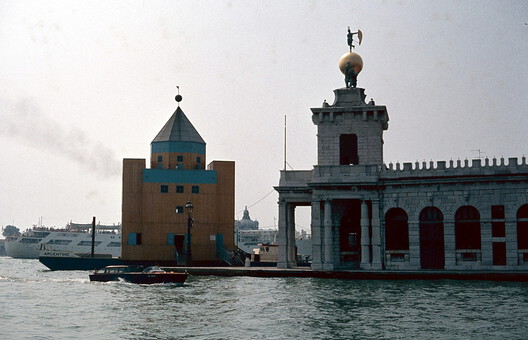
In late 1979, a few months before the official opening of the first Biennale, the boat-theatre appeared on the city’s horizon, floating on the Basin of San Marco and leaving a distinct mark on the landscape. Like a silent and metaphysical apparition, the structure seemed to condense both memory and anticipation — a fragment anchored in the past and projected into the future of Venetian architecture. Standing 25 meters tall, with a tubular steel frame clad in blue and yellow wooden panels, the theatre presented itself not only as a building but as a symbol. For Rossi, using wood was not simply a construction choice; it evoked Venice’s maritime imagination — from traditional boats to dark-hulled gondolas, from the fleeting platforms of historical carnivals to the city’s very essence: fluid and built on water.
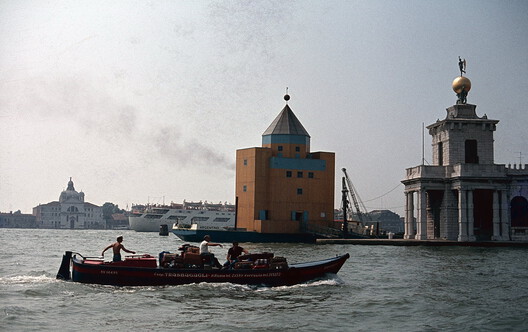
Teatro del Mondo’s design is defined by three facts: it has a precise, though unspecified, usable space; it positions itself as a volume shaped by the movements of Venice; and it rests on water. It is evident that being on water is its main characteristic — a raft, a boat: the edge or boundary of Venice’s architecture. — Aldo Rossi
Between fantasy and reality, Rossi created an architecture that was deeply attuned to its context. Although it lacked a fixed location, the theatre remained strongly connected to its surroundings, assuming different relationships with the people of Venice. Its proportions and form, reminiscent of the city’s iconic buildings, made it seem as though it had always belonged there. One of the clearest references was its roof, crowned with a sphere — a feature also seen in buildings such as the Punta della Dogana and the Church of Santa Maria della Salute. Philosopher Otília Arantes described the Teatro del Mondo as one of the rare examples of “situated architecture” within the context of simulated postmodernity. The theatre, she argued, “ties itself to the architecture of Venice while continuing the history of certain artistic and social practices of the city — it is a work of invention, especially in how it reinterprets, in a fresh and timely manner, elements patiently drawn from memory.” More than its physical form, however, Rossi stated in 1981 that what impressed him most about the Teatro del Mondo was its vitality — its construction, its presence in the city, and its relationship with performance.
While listening to Benedetto Marcello’s music on the night of the theatre’s inauguration, in front of the Salute, and watching people climb the stairs and gather inside on the upper levels, I witnessed an effect that I had only vaguely anticipated. Since the theatre floats on the water, through the windows and from outside, it was possible to see the vaporetti and ships sailing past, as if one were aboard another vessel — and these passing boats entered the theatre’s image, becoming its true, ever-changing and mobile backdrop. — Aldo Rossi
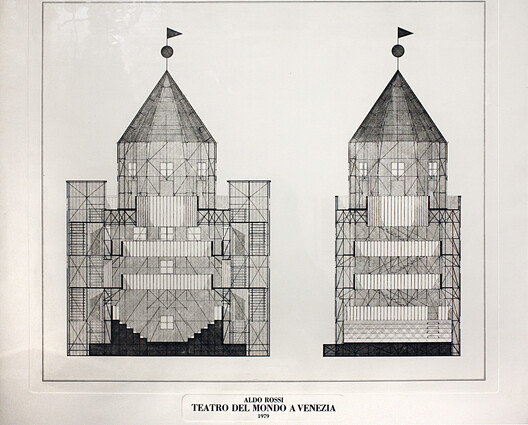
The theatre could accommodate an audience of 250 people, seated in galleries on the upper levels, who observed from above the spectacle of the city itself. Commenting on public interaction, Daniel Libeskind suggested that the structure presented a spatial subversion. In it, the typical internal arrangement of a theatre — with clearly defined spaces and circulation — was replaced by a setting where performance and spectator merged and interacted, allowing each to influence the other. A similar dynamic would later appear in the Teatro Oficina, designed by Lina Bo Bardi four years later in São Paulo. Deus ex machina, machina ex deo was Libeskind’s reflection on the Teatro del Mondo — “an exemplar of Aldo Rossi’s vision, because in both its function and its analog form, it affirms the monotony of reproduction and rejects the passions implicit in a self-determined dialectic.”
Unfortunately, only a few performances took place in the Teatro del Mondo. However, following its brief presence in Venice, the structure was granted a second life: it was transported by barge across the sea to Dubrovnik for the local theatre festival. Its arrival and brief installation in Croatia inspired discussions about cultural eclecticism and the complex historical layers of Adriatic cities. This coincided with the emergence of the postmodern movement in the former Yugoslavia, reinforcing the role of this architectural work as a space for reflection and provocation, regardless of its geographic or cultural setting.
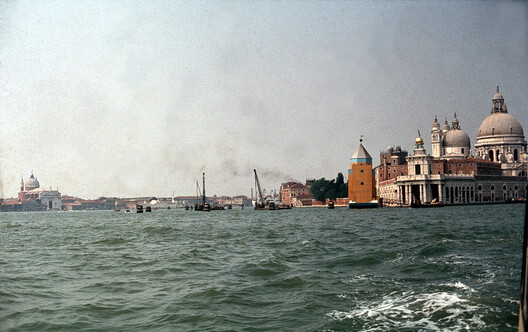
Rossi — who believed that architecture could be reduced to the scale of a domestic object, and that such an object could be dreamily expanded to the scale of a city — played with perception and imagination in creating this iconic project. Within the misty, Gothic landscape of a city built on water, he once again affirmed his existential commitment to architecture: to create spaces that serve as stages for life — in this case, “a place where architecture ends and the world of imagination begins.”
This feature is part of an ArchDaily series titled AD Narratives, where we share the story behind a selected project, diving into its particularities. Every month, we explore new constructions from around the world, highlighting their story and how they came to be. We also talk to the architects, builders, and community, seeking to underline their personal experiences. As always, at ArchDaily, we highly appreciate the input of our readers. If you think we should feature a certain project, please submit your suggestions.
We invite you to check out ArchDaily's comprehensive coverage of the 2025 Venice Biennale.


