Venice Biennale 2012: The Piranesi Variations / Peter Eisenman

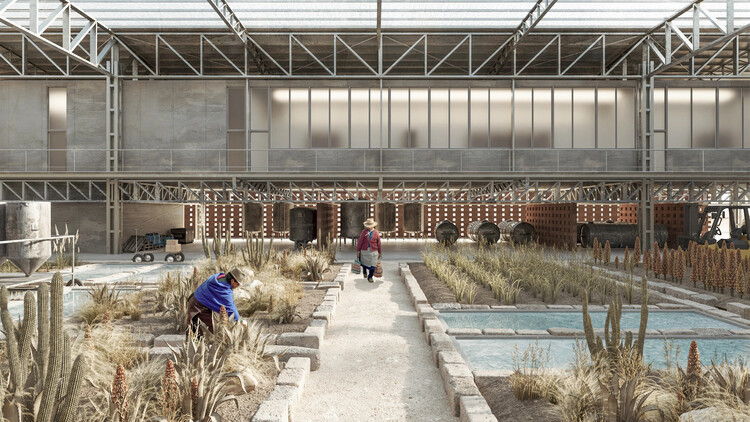
Field of Dreams / Knowlton School of Architecture © Nico Saieh

Inspired by the 13th International Architecture Exhibition‘s theme Common Ground, Peter Eisenman has formed a team to revisit, examine and reimagine Giovanni Battista Piranesi’s 1762 folio collection of etchings, Campo Marzio dell’antica Roma. Derived from years of fieldwork spent measuring the remains of ancient Roman buildings, these six etchings depict Piranesi’s fantastical vision of what ancient Rome might have looked like and represent a landmark in the shift from a traditionalist, antiquarian view of history to the scientific, archaeological view.

Eisenman’s team consists of Eisenman Architects, students from Yale University, Jeffrey Kipnis with his colleagues and students of the Ohio State University, and Belgian architecture practice, Dogma. Each group has contributed a response to Piranesi’s work through models and drawings that stimulate discourse on contemporary architecture. In particular, they explore architecture’s relationship to the ground and the political, social, and philosophical consequences that develop from that relationship.

The Project of Campo Marzio / Yale University School of Architecture © Nico Saieh

Described as “precise, specific, yet impossible”, Piranesi’s images have been a source of speculation, inspiration, research and contention for architects, urban designers and scholars since their publication 250 years ago. Continue after the break to learn more.

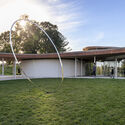
Assembly One Pavilion / Yale School of Architecture Students

© Chris Morgan Photography

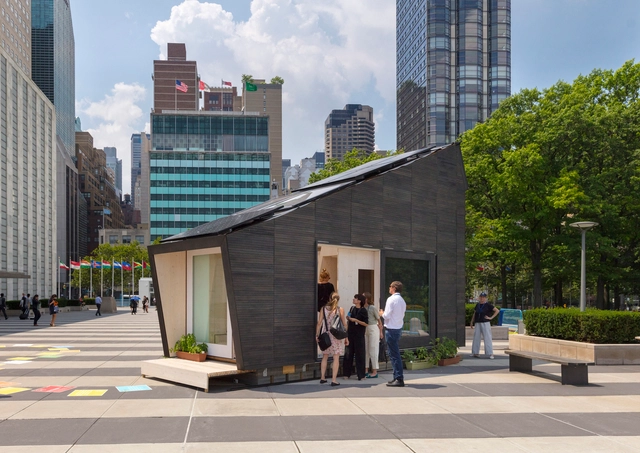
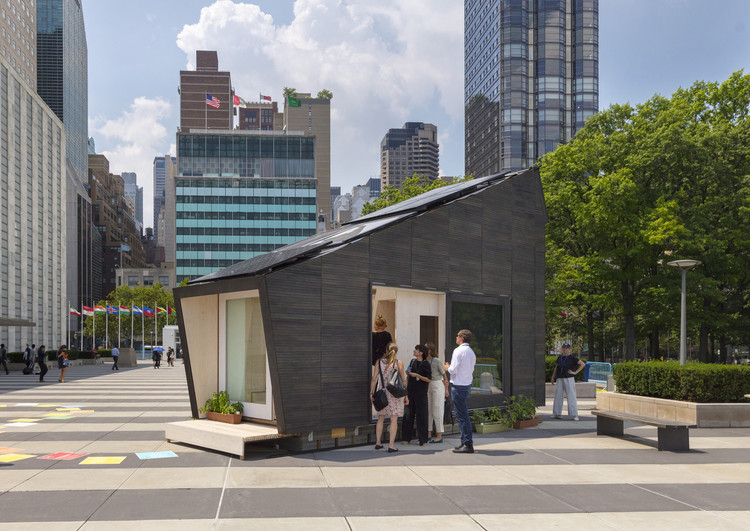
The Yale ‘Assembly One’ pavilion is the younger, smaller, more carefree sister to Yale’s building project – a 40-year old tradition in which first-year students design and building a house. It is the product of a seminar and design studio in which students focused on alternative ways in which contemporary buildings can come together and the potential architectural effects computational and material techniques can offer. The ‘Assembly One’ pavilion is designed to act as an information center for ’s summer International Festival of Arts and Ideas and therefore was developed with the following characteristics in mind: dynamism, visual transparency and visual density.

Continue after the break for more!

On Oikonomia: Saarinen’s Ezra Stiles College Open After $55M Renovation

under construction, 1961. Copyright Balthazar Korab Ltd.

NEW HAVEN, –Yale’s Ezra Stiles College, designed by Eero Saarinen and completed in 1961, reopened to students last month after a one-year, $55 million dollar renovation. The project was the last in a complete overhaul of all the residential colleges at Yale, which started in 1998 and has cost over $500 million (adjusted for inflation).

Students are happy with the work, praising the new brick pizza oven in the dining hall, shift from single to suite-style rooms, and improved furniture and lighting. Jon Rubin ’12 told the Yale Daily News (YDN) the renovated Stiles is “definitely a step up” from the college he lived in two years ago.

10 College Campuses with the Best Architecture

Photo by Rex Hammock - http://www.flickr.com/photos/rexblog/

Architectural Digest has compiled a list of college campuses throughout the which have the most remarkable architectural traditions, which broadcast their innovative philosophy through design. A number of colleges have fully incorporated modern architecture into their campus schemes, for example MIT; while others have preserved their historical edifices through the course of the years, like the University of Virginia. The list involves some prestigious institutions, in addition to some surprises, all possessing their individual architectural languages.

See the 10 College Campuses with the Best Architecture after the break.

The Architecture of Stanley Tigerman Exhibition / Yale School of Architecture

© , 'The Titanic', 1979

The career of eminent architect and educator Stanley Tigerman is the subject of a retrospective exhibition that opened at the Yale School of Architecture Gallery, in historic Paul Rudolph Hall, on August 22, 2011. Ceci n’est pas une rêverie*: The Architecture of Stanley Tigerman, which remains on view through November 5, 2011. The exhibition celebrates Tigerman’s distinguished career with a diversity of original artworks, models, photographs, and archival documents, among other items. It is curated by Associate Professor Emmanuel Petit. In January 2012, the exhibition will travel to the Graham Foundation’s Madlener House, in Chicago, and then onto the School of Architecture at the University of Illinois Urbana-Champaign. More information on the exhibition after the break.

5 Projects: Interview 5 / Alexander Maymind

X-ray view through front elevation, above and below ground

5 (student) Projects: is a group of projects completed at Yale University’s School of Architecture by 5 young architects during their graduate education. Each of the 5 projects are sited in New Haven on or adjacent to Yale’s campus. Each project focused on an institutional building, loosely defined by program, type and context. These commonalities became a framework for discussion that illuminated individual polemics and debate about experimentation in today’s architectural landscape. Despite the initial appearance of diversity within the set, each architect sought to address a common set of ideas emerging at Yale and perhaps within the discourse of architecture at large.

Primarily addressing the legacy of Postmodernism (in its various guises and forms), each sought an architecture that engaged historical memory, local context and an renewed concern for communication and legibility. Each was interested in an operable or speculative way to use history and its associated culturally established values, meanings and forms to produce new bodies of work. In that sense, each sought a contemporary way to learn from the past that would have particular resonance in today’s social, political, and cultural milieu.

The identity of the group of 5 is meant as a provocation towards two related issues: the desire for individuality and expression by today’s younger generation of architects inculcated by media and secondly, the desire for consensus within discourse on what counts today as critical & theoretical concerns for architecture. The aspiration behind the interviews and feature is to reveal an internal discussion which demonstrates an effort to clarify and identify a set of ideas that underpin contemporary architectural production. The feature and interviews were organized and conducted by .

You can check the first interview, second interview, third interview and fourth interview in case you missed them. Read the fourth one after the break.
5 Projects: Interview 4 / Brian Spring

exterior view

5 (student) Projects: is a group of projects completed at Yale University’s School of Architecture by 5 young architects during their graduate education. Each of the 5 projects are sited in on or adjacent to Yale’s campus. Each project focused on an institutional building, loosely defined by program, type and context. These commonalities became a framework for discussion that illuminated individual polemics and debate about experimentation in today’s architectural landscape. Despite the initial appearance of diversity within the set, each architect sought to address a common set of ideas emerging at Yale and perhaps within the discourse of architecture at large.

Primarily addressing the legacy of Postmodernism (in its various guises and forms), each sought an architecture that engaged historical memory, local context and an renewed concern for communication and legibility. Each was interested in an operable or speculative way to use history and its associated culturally established values, meanings and forms to produce new bodies of work. In that sense, each sought a contemporary way to learn from the past that would have particular resonance in today’s social, political, and cultural milieu.

The identity of the group of 5 is meant as a provocation towards two related issues: the desire for individuality and expression by today’s younger generation of architects inculcated by media and secondly, the desire for consensus within discourse on what counts today as critical & theoretical concerns for architecture. The aspiration behind the interviews and feature is to reveal an internal discussion which demonstrates an effort to clarify and identify a set of ideas that underpin contemporary architectural production. The feature and interviews were organized and conducted by .

You can check the first interview, second interview and third interview in case you missed them. Read the fourth one after the break.

5 Projects: Interview 3 / Matthew Persinger

Michael Graves

5 (student) Projects: is a group of projects completed at Yale University’s School of Architecture by 5 young architects during their graduate education. Each of the 5 projects are sited in New Haven on or adjacent to Yale’s campus. Each project focused on an institutional building, loosely defined by program, type and context. These commonalities became a framework for discussion that illuminated individual polemics and debate about experimentation in today’s architectural landscape. Despite the initial appearance of diversity within the set, each architect sought to address a common set of ideas emerging at Yale and perhaps within the discourse of architecture at large.

Primarily addressing the legacy of Postmodernism (in its various guises and forms), each sought an architecture that engaged historical memory, local context and an renewed concern for communication and legibility. Each was interested in an operable or speculative way to use history and its associated culturally established values, meanings and forms to produce new bodies of work. In that sense, each sought a contemporary way to learn from the past that would have particular resonance in today’s social, political, and cultural milieu.

The identity of the group of 5 is meant as a provocation towards two related issues: the desire for individuality and expression by today’s younger generation of architects inculcated by media and secondly, the desire for consensus within discourse on what counts today as critical & theoretical concerns for architecture. The aspiration behind the interviews and feature is to reveal an internal discussion which demonstrates an effort to clarify and identify a set of ideas that underpin contemporary architectural production. The feature and interviews were organized and conducted by .

You can check the first interview and second interview in case you missed them. Read the third one after the break.

5 Projects: Interview 2 / Adam Tomski

interior view of public room: with library above, and movable seating, cafe beyond

5 (student) Projects: is a group of projects completed at Yale University’s School of Architecture by 5 young architects during their graduate education. Each of the 5 projects are sited in on or adjacent to Yale’s campus. Each project focused on an institutional building, loosely defined by program, type and context. These commonalities became a framework for discussion that illuminated individual polemics and debate about experimentation in today’s architectural landscape. Despite the initial appearance of diversity within the set, each architect sought to address a common set of ideas emerging at Yale and perhaps within the discourse of architecture at large.

Primarily addressing the legacy of Postmodernism (in its various guises and forms), each sought an architecture that engaged historical memory, local context and an renewed concern for communication and legibility. Each was interested in an operable or speculative way to use history and its associated culturally established values, meanings and forms to produce new bodies of work. In that sense, each sought a contemporary way to learn from the past that would have particular resonance in today’s social, political, and cultural milieu.

The identity of the group of 5 is meant as a provocation towards two related issues: the desire for individuality and expression by today’s younger generation of architects inculcated by media and secondly, the desire for consensus within discourse on what counts today as critical & theoretical concerns for architecture. The aspiration behind the interviews and feature is to reveal an internal discussion which demonstrates an effort to clarify and identify a set of ideas that underpin contemporary architectural production. The feature and interviews were organized and conducted by .

We featured the first interview yesterday. Read the second one after the break.

5 Projects: Interview 1 / Mark Talbot

The skyline as seen from the roof of Rudolph Hall

5 (student) Projects: is a group of projects completed at Yale University’s School of Architecture by 5 young architects during their graduate education. Each of the 5 projects are sited in New Haven on or adjacent to Yale’s campus. Each project focused on an institutional building, loosely defined by program, type and context. These commonalities became a framework for discussion that illuminated individual polemics and debate about experimentation in today’s architectural landscape. Despite the initial appearance of diversity within the set, each architect sought to address a common set of ideas emerging at Yale and perhaps within the discourse of architecture at large.

Primarily addressing the legacy of Postmodernism (in its various guises and forms), each sought an architecture that engaged historical memory, local context and an renewed concern for communication and legibility. Each was interested in an operable or speculative way to use history and its associated culturally established values, meanings and forms to produce new bodies of work. In that sense, each sought a contemporary way to learn from the past that would have particular resonance in today’s social, political, and cultural milieu.

The identity of the group of 5 is meant as a provocation towards two related issues: the desire for individuality and expression by today’s younger generation of architects inculcated by media and secondly, the desire for consensus within discourse on what counts today as critical & theoretical concerns for architecture. The aspiration behind the interviews and feature is to reveal an internal discussion which demonstrates an effort to clarify and identify a set of ideas that underpin contemporary architectural production. The feature and interviews were organized and conducted by .

We will be featuring the five interviews this week, one per day. Read the first one after the break.

Kroon Hall Yale University / Hopkins Architects and Centerbrook Architects and Planners

© Morley von Sternberg

Kroon Hall School of Forestry & Environmental Studies is Yale University‘s Greenest Building. Chosen as a 2010 AIA/COTE Top Ten Green Project the ambitious goals for Kroon Hall encompassed taking a brownfield site crowded by looming and gloomy brownstone edifices – an area replete with dumpsters, pavement, and an aging power plant – and establish a building that would bring light, openness, and a connection to the natural world.

Follow the break for drawings and photographs of this project.

Architects: Hopkins Architects Design Architects and Centerbrook Architects and Planners, LLP Executive Architect
Location: New Haven, Connecticut, USA
Project Team: (Centerbrook) Mark Simon, FAIA, James A. Coan, AIA, LEED AP, Theodore C. Tolis, AIA, LEED AP, David O’Connor, Nick Caruso, Sheryl Milardo, Sue Pinckney, Barbara Kehew, Sue Savitt, Steve Haines; (Hopkins) Sir Michael Hopkins, Michael Taylor, Sophy Twohig, Henry Kong, Thomas Corrie, Tom Jenkins, Andrew Stanforth, Nate Moore, Edmund Fowles, Laura Wilsdon, Kyle Konis, Rose Evans, Martyn Corner
Structural, Mechanical, Electrical, Plumbing, and Fire Protection Engineers: ARUP
Architectural Lighting and Acoustical Design: ARUP
Sustainable Design: Atelier Ten
Landscape Architect: The Olin Studio
Civil Engineering and Stormwater Management: Nitsch Engineering, Inc.
Geothermal Engineers: Haley and Aldrich
Façade Engineering/ Thermal Performance: Simpson Gumpertz & Heger, Inc.
Materials Handling: SEA Consultants, Inc.
Code Consultant: Philip R. Sherman, Inc.
Specifications Consultant: Kalin Associates
Elevator Consultant: Van Deusen & Associates
Cost Estimator: Faithful + Gould
Construction Manager: Turner Construction Company
Client: Yale University
Project Area: 68,800 sqf
Project Year: 2009
Photographs: Morley von Sternberg