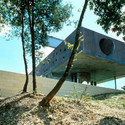
Today, one of Richard Meier’s most notable and acclaimed residences, the 1973 Douglas House, has been named to the National Register of Historic Places, the federal list of cultural resources worthy of preservation across the United States. The announcement comes after an extensive renovation to the property was completed in 2011, and will grant the home the legal status to help ensure the building is maintained for generations to come.
As the first month of 2016 draws to a close, we decided to tap into our network and ask an esteemed group of architects, critics, theorists and educators to tell us what they are looking forward to this year in architecture.
What are you looking forward to in architecture this year?
https://www.archdaily.com/780498/50-architects-tell-us-what-they-are-looking-forward-to-in-2016AD Editorial Team
Rothschild Tower. Photo by Diana Carta Courtesy Richard Meier & Partners Architects
Richard Meier & Partners is pleased to announce Richard Meier: Process and Vision at Mana Contemporary Chicago in partnership with the inaugural Chicago Architecture Biennial.
Richard Meier’s international body of work is acclaimed for its timeless, classic design from the Museum of Contemporary Art in Barcelona to the Getty Center in Los Angeles to Rome’s Jubilee Church. Each project throughout Richard Meier’s decades of architectural practice has posed its own set of inherent challenges, whether social, environmental, technological, or economical.
Bjarke Ingels worked on the Seattle Central Library during his time at OMA. Image Courtesy OMA
The world of architecture is small. So small in fact, that Rem Koolhaas has been credited with the creation of over forty practices worldwide, led by the likes of Zaha Hadid and Bjarke Ingels. Dubbed “Baby Rems” by Metropolis Magazine, this Koolhaas effect is hardly an isolated pattern, with manifestations far beyond the walls of OMA. The phenomenon has dominated the world of architecture, assisted by the prevalence and increasing necessity of internships for burgeoning architects.
In a recent article for Curbed, Patrick Sisson dug into the storied history of internships to uncover some unexpected connections between the world's most prolific architects. With the help of Sisson's list, we've compiled a record of the humble beginnings of the household names of architecture. Where did Frank Gehry get his start? Find out after the break.
Happy Fourth of July! In recognition of Independence Day in the United States, ArchDaily has assembled six of our favorite "American Classics." Featuring projects by Louis Kahn, Mies van der Rohe, Richard Neutra, Paul Rudolph, Eero Saarinen, and Richard Meier, each of these canonical works occupies a prominent place in twentieth-century American architecture. See them all after the break.
Ulm Stadthaus Exhibition & Assembly Building - Copyright Scott Frances
Designed by Richard Meier & Partners Architects, The Ulm Stadthaus presents a new exhibition of some of the most iconic and current projects by Pritzker Prize-winning architect Richard Meier. The works on display explore the development of the work of Richard Meier with some of his early residential projects in contrast to some of the more recent urban and large scale projects all around the globe in New York City, Hamburg, Prague and Mexico City.
The exhibition includes a selection of models, original sketches, drawings and photographs. Some of the projects exhibited on the show include the house designed by Richard Meier for his parents in Essex Fells, New Jersey, the Ulm Stadthaus, and the iconic Smith House in Darien, Connecticut. Other projects in the exhibition are some of the more recent and large scale developments such as the Reforma Towers, the East River Masterplan, Coffee Plaza, the Charles & Perry Street Condominiums, ECM City Tower and the unbuilt competition proposals for Madison Square Garden and the New York Historical Society.
Proposal: John Pawson (Chateau Aerial View). Image Courtesy of Oaks Prague
Three practices have been appointed to the design team for Oaks Prague, a new rural residential development located in the commune of Popivičky, close to the city of Prague. John Pawson, Richard Meier + Partners and Eva Jiřičná with AI-Design have drawn up design proposals for key buildings for the scheme, which is managed by the Czech development company Arendon. In November last year, ten practices were shortlisted in a competition to design housing schemes for the €400 million, 220-home "residential and lifestyle development" in Popivičky.
The entire development, which has previously been master-planned by EDSA assisted by Chapman Taylor and John Thompson & Partners, "responds to the form, layout and vernacular of the surrounding Czech villages."
Through the passage of time and technology, models remain integral in Richard Meier's office. No only are they tactile, visceral objects that represent space in way a computer simply cannot, but they also serve as "remembrances" for Meier (after all, the clients get to keep the buildings themselves). In the video above, NOWNESS gives us a sneak peek into Richard Meier's Model Museum at Mana Contemporary in New Jersey, where many of Meier's 300+ models now call home. Enjoy!
This past Tuesday, design icon Massimo Vignelli passed away at the age of 83. To commemorate his memory, we're re-publishing a fantastic video from NOWNESS in which Vignelli and Richard Meier discuss their fruitful collaborations and their long friendship. Learn more about the pair's collaborationsand read Meier's full, touching statement on his late friend and neighbor, Massimo Vignelli, after the break...
Videos
Gehry's Vertigo. Image Courtesy of Living Architectures
This time last year we published our 30 Architecture Docs to Watch in 2013featuring a fantastic range of films telling the tales of some of the world's greatest unsung architectural heroes. We now bring you eleven more for 2014, looking past the panoply of stars to bring you more of the best architectural documentaries which will provoke, intrigue and beguile.
From the Publisher. From his early days as one of the "New York Five," Richard Meier has been a central figure in contemporary architecture; this updated 2013 trade edition of the XL version is published in the occasion of the firm’s 50th anniversary. With the Getty Center and more recent buildings such as the Jubilee Church in Rome, Meier has established a reputation for expanded the horizons of contemporary American architecture while maintaining his rigorously rational approach to design and detailing. Known for carefully conceived grid plans and frequent use of white, Meier is a master of light, space, and volume, able to adapt his style to very different circumstances and locations.
Pritzker Laureate Richard Meier’s iconic new residential tower in the heart of Tel Aviv is nearing completion. Located in Rothschild Boulevard, the city’s bustling high-end commercial, cultural and financial district, it is no surprise that over 70% of the 42-story luxury tower has already been sold.
More on the tower, and its potentially controversial context, after the break...
Thanks to the courtesy of our friends from Beka & Partners, we are giving you the chance to win one of the five DVD-Books of the Living Architectures collection.
"Living Architectures” is a series of films that seeks to develop a way of looking at architecture which turns away from the current trend of idealizing the representation of our architectural heritage.
"Which architect would you like to see next in the Living Architectures series and why?"
You have until June 24 to submit your answer. Winners will be announced and contacted during the same day.
For more information about the DVD-Books you can check the trailers after the break, or go to www.living-architectures.com for more details. Good luck!
Third project of the Living Architectures series, Xmas Meier takes us, during the Christmas season, in the heart of a working-class neighbourhood in the suburbs of Rome, which had been lifted from anonymity to international renown thanks to the church built by Richard Meier for the Jubilee. Controversy, caustic irony and free speech opposed to the faithful's devotion. Welcome to Rome!
Courtesy of Fondazione Bisazza + Richard Meier & Partners
As an update to our recent post about the ‘Richard Meier – Architecture and Design’ Retrospective Exhibition currently taking place until July 28 at the Fondazione Bisazza in Vicenza, Italy, the first images have been shared with us. The exhibit includes several iconic, current and recently completed projects by Richard Meier & Partners, in celebration of the company's 50th anniversary. Also being unveiled at this exhibition is a site-specific installation for the Foundation’s permanent collection. For more information about the exhibition, please visit here. More images after the break.
In celebration of the 50th Anniversary of Richard Meier’s architecture career, Richard Meier & Partners Architects, in collaboration with the Fondazione Bisazza from Italy, are presenting the first Richard Meier Retrospective in Europe, titled 'Richard Meier - Architecture and Design'. Taking place May 8-July 28, the new exhibition will be a retrospective of the American architect’s iconic work and the unveiling of a site-specific installation for the Foundation’s permanent collection. Meier’s oeuvre is a reflection of the continuous search and analysis of concepts perfected over more than half a century of constant work in the field of architecture and design. More images and information on the exhibition after the break.
Our friends at NOWNESS have shared with us this mesmeric film by Johnnie Shand Kydd that captures the illustrious modernist Richard Meier and multi-disciplinary creator Massimo Vignelli as they reflect on their respective crafts, city life, and enduring friendship. Filmed inside the minimalist offices of Richard Meier & Partners on 10th Avenue and West 36th Street in New York City, the two powerhouses discuss their collaboration on the firm’s forthcoming monograph, Richard Meier, Architect Volume 6, chronicling the stark, white, rationalist buildings that define the firm’s aesthetic. Enjoy!
Continue after the break to browse through iconic works by Richard Meier & Partners.