‘Research as Practice’ Symposium

Taking place this Friday, April 12th, from 4:00pm-8:30pm, the Doctor of Design program at the Harvard University Graduate School of Design is inviting you to ‘Research as Practice’, their annual Convergence symposium. As the traditional boundaries of design practice are increasingly questioned, broadened, and blurred, scientific research in technology development and application emerges as an essential vehicle for exploration and assessment. In this inaugural year, the symposium will seek to explore the position, relevancy, and sustainability of applied research in design practice across various disciplines with examples from contemporary practitioners. For more information, please visit here. For more information, please visit here.
Long Lane Housing Proposal / C.F. Møller

Long Lane, a key section of the Great Kneighton development on the southern fringe of Cambridge, has recently received planning approval, which will provide 273 homes over 5.4 hectares. Designed by C.F. Møller their contemporary masterplan retains historic features from the existing site, while providing homes that are functional, flexible and sustainable. Working in collaboration for developer Homes by Skanska and PRP, the customer-focused scheme provides a tenure-blind mix of private and affordable housing. More images and architects’ description after the break.
7th Annual Cambridge Talks Conference: ‘Architecture and the Street’

Free and open to the public, the PhD program at the Harvard University Graduate School of Design is pleased to invite you to the 7th annual Cambridge Talks conference, which will take place on Friday, March 29, from 9:00am to 4:30pm. This year’s conference seeks to bring fresh historical themes and tools to bear on the problem of ‘Architecture and the Street’. New research promises to enrich and challenge perspectives pioneered by Spiro Kostof, Jane Jacobs, and William H. Whyte. You will be challenged to critically think about questions such as ‘How might we theorize and historicize modern streets as sites of cultural memory and nostalgia? And above all, what are the effects of such social, political, and technological forces on architectural form? For more information, please visit here.
‘Infrastructural Monument’ Conference

Taking place April 8-9 at MIT’s School of Architecture and Planning the ‘Infrastructural Monument’ Conference hosted by the Center for Advanced Urbanism (CAU), focuses on the development of infrastructural research agendas and projects which is a key mission for MIT’s CAU. This conference is the first in a series, devoted to a series of strategic design challenges facing cities worldwide. The conferences challenges you to answer the question, ‘Can a typical American city be transformed from a collection of fragments assembled regionally by interstate highways, to a more durable regional constitution, using targeted infrastructural investment projects?’ For more information, please visit here.
C+S Architects: ‘Feeling Contexts’ Exhibition

Summarizing the philosophy and methodology of C+S Architects, the Keller Gallery at MIT Department of Architecture will serve as a new context for the work of C+S Architects. As if lifted from their Treviso, Italy studio and planted directly within MIT, a working table of models and drawings will compose the central space of the gallery, juxtaposed with the firm’s recent built works. Taking place March 14-April 10, C+S re-writes the contexts as a map of the potentialities, where to graft interferences which react with the physical, economic, social and political spheres. These interferences are frames in search for the beauty of the ordinary, open to the flowing of time, energy, people. For more information, please visit here.
By Design Inaugural event at Harvard University

By Design is a two-day inaugural event taking place January 25-26 that aims to build a platform of innovation by engaging key stakeholders through the creative process. The event includes a speaker series and a design challenge at the newly constructed Harvard Innovation Lab, Harvard Business School, and the Graduate School of Design. With a focus to reframe the future of education, the model and structure of the conference allows participants to unpack tacit, hidden, and evident knowledge from each corner of the university, through simple yet uncommon dialogue between each school. More information after the break.
Novartis Research Complex / Cannon Design (Maya and Toshiko)

Cannon Design recently announced that they are teaming up with Maya Lin and Toshiko Mori, FAIA to design a new, innovative research campus for Novartis, a global leader in the pharmaceutical industry. The new $600 million laboratory and office complex will serve as the centerpiece of the company’s worldwide research operations based in Cambridge, Massachusetts and change the way Novartis conducts research. Doing so will help in promoting increased collaboration, idea-sharing, and teamwork. The entire project is slated for completion in 2015. More images and architects’ description after the break.
Proposed Demolition of Josep Lluis Sert’s King School Cambridge

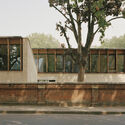
At a time when sustainability is high on the agenda and construction costs continue to soar, many Cambridge residents are questioning a proposal to demolish a sound and respected school building to replace it with a new school one that will strive to be a “green facility”. The Martin Luther King Elementary School (1968-1971) was designed by Catalan architect Josep Lluis Sert (Sert, Jackson and Associate). As it stands today, the school compliments the many other buildings in Cambridge that Sert worked on while also teaching at Harvard University, including the Peabody Terrace Graduate Housing complex just across the street.
Read on to find out what the community is doing to save the building from demolition and why it can prove to be a more sustainable option for the city.
‘Latest Works’ Lecture by Manuel Aires Mateus at MIT

Manuel Aires Mateus of Aires Mateus e Associados will be giving a lecture at MIT featuring ‘Latest Works’. The projects of Aires Mateus e Associados are characterised by materiality, mass and an essential muteness or quietness. The Paulo Gomes Archeological Center, Casa Areia and Furnas Monitoring and Investigation Centre are perhaps the most elemental and representative of their projects, seeming to draw power from the connection or contrast with nature.
Situated at the archaeological site of Crasto Lofts, the Paulo Gomes Archeological Center features an exhibition area defined as the liminal space between a concrete and glass skin and the exposed cliff side. (Australian Institute of Architects).The event, which is free and open to the public, takes place Thursday, May 3rd at 6:30pm at MIT Building 10, room 250. For more information, please visit here.
‘Elemental Recent Projects: Monoliths and Trees’ Lecture by Alejandro Aravena at MIT

Alejandro Aravena, based in Santiago de Chile, will be giving a lecture at MIT on the theme of ‘Elemental Recent Projects: Monoliths and Trees’. After the 8.8 earthquake and tsunami that hit Chile in 2010, they have worked in the reconstruction by proposing a mitigation forest as the main infrastructural work, but also dealing with housing, public buildings, productive activities and transportation. In 2011 they were called to perform a similar redesign of an entire city in the Atacama desert, where the Chilean Copper Company, Codelco, commissioned them to intervene at the whole scale of Calama where they are proposing an oasis.
They have been also working in different buildings like the Angelini Innovation Center in Chile and the Mirador del Diablo in Mexico where architecture has become rather monolithic. The event, which is free and open to the public, takes place Thursday, April 19th at 6:30pm at MIT Building 10, room 250. For more information, please visit here.
‘Evolved to Fit: Biomimicry in the Built World’ Lecture by Janine Benyus at MIT

Janine Benyus, president of the Biomimicry 3.8 Institute in Missoula, MT, will be giving a lecture at MIT on the theme of ‘Evolved to Fit: Biomimicry in the Built Word’. Janine Benyus is a natural sciences writer, innovation consultant, and author of six books, including her latest − Biomimicry: Innovation Inspired by Nature. In Biomimicry, she names an emerging discipline that seeks sustainable solutions by emulating nature’s designs and processes (e.g., solar cells that mimic leaves, agriculture that models a prairie, businesses that run like redwood forests). The event, which is free and open to the public, takes place Thursday, April 5th at 6:30pm at MIT Building 10, room 250. For more information, please visit here.
Shortlist announced for the North West Cambridge extension

In order to compete in an increasingly competitive global market and address long-term development needs, the University of Cambridge is undertaking an ambitious new urban extension in North West Cambridge. The master plan for the development, prepared by Aecom, lays out the framework for a new district centered on a mixed academic and urban community. With aspirations of achieving place that is well balanced, long-lasting and sustainable, the University is focused on creating a high quality of life for its residents that will enhance both the City and the University.
The University is now looking to appoint a number of architecture and landscape firms to design and deliver each proposed lot as part of the first phase of the extension. The shortlist consists of internationally renowned architects, including Bjarke Ingels Group and David Chipperfield Architects. Continue reading to learn more information on the extension and review the complete shortlist.
‘REACH: The Architecture of The Freelon Group’ Exhibition

The Massachusetts Institute of Technology School of Architecture + Planning will showcase the architecture of The Freelon Group in an art exhibition opening February 15th at the Wolk Gallery at MIT. The exhibit, which runs through April 13th, includes ten projects designed by the Freelon Group, plus a table from the furniture collection designed by founder Philip Freelon. Featured projects include museums, university buildings, libraries and an airport parking structure (we’ve published a few you can see here. And don’t miss our interview with Philip Freelon). More information on the event after the break.
South American Project: Hinterland Urbanisms Symposium

The Hinterland Urbanisms Symposium, curated by Felipe Correa of Somatic Collaborative, Assistant Professor of Urban Design and Ana Maria Duran, Loeb Fellow ’11, looks at the Initiative for the Integration of Regional Infrastructure in South America (IIRSA) as a point of departure for an ample discussion regarding the diverse models of urbanism that emerge at the intersection of resource extraction and regional integration projects (primarily through mobility corridors).
The symposium takes place October 7th and 8th at Harvard University Graduate School of Design. More information on the event after the break.
Sainsbury Laboratory / Stanton Williams

Architect: Stanton Williams
Location: Cambridge, United Kingdom
Client: The University of Cambridge
Main Contractor: Kier Regional
Civil and Structural Engineer: Adams Kara Taylor
Building Services Engineer: Arup
Landscape Architects: Christopher Bradley-Hole Landscape and Schoenaich Landscape Architects
Project Area: 11,000 sqm
Project Year: 2010
Photographs: Hufton+Crow
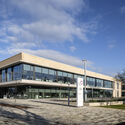
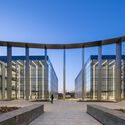
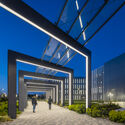
Cambridge University Botanic Garden was conceived in 1831 by Charles Darwin’s guide and mentor, Professor Henslow, as a working research tool in which the diversity of plant species would be systematically ordered and catalogued. Completed in December 2010, the Sainsbury Laboratory develops Henslow’s agenda in seeking to advance understanding of how this diversity comes about. Its design was therefore shaped by the intention that the Laboratory’s architecture would express its integral relationship with the Garden beyond.
Riverside Park Pavilion / Touloukian Touloukian Inc.

Architects: Touloukian Touloukian Inc.
Location: Cambridge, Massachusetts, USA
Client: James Wilcox
Structural Engineer: Richmond So
Landscape Architect: Bob Uhlig
General Contractor: Dave Quirk
Photographs: Ed Wonsek
Graduate Accommodation at Clare Hall College / Cowper Griffith Architects

Architects: Cowper Griffith Architects
Location: Cambridge, United Kingdom
Design Team: Ramboll UK, Max Fordham LLP, Gardiner & Theobald
Contractor: Kier Marriott
Project Year: 2010
Photographs: Peter Cook
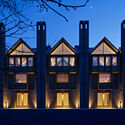
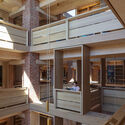
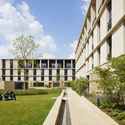
The Salje building at Clare Hall in Cambridge is named after the former college president Eckhard Salje, who spent a significant amount of his presidency travelling the Far East and raising funds for an ‘International Study and Research Centre’. The new Salje building provides accommodation for visiting fellows from South Korean, Japanese and Chinese Universities, who contributed to the fundraising, for this new college accommodation.
Hairy House / Ashworth Parkes Architects

Architects: Ashworth Parkes Architects
Location: Auckland Road, Cambridge, England
Project area: 130 sqm
Project year: 2008 – 2009
Photographs: Mel Yates, Ashworth Parkes Architects
ICEWALL / Yushiro Okamoto

As a part of MIT’s 150th anniversary celebration, a student competition was held for a installation to become part of the festivities. Yushiro Okamoto‘s winning proposal, ICEWALL, has recently been completed and has been submitted to share with us here at ArchDaily. Follow after the break to browse through a large collection of photographs of the project.
Archiprix International 2011
Archiprix International is an international design competition, displaying the work of the world’s best graduates in architecture, urban design, and landscape architecture!
Organized by the Archiprix Foundation, the 2011 host of MIT in conjunction with the Platform for Permanent Modernity, and sponsored by Hunter Douglas, Archiprix International invites schools to nominate their best graduation project of the past year and submit that project for consideration in the competition, as well as participate in a series of workshops and debates revolving around the topics critical to architectural discourse today.
All participating schools must register their best graduation project by August 1st, 2010 at the online registration site. For more information visit the competition’s official website.