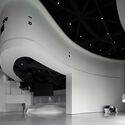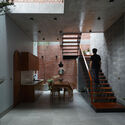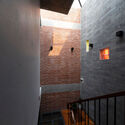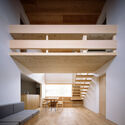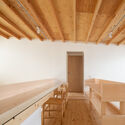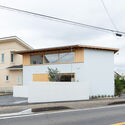
Hotlinks, duplex house for Make It Right / Atelier Hitoshi Abe
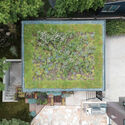
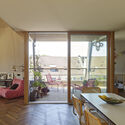
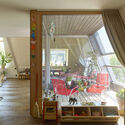
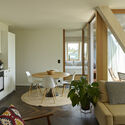
Atelier Hitoshi Abe shared with us their duplex house for the new phase of the Make It Right project we presented earlier. A renovated version of a shotgun house, the Hotlinks project offers several configurations depending on the client´s needs as described on the architect´s description and diagrams after the break:
Brad Pitt’s Make It Right presents duplex homes for NOLA

William McDonough + Partners duplex home for Make It Right
Brad Pitt´s Make It Right Foundation has been working with a group of international architects to redevelop the Lower 9th Ward in New Orleans, after hurricane Katrina. The name of the foundation addresses the desire of Pitt, architecture enthusiast, to design these houses the best way and not just as a temporary solution, in a process that also included working not only with these renowned firms, but also very close with the community, with a focus on sustainable development.
The designs are referential, and each client (as the houses aren´t “free”, yet they use existing finance ways and low interest loans) can pick a design, which is then adjusted by local firm John C. Williams Architects to suite the client´s needs.
A first phase included single family homes, designed by practices such as Kieran Timberlake, Shigeru Ban, Morphosis, MVRDV and Trahan Architects. As of now 8 houses have been built, and more than 10 houses are already on construction or in the permit process.
Make It Right has recently unveiled a second phase with 14 duplex homes to accommodate up to 2 families, which include a site-specific sustainable strategy and flexible plans for future family growth. But also, the practices were required to meet integration with the street and the use of landscaping as a design and energy element.
The result? The 14 duplex homes after the break:
1028 Natoma Street / Stanley Saitowitz | Natoma Architects
Architects: Stanley Saitowitz | Natoma Architects
Location: San Francisco, CA, USA
Project year: 2004-2005
Photographs: Natoma Architects
Cascade House / Paul Raff Studio
Nestled among the Forest Hill neighborhood in Toronto, Paul Raff Studio‘s latest sustainable residence is “a marriage of environmentally responsible building strategies and elegant architectural composition.” The 353m2 residence, entitled the Cascade House, is designed in an I-formation around an outdoor swimming pool and offers a high quality of aesthetics in addition to environmentally friendly strategies.
More about the home after the break.
Fray Leon house / 57 STUDIO
Architect: 57 STUDIO – Maurizio Angelini / Benjamín Oportot
Location: Santiago, Chile
Collaborator: Felipe Zamora
Project year: 2006–2007
Construction year: 2007–2008
Structural Engineer: Claudio Hinojosa
Construction: Jorge Carrasco
Materials: Concrete / Steel / Travertine Marble
Photographs: 57 STUDIO
Western Red Cedar Architectural Design awards winners announced
The Western Red Cedar Lumber Association recently announced the winners for the 2008 Western Red Cedar Architectural Design awards.
The winners were chosen by a panel of esteemed architects, and the results were announced at the AIA 2009 National Convention in San Francisco.
The complete list of winners after the break.
Crystal Clear / C.F.Møller Architects + Kristin Jarmund Arkitekter
C. F. Møller Architects, in collaboration with Kristin Jarmund Arkitekter, have won a major competition to design a new landmark for Oslo. Their project, entitled Crystal Clear, consists of three towers, which are composed of stacked, prismatic volumes that will provide a dynamic new addition to the city’s skyline.
More about the towers after the break.
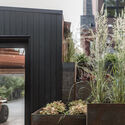
Petit Bayle / Meld Architecture
Architects: Meld Architecture
Location: Garone, France
Client: Private
Structural Engineer: Arup (for schematic design, Contractor’s in-house for detail design)
Services engineer: Contractor’s in-house
Main Contractor: Arpose le Grand
Window sub-contractor: Duforet
Solar heating: Sarl Bedouret
Project Year: 2007
Gross external floor area: 265sqm
Total Cost: € 280,000
Photographs: Tim Crocker
New College Student Residence / Saucier + Perrotte architectes
Architects: Saucier + Perrotte architectes
Location: Toronto, Ontario, Canada
Program: Student Residences (277 beds, related functions, meeting spaces & sport room)
Constructed Area: 11,000 sqm
Project year: 2003
Photographs: Marc Cramer, Michael Awad & Saucier + Perrotte
Media Pavillion / Moho Arquitectos + Carlos Abadía Sánchez

Architects: Moho Arquitectos + Carlos Abadía Sánchez
Location: Campus UMH. Elche, Spain
Architect in Charge: Álvaro Abadía Sánchez
Construction: Villegas
Client: Miguel Hernandez University
Budget: $443,580.16 €
Project year: May 2007
Project Area: 395 sqm
Photography: David Frutos
Walking Berlin / Fantastic Norway
Our friends from Fantastic Norway shared with us their project, “Walking Berlin”, an event created as part of their exhibition at the DMY International Design Festival 09 in Germany.
The walking houses are man-sized models of their latest architectural project: a tourist destination located on the northern west coast of Norway. As the project depends on the idea of travelling, they decided it was only fair that the houses got to do some travelling too!
The project consists of a group of narrow high-rise modules welcoming the guests of the Norwegian west coast. The systematic and flexible module-system allows the outdoor spaces, the miniature high-rise modules and the interiors to be designed in collaboration with the future inhabitants and selected artists.
More images after the break.
Compromises for the Guggenheim
It seems fitting that since the Guggenheim is currently featuring the works of its designer, Frank Lloyd Wright, we should feature some of the process work of the iconic museum. Well known for its white curving form, it is important to note that the current rendition of the museum is vastly different from Wright’s original ideas. The struggle between the architect and the client (in this case Solomon R. Guggenheim, a wealthy mining entrepreneur) to see eye-to-eye is not something new, however it is interesting to consider whether the renowned museum would still have its status if it were as Wright had originally envisioned: a polygonal structure, partly in blue or perhaps a red-marble structure with long-slim pottery red bricks.
More about the Guggenheim after the break.
Bextra / PROJEKTSTUDIO
Architects: PROJEKTSTUDIO, ing.arch. David Kotek
Location: Ostrava, Czech Republic
Consultant: Hutní projekt Ostrava a.s.
Constructed Area: 2,200 sqm
Project year: 2006
Photographs: PROJEKTSTUDIO
Red+Housing / OBRA Architects

Our friends from OBRA Architects shared with us their project Red+Housing, an emergency housing prototype commissioned as part of CROSSING: Emergency Dialogues for Architecture to acknowledge the anniversary of the Sichuan earthquake, exhibition held at the National Art Museum of China. More images and architect’s description after the break.
Site One / Elenberg Fraser
Architects: Elenberg Fraser Architecture
Location: Melbourne, Victoria, Australia
Project Management: Baracon
Civil Engineering: Reeds Consulting
Structural Engineering: Robert Bird & Partners
Services Engineering: Norman Disney & Young
Building Surveyor: Garden Group
Fire Engineer: Umow Lai & Associates
Acoustic Engineering: Marshall Day
Wind Engineering: Mel Consultants
Environmental Engineering: ERM
Quantity Surveyors: Slattery Australia
Land Surveyor: Reeds Australia
Geotechnical Engineering: Golders Associates
Project year: 2007
Client: Pan Urban
Photographs: Tony Miller
Zhuhai Opera House / SPF architects
SPF Architects, based in Culver City, California, have created an design for the Zhuhai Opera House in Guangdong Province, China. Learning from the traditional principles of the region, the opera house’s form gives the appearance of stacked pebbles. Such an idea was conceived as a way to create a visual balance based on the Chinese principle from the five element theory. The opera house has three stacked levels that provide varying programmatic activities, such as a 1500 seat auditorium, large plaza gathering space, rehearsal hall, restaurants and other public amenities. A forest behind the structure gives the impression of growth and sustainability.
More images after the break.
Volume #19

In times of crisis, hope is what we need. And hope is what the latest issue of Volume magazine explores under the title “Architecture of Hope”.
Once again, Arjen Oosterman writes a short yet provocative editorial, starting by why they choose to only use black&white images on this issue. He brings back the subject of the welfare society during post-War, and compares the european and american models of sprawl/density which are key aspects of current crisis.
And since hope is the word of the day, “Yes we can” is also mentioned on the editorial and other articles related to Obama.
More about this issue after the break.
Erika Mann Elementary School / Die Baupiloten
Architects: Die Baupiloten
Location: Berlin, Germany
Client: Stattbau Berlin – Stadtentwicklungsgesellschaft mbH
Project Team: Maximilian Assfalg, Ania Busiakiewicz, Andrea Ceaser, Fee Kyriakopoulos, Ansgar Schmitter, Irmtraut Schulze, Thilo Reich, Wojciech Wojakowski
Sponsors: Baustoffhandel Mammitzsch, Eternit, Eurostahl, Follenius und Martin Tischlerei, GLS Bank Bochum, Firma Transresch, Bristol Kempinski Hotelkette, Essensanbieter Luna and Ridi Leuchten
Project year: 2006-2007
Photographs: Jan Bitter
Beachcroft Orth Residence / Andrew Maynard Architects
Andrew Maynard Architects present this residential alteration and extension to an existing double fronted weatherboard house in Melbourne, Australia. The brief required 2 bathrooms, a bedroom, living area, kitchen and increased connection with outside areas.
Royal Elephant Pavilion Competition / Visiondivision
Visiondivision shared with us their design for the Royal Elephant Pavilion which was rewarded an honorable mention in a not so ordinary competition. Recently, the Swedish King Carl XVI Gustav received two female elephants from the King and Queen of Thailand as a way to express their gratitude for the creation of a Buddhist pavilion in the north of Sweden. Stemming from this event, a competition was created to design the facilities for the two elephants.
More about the Elephant Pavilion after the break.