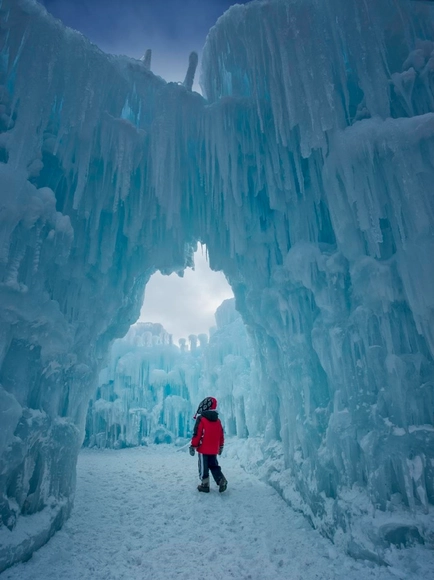
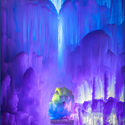
Coming off of a weekend of brutally cold temperatures in the Northeastern United States, the praising of ice might strike some as disagreeable. But seeing the aqueous creations of the Utah based Ice Castles makes a persuasive case for enduring winter’s wrath. Using a patented system, the company designs ice constructions formed through an additive process in which a substructure of icicle lattices are sprayed with liquid water, resulting in grand formations with the appearance of stalactites or sublimating gases frozen in time.
Seasonally, in four cold-climate locations in North America, the company creates castles of varying sizes that are built over the course of three to four weeks and maintained for approximately six to eight weeks thereafter. What may seem like a simple activity – after all, it’s just ice and water – is actually a complex orchestration, not unlike more traditional architecture, which involves the careful consideration of a number of strategic and site-specific factors.
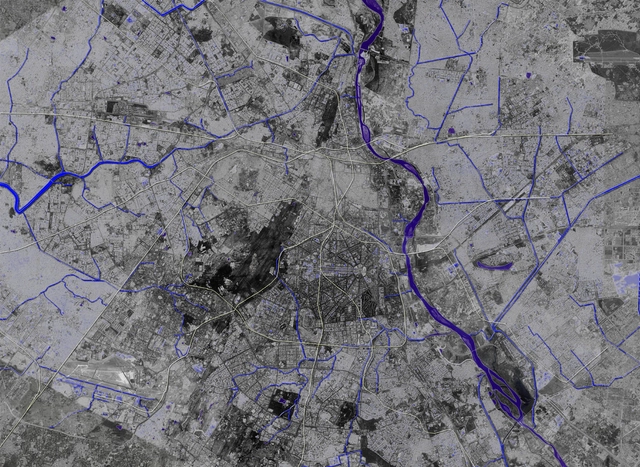
Map of Delhi's nullah network. Image Courtesy of Morphogenesis
The city of Delhi has a transportation problem. The streets are crowded and dangerous, and with 1,100 new vehicles being added to the roads each day the city is suffering from the consequences. Last year, New Delhi was rated the most polluted city in the world by the World Health Organization, with nearly 3 times the particulate matter of Beijing. Noise levels throughout the city consistently exceed regulations set by the Indian Central Pollution Control Board, and heavy traffic means increased travel times and perilous pedestrian conditions. Even walking the last mile from a bus stop to a destination has become a game of chance.
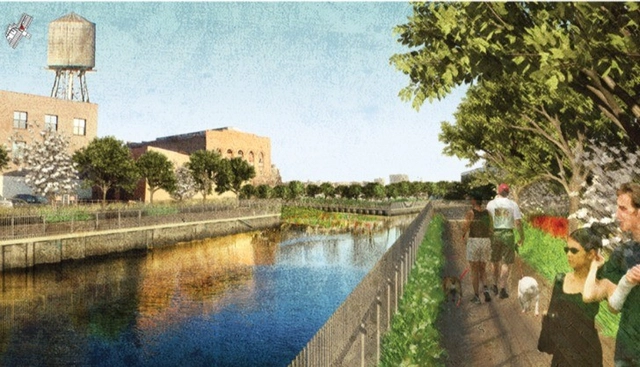
At the same time, the river upon which the city was founded, the Yamuna (a main tributary of the Ganges), has been polluted to the point where it has become little more than a glorified sewer drain. Illegal settlements without sewage systems pollute the river directly, and even within the regulated systems, 17 sewage drains empty directly into the Yamuna. For a city already struggling with water shortages, polluting a main water source is akin to throwing salt into a wound. However, a proposal by Dehli-based Morphogenesis Architects attempts to tackle all of these issues through the revitalization of the river and its canals, known as nullahs.
Los Angeles, as we know it today, was made possible by massive infrastructure projects that provide reliable sources of water to the otherwise semi-arid region. The mastermind behind many of these infrastructure projects in the early twentieth century was William Mulholland, the self-taught engineer who rose through the ranks to become the Chief Engineer and General Manager of the Bureau of Water Works and Supply (the precursor to today’s Los Angeles Department of Water and Power). Mulholland is most commonly remembered for the construction of the Los Angeles Aqueduct, which piped water to the city from the Owens Valley, over 200 miles away. But Owens Lake was drying up faster than expected, and the aqueduct was threatened by both earthquakes and sabotage from angry landowners and farmers in the Owens Valley who orchestrated dynamite attacks on the waterway, in what became known as the California Water Wars.
Mulholland needed a backup plan, so he turned to building reservoirs, most of which still function to this day. Tom Scott’s video above tells the story of how one of those reservoirs, and the failure of the dam that held it back, shaped the development of Los Angeles itself. When the St. Francis Dam collapsed in 1928 the ensuing rush of water killed at least 450 people (though some estimate the total is closer to 600), destroyed 1,200 homes, forever altered the reputations of Mulholland and the city’s water infrastructure, and ultimately cemented the boundaries of the city and its neighbors.
Reactive materials hold huge potential for architects and engineers in the near future, offering forms of interactive and customizable construction that could, if used properly, seriously alter the way in which people interact with their built environment. The massive expansion in the capabilities of touch screens and other glass based technologies have opened up user interfaces to levels where interactive cityscapes are becoming reachable - but creating materials which are themselves reactive is a much less-explored solution. Water Reaction, a project by Royal College of Art student Chao Chen, is an attempt at exactly that: creating a material that reacts to external conditions with no human input required.
This week COSMO begun its venture to filter more than 42,000 gallons of New York Citywater during the course of MoMA PS1's Summer Warm Up series. The 16th installation built as part of the annual Young Architect's Program (YAP), COSMO is a portable water purifier designed by Andrés Jaque / Office for Political Innovation to combat the world's clean water crisis while serving an animated backdrop to PS1's party atmosphere.
London's central waterway, the River Thames, has been a site of enormous interest from architects and urbanists in previous years. From a controversial garden bridge to discussions about how to appropriate what has been described as one of the city's largest untapped public spaces, London-based practice studio octopihave now launched a Kickstarter campaign to help to realise their dream of creating "a new, natural, beautiful lido" on its banks.
Endorsed by a number of renowned and respected Londoners, including Turner-prize winning artist Tracey Emin, architect Ivan Harbour (RSHP), and Tim Marlow, a director at the Royal Academy of Arts (RA), the ambition is to raise at least £125,000 (around $190,000 or €175,000) in order to seek planning permission for the Thames Baths project.
Find out more about the project and how you can support it after the break.
Among the many complex interactions between humans and water in the Ganges river basin, perhaps none is more awe-inspiring than the religious festival of Kumbh Mela, which every twelve years hosts the largest single-purpose gathering of people on the planet, with an estimated 2 million temporary residents and 100 million total visitors in 2013. In the following excerpt from his book "Ganges Water Machine: Designing New India's Ancient River," Anthony Acciavatti recounts the history of this spectacular event, as well as the smaller annual Magh Mela - and explains why even though it is temporary, the huge tent settlement that supports these festivals is not the "instant city" it is often described as, but instead a microcosm of settlement patterns across the whole Ganges.
Dangling at the tip of the Ganga-Jamuna Doab, where the Lower Ganges Canal system terminates, the city of Allahabad overlooks the confluence of the Ganges and Jamuna rivers. While the Jamuna, to the south of the city, runs deep and narrow, the Ganges, to the north and east of the city, runs shallow and wide. Where these two rivers meet (and a third mythical river, the Saraswati), is known as the Triveni or Sangam, the most sacred site within Hinduism.
Every twelfth year, the sleepy university city of Allahabad is transformed into a colossal tent city populated by millions of pilgrims for the Kumbh Mela (literally Pitcher Celebration). And it all seems to happen so fast. After the deluge of the southwest monsoon (June-August), the waters of the Ganges and Jamuna slowly start to recede. A city grid is tattooed into the banks and shoals of the Ganges. Tents and temples pop up in October. Pontoon bridges stretch from one bank of the river to the other and pilgrims begin to arrive in January. Then come reporters and camera crews from all over the world, who come to document the life of what must at first appear to be the world’s largest Instant-Mega-City: a temporary tent city with the major infrastructure of a metropolis.
Few geographies in the world nurture such a rich and complex imaginary as the Ganges River Valley. The heart of Indian Culture, and home to over one quarter of India’s population, the Ganges is one of the most fertile and infrastructure-heavy river valleys in the planet. Its many physical, historical and spiritual natures defy a single interpretation: always in flux, source of life and destruction, and venerated as a Hindu Deity, the Ganges fully embodies the complexities and excesses of the Indian Civilization.
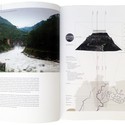
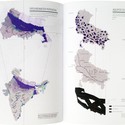
In “Ganges Water Machine: Designing New India’s Ancient River,” Anthony Acciavatti orchestrates a magnificent portrait of the Ganges River Basin, and its continuous reinvention as a test-bed for infrastructural innovation. Through the hybrid genre of the Atlas-Almanac-Travelogue, the book unfolds the many nested spatial and temporal scales that characterize this highly contested territory. Those captivated with the planetary urbanization of water will find in this book a timely and relevant volume of encyclopedic ambition and exquisite design.
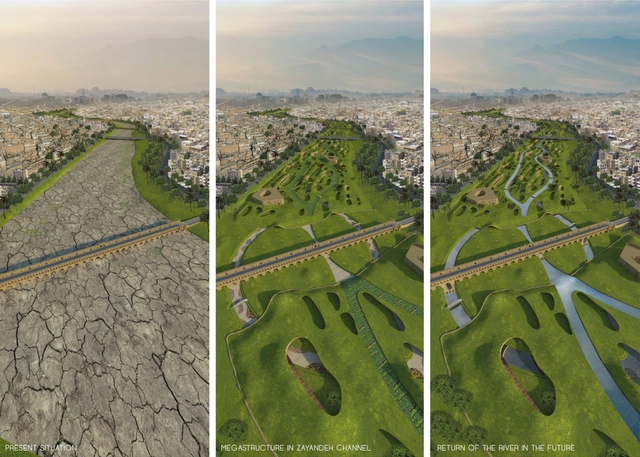
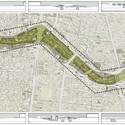
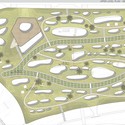
For generations, nature has been held up as something to respect, to take inspiration from, to place at the center of architecture. Few new designs today are complete without some visualized parkland or tree placed implausibly high up on the latest visionary high rise development. But what do you do when nature ups and leaves? How can architecture respond? That’s the question that Mateusz Pospiech’s master’s thesis, completed at the Silesian University of Technology, attempts to answer by taking the severe example of the disappearance of Iran’s Zayanderud River and proposing the equally incredible solution: an enormous, six-kilometer-long ecologically sustainable megastructure along the dried riverbed, healing the scar both in the landscape and in the minds of Iranians.
The Latrobe Prize, named for architect Benjamin Henry Latrobe, is awarded biennially by the AIA College of Fellows for a two-year program of research leading to significant advances in the architecture profession. The $100,000 award will enable the Arid Lands Institute (ALI) and its cross-disciplinary partners to further develop and test a proprietary digital design tool, known as “Hazel,” that eventually will enable arid communities anywhere to design and build the infrastructure needed to capture, retain and distribute stormwater runoff.
Water scarcity is a profound challenge for designers of the built environment. Beyond looking for water sources and creating sustainable ecosystems, how can we begin to create cities and buildings that will help us to celebrate and mitigate hydro-logical concerns? Hadley and Peter Arnold, co-directors of the Arid Land Institute (ALI) at Woodbury University, have decided to tackle this problem around Los Angeles. With the support of the World Water Forum and the Metropolitan Water District of Southern California, they recently developed a high-resolution geospatial model to strategically identify and quantify the potential for improving storm water capture within urban areas.
One of the United States’ most polluted bodies of water is about to receive a much needed make-over: In early 2014, construction will begin on a pollution-preventing greenscape that will run alongside Brooklyn’s Gowanus Canal. The proposal, dubbed Sponge Park, was envisioned more than five years ago by Susannah Drake of dlandstudioand has just now “soaked up” enough funds to move forward.
Videos
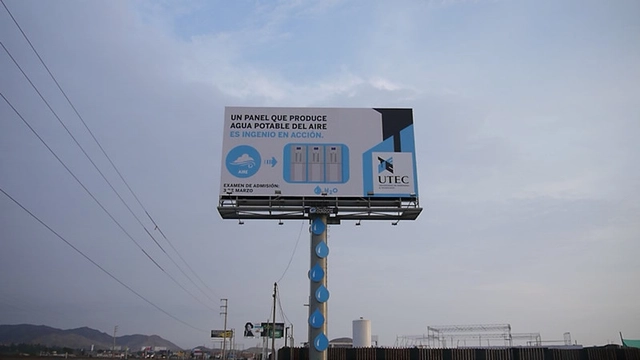
The billboard reads "A panel that produces potable water out of air is ingenuity in action." Courtesy of UTEC.
According to the UN, about 60% of the world's population will be living in cities within the next 8 years - a human migration that adds more and more strain on cities' sanitation and resources. One of these many urban centers is Lima, Peru, the second largest desert capital in the world that receives less than 2 inches of rain a year. Despite its nearly nonexistent rainfall, Peru has some of the highest atmospheric humidity anywhere - 98%.
The University of Engineering and Technology of Peru (UTEC) and an ad agency called Mayo DraftFCBand saw great opportunity in this invisible source of water and created a billboard that can capture this humidity and turn it into potable drinking water for nearby residents.
Which cities are embracing the green revolution? This infographic compares the efforts of six leading cities - New York, Vancouver, Copenhagen, London, Amsterdam and Stockholm - in the race to drastically reduce global C02 emissions. Based predominantly on 2009 statistics, Stockholm seems to be leading the way in carbon reduction. Continue reading after the break to see who claims the blue ribbon for renewable energy, efficient water consumption and rigorous recycling.
In celebration of World Water Day, we have complied a list of ten environmentally conscious designs that epitomize the importance of water conservation. See what they have to offer, after the break.
Who will run the world for the next 100 years? Envision Solar President and CEO Desmond Wheatley argues that it will be whoever has abundant sources of power. That is constructive power, rather than destructive power, which is essential to run the information and technology industries that our world is entirely dependent on. Additionally, Wheatley states that energy equals water. And, with less than 1% of the world’s fresh water available for use, desalination is becoming an increasingly plausible solution. The only problem now is that energy is expensive. But, once cities have the will to switch over to renewables, that will no longer be an issue. Could you imagine San Diego as an net exporter of water? Desmond Wheatley can.





.jpg?1436251994 "An artificial pinecone proof of concept. Image © Chao Chen")
.jpg?1436252280 "The reactive surface when open. Image © Chao Chen")
.jpg?1436252336 "The reactive canopy when dry. Image © Chao Chen")
.jpg?1436252378 "The reactive canopy when wet. Image © Chao Chen")
.jpg?1436252280)


.jpg?1429623147&format=webp&width=640&height=580)







.jpg?1428000940&format=webp&width=640&height=580)