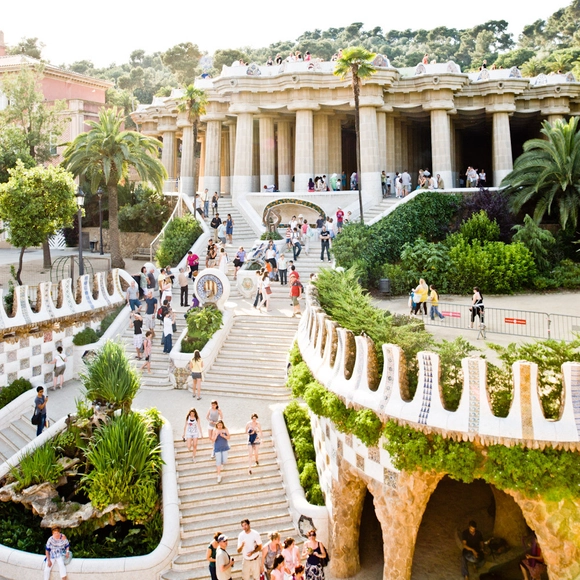
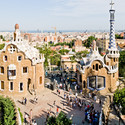
Parc Güell is a park designed by Antoni Gaudí upon the request of Count Eusebi Güell, who wanted to build a stylish park for the aristocrats of Barcelona. The Count had planned to build a housing development that would take advantage of the area's views and fresh air; however, only two show houses were completed. Gaudí himself inhabited one of them, designed by architect Francesc Berenguer in 1904. The house is now a museum showcasing some of Gaudí's work. The park is a common tourist attraction in Barcelona, and is known for its famous terrace and iconic entrance, flanked by two Gaudí buildings.
Constituting the northern portion of the planned ‘Future Square’ in the rapidly developing Airport District of Zhengzhou, China, Atelier of Urban Architecture (AUA)‘s design is an iconic addition to the area. The proposed urban planning exhibition centre and associated landscape consists of various programs that are organized on the folding floor slabs, bringing visitors around the centre piece of the exhibition – the physical model, which itself is positioned within a sunken space on ground level. More images and architects’ description after the break.
Global architecture underwent a seismic shift in the 20th Century. Governments, keen to mitigate the impoverishing effects of rapid urbanization and two world wars embarked on ambitious social housing programs, pairing with modernists who promised that design could be the solution to social inequality and poverty. Today, the problems inherent in these mid-century tower blocks are well documented and well known, and these modernist solutions to poverty are often seen as ill-conceived failures.
If the 20th century was all about designing to solve social problems, then the 21st century has been about the exact opposite – not designing to solve social problems. These days, it is much more common to see architects praising the social order and even aesthetic of illegal slums, which in many cases provide their residents with a stronger community and higher quality of life than did many formal social housing projects of the past. The task of architects (both today's and tomorrow's) is to develop this construction logic: to use design and, rather counter-intuitively, non-design to lift these urban residents out of their impoverished conditions.
More on the social potential of non-design after the break...
Think the best way to promote the economic and creative development of a city is to build stadiums and and shopping malls? Think again. In a recent article in the New York Times, Steve Lohr reveals the findings of a study from the Brookings Institution that looks into where and why specific cities emerge as hubs of creativity and innovation. By studying the patent filings of the United States' 370 metropolitan areas, the study revealed that cities with the most innovation were centers of education and research. San Jose-Sunnyvale-Santa Clara, California; Burlington-South Burlington, Vermont.; Rochester, Minnesota; Corvallis, Oregon; and Boulder, Colorado topped the list as the "output of innovation. Lohr suggests that this data can help promote policies that encourage urban development for economic feedback.
New York-based SCAPE/Landscape Architecture has beat out 4 national/international firms, including JDS Architects, to design a Masterplan for the Town Branch Commons, a two-mile linear stretch of green space that will connect the eastern and western sections of downtown Lexington, Kentucky. The Competition has garnered attention for its interesting challenge: to bring the Town Branch Creek, a river which has been underground for over 100 years, to the surface.
Jeff Fugate, President and COO of the Lexington Downtown Development Authority, which sponsored the competition, noted that “The [five-person] jury had five excellent choices, but SCAPE clearly was above the competition.” Aaron Betsky, the director of the Cincinnati Art Museum and the jury chairman also explained the choice: “As a jury, we felt inspired and excited by the breath of the designers’ vision, while we felt confident that they would be able to implement their plan."
Kate Orff, founder of SCAPE, notes that the firm is looking forward to working with the community to make the vision a reality: “SCAPE is so thrilled to be a part of this exciting initiative to revive Town Branch, make new connections downtown, and improve the quality of life in Lexington. We’ve been inspired by the realities and conditions on the ground and by the potential of water to inform the design of new urban landscapes.”
Find out more about the Masterplan, after the break...
Walkability, density, and mixed-use have become key terms in the conversation about designing our cities to promote healthy lifestyles. In an interview with behavioral psychologist, Dr. James Sallis of the University of California San Diego in The Globe and Mail, Sallis discusses how his research reveals key design elements that encourage physical activity. In the 20th century, the automobile and new ideals in urban planning radically changed the way in which cities were structured. Residential and commercial areas were divided and highways were built to criss-cross between them. Suburban sprawl rescued city dwellers from dense urban environments that had gained a reputation for being polluted and dangerous. In recent decades, planners, policy makers and environmentalists have noted how these seemingly healthy expansions have had an adverse affect on our personal health and the health of our built environment. Today, the conversation is heavily structured around how welcoming density, diversity and physical activity can help ameliorate the negative affects that decades of mid-century planning have had on health. Sallis describes how much of a psychological feat it is to change the adverse habits that have developed over the years and how design, in particular, can help encourage the change.
Karakusevic Carson and David Chipperfield have been announced as the “preferred bidder” for a pair of residential towers the East London district of Shoreditch. As reported on BDOnline, the £25 million project at Colville Estate will rise up to 14 and 20 stories high to replace the existing 1950‘s low-rise buildings. This will be the second and last phase of the largest council-backed housing development in London and the first UK mass housing project for Chipperfield.
Witteveen+Bos, OKRA, and ZJA have recently won the integral design for the Jaarbeursplein Utrecht and the underground parking. Their vision focuses on the realization of the perfect parking concept, with a comfortable, lively, and socially safe city square on top of it. Forming the face of the new Utrecht, their vital and highly dynamic proposal becomes a place where inhabitants and visitors can have a taste of the new city. More images and architects’ description after the break.
The bursting of the housing bubble wreaked havoc on cities across the United States causing widespread blight in once-thriving community economies. Foreclosed, abandoned and condemned homes continue to pockmark neighborhoods and communities, adding to the vacant lots of populous but affected cities like Philadelphia. The Mayor's Office of Philadelphiaapproximates that there are nearly 40,000 vacant lots throughout the city of brotherly love, about 74% of which are privately owned, making them virtually inaccessible to rehabilitation. But the city has a strong drive to amend these conditions. With organizations like DesignPhiladelphia's "Not a Vacant Lot"and the city's Redevelopment Authority, some of this land is being put to good use.
Slums, shanty-towns, favelas - they are all products of an exploding migration from rural to urban areas. Over the last half century, people living in or near metropolises has risen in proportion to the global population. Migrations from rural areas to urban areas have grown exponentially as cities have developed into hubs of economic activity and job growth promising new opportunities for social mobility and education. Yet, with all these perceptions holding fast, many people who choose to migrate find themselves in the difficult circumstances of integrating into an environment without the proper resources to accommodate the growing population. Cities, for example, like Mumbai, India's largest city and 11th on the list as of 2012 with a population of an estimated 20.5 million. According to a New York Times article from 2011, about 60% of that number live in the makeshift dwellings that now occupy lucrative land for Mumbai's developers.
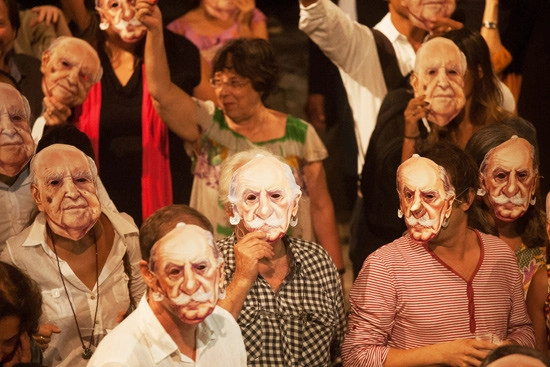
Wearing masks with the faces of Oscar Niemeyer and Lúcio Costa, architects and urban planners swarmed the 50th Annual IAB (Institute of Architects of Brazil) Awards in Rio de Janeiro this week. The architects were protesting a contract the city government of Brasilia struck with a Singaporean firm to create an urban masterplan outlining the next 50 years of Brasilia's future.
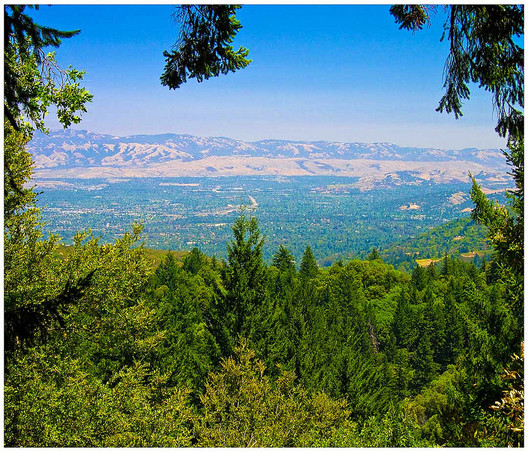
As most New Yorkers know, people are willing to shell out a hefty sum to live in a place where work and play are right around the corner from each other. But as the article by Ken Layne in The Awl points out, the west coast is a somewhat different place. UNLIKE New York City, which is crowded with restaurants, bars, and entertainment, as well as offices, design firms and businesses; Silicon Valley, which caters to programmers and tech companies that hire at $100k a year, offers few of the amenities that a nearby town like San Francisco does. So, Layne concludes, residents are willing to spend hours of their day making their way into the fortressed office parks of Silicon Valley, flanked by parking lots and boulevards, just to have a cultural reprieve to call home.
When plans for the High Line were first revealed it made quite an impression on the design community. The converted elevated rail line, long abandoned by New York City, was threatened by demolition until a group of activists fought for its revival and helped transform it into one of the most renowned public spaces in Manhattan. Now Queens, a borough with its own abandoned infrastructure is on its way to redeveloping the land for its own version of the High Line, to be known as the Queensway Cultural Gateway.
In late December, the Trust for Public Land announced that New York Governor Andrew Cuomo has awarded a $467,000 grant to the organization to begin a feasibility study on the 3.5 mile Long Island rail line. Early proposals reveal a new pedestrian and bike path, public green space and a cultural gateway that will celebrate Queens’ diversity in art, sculpture and food, serving the 250,000 residents that live in the neighborhoods along the route, which include Rego Park, Forest Hills, Richmond Hill, Ozone Park and Forest Park.
In Bangladesh, where rising sea levels are having profound effects on the landscape, one nonprofit organization called Shidhulai Swanirvar Sangstha run by architect Mohammed Rezwan is fighting back by adapting, a true quality of resilience. Rising water levels and the tumultuous climate is displacing people by the thousands; a projected 20% of Bangladesh is expected to be covered in water within twenty years. For a country that is one of the densest populated state on the planet, this figure has disastrous consequences for a population that has limited access to fresh water, food, and medicine. In response to these conditions, Shidhulai has focused on providing education, training and care against the odds of climate change by adapting to the altered landscape: moving schools and community centers onto the water – on boats.
Spread across 1156 acres, the proposal for the Trans Ganga Masterplan by Studio Symbiosis is envisioned as an iconic city on the banks of Ganga, aimed at being a self sufficient sustainable city. Developed as a mixed use project, this will provide the most influential and dominant context for the master plan. More images and architects’ description after the break.
International architecture firm Kohn Pedersen Fox Associates (KPF) recently announced that their design for the 120 million square foot master plan for Meixi Lake in Changsha, China is being realized. A new city in the West Changsha Pioneer Zone in Hunan Province, Meixi Lake is centered around a 3.85 kilometer‐long lake. Upon completion, the city will be home to 180,000 inhabitants, and will provide residents, workers and visitors sustainable neighborhoods for living, working, recreation, culture and entertainment. More images and architects’ press release after the break.
One of the most talked-about topics of the XXIV Pan American Congress of Architects (XXIV CPA), which took place this November in Maceió, Brazil, was the Brazilian Government’s controversial move to contract consulting company Jurong, based in Singapore, with designing a new Masterplan for Brasilia.
Jurong’s "Brasilia Plan 2060,” which was chosen by the government with no outside participation or input, was criticized not only by Brazilian architects and urban planners, but by the majority of American and European professionals present at the XXIV CPA.
President of the UIA (International Union of Architects), Albert Dubler, stressed that community participation must be a crucial part of any wide-scale urban planning endeavor such as this. "We can not solve the problems of Brasilia without consulting the public. You need governance. I cannot imagine how this dialogue will happen with Singapore.” Dubler continued: “To have an idea represents 5% of a project. The design,10%. But 85% of any project is to discuss it with people - to convince the public."
In recent years Downtown Brooklyn has become somewhat of a hub of cultural activity. Just past the triangular intersection of Flatbush Ave and Fulton Street, a high density of cultural buildings, expansive retail, and entertainment exists. Mayor Michael Bloomberg of NYC announced in late November that the city and private companies will be partnering to produce three new projects in this area that will bring affordable housing and additional cultural and community spaces to Downtown Brooklyn. This last city-owned parcel will be developed into mixed use facilities: a 515,000 square foot building at Fulton St, Rockwell Place and Ashland Place; a 32-story mixed use building on Flatbush and Lafayette to be designed by Enrique Norten of TEN Arquitectos and a third building currently in the RFP stage of development at Ashland Place and Lafayette.