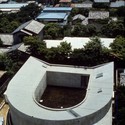
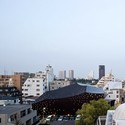
Tama Art University Library (Hachioji Campus) / Courtesy Ishiguro Photographic Institute
The innovative work of the 2013 Pritzker Prize Laureate Toyo Itois often driven by an internal critique and struggle towards perfection. In this translated program, the principal of Toyo Ito & Associates, Architects will discuss his design philosophy and remarkable work, which includes the Sendai Mediatheque in Miyagi, Japan, and Tokyo's Tama Art University Library and TOD’S Omotesando Building.
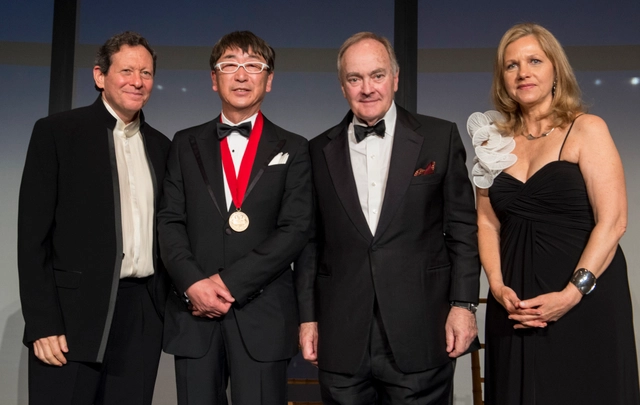
Thomas Pritzker, Toyo Ito, Lord Palumbo, Martha Thorn
Last night we attended the Pritkzer Prize ceremony, where the 2013 laureate Toyo Ito accepted the prestigious award at the JFK Presidential Library in Boston.
On his acceptance speech, Toyo Ito recognised the team that has worked with him during his 42 years of practice, including engineers and architects who attended the ceremony, including a very special former employee: Kazuyo Sejima, who worked with him for 7 years before establishing her practice, and also a Pritzker laureate (2010). As Ito said "Making architecture is not something one does alone; one must be blessed with many good collaborators to make it happen".
And then, Ito continued his wonderful speech on how modern architecture and nature have been in a constant clash, how he has approached this relation and what he hopes for the future, appealing to JFK's famous quote "ask not what America will do for you” to propose the question "What can we ourselves do for the freedom of man?".
The full speech is reproduced below, so you can understand how Ito's passion for architecture and critic view of the state of world turns into a message of union for architects:
In Chile, a very special project is being developed.
Eduardo Godoy, a design impresario who started his business in Chile in the '80s, has always been an advocate for design and architecture in the country. In Chile, more than 40 schools of architecture have flooded the market, but the ever-growing number of professionals has had a relatively small impact on Chilean cities. Seeing the almost infinite landscape of cookie-cutter housing in the suburbs, Godoy asked himself: why not break this model into smaller pieces, each designed by a particular architect, each an opportunity for a young professional? With this in mind, and to foster the appreciation for architects, Eduardo and his team at Interdesign started a project called "Ochoalcubo" (Eight-Cubed). His original idea was to make 8 projects, with 8 buildings designed each by 8 architects, to create developments where the singularity of each piece was key, in order to demonstrate how the individuality of the architect could result in good architecture.
At 71, the 2013 Pritzker Prize winner Toyo Itois not content with settling down just yet, at least not architecturally-speaking. Where many architects have established distinct styles, Ito is known for constantly shifting, experimenting, questioning and developing his approach to architecture. As one member of the Prtizker jury put it "he has been working on one project all along - to push the boundaries of architecture. And to achieve that goal, he is not afraid of letting go what he has accomplished before.”
In this video entitled Learning from Laureates - which comes courtesy of the good folks at ARCHITECT magazine -fellow experimentalist and Pritzker Prize recipient (not to mention 2013 AIA Gold Medalist) Thom Mayne gets to grips with Ito's motivation. The pair of laureates converse via Skype examining the drive behind Ito's evolutionary approach, before getting down to discussing how they think architecture is being affected by society's biggest change yet - the advent of the post-digital age.
See more of Ito's work along with some of our previous coverage after the break...
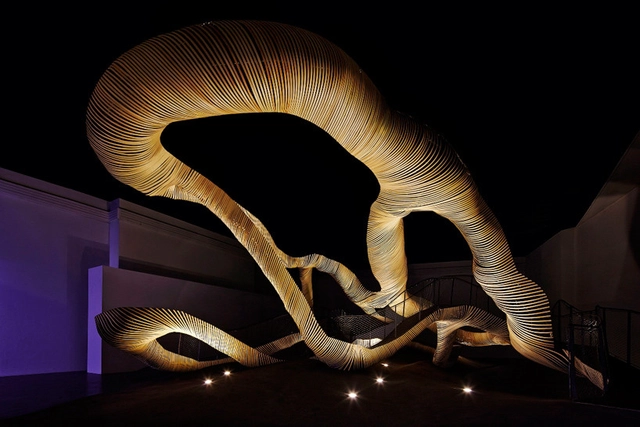
Under the guidance of Toyo Ito, Japanese architect Akihisa Hirata envisioned an futuristic, experienced-based installation which sought to express “manifestations of flow as they relate to people and nature” to the spectators of the 2013 Milan Design Week. Titled “Amazing Flow”, the installation offered a “vision of the city of tomorrow” with a multi-sensory experience that embodied the “Lexus’ world vision” and a glimpse into how cars flow throughout built environment The display consisted of a continuous, wooden structure that represented a moment in which “roads, humans, wind and water flow as a single entity.”
Compare the installation to the Lexus “Create Amazing” promotional video for the 2014 LF-LC Concept car and watch an interview with Hirata after the break...
“Although Mr. Ito has built a great number of buildings in his career, in my view, he has been working on one project all along, -- to push the boundaries of architecture. And to achieve that goal, he is not afraid of letting go what he has accomplished before.” -- Yung Ho Chang, Member of the Pritzker Jury for 2013
Toyo Ito has been announced as the Pritzker laureate for 2013. Ito is the thirty-seventh recipient of the Pritzker Prize and its sixth Japanese recipient.
The Pritzker jury applauded Ito for his ability to synthesize many architectural languages and functionalities in the expression of one personal “syntax,” inspired by the organic structures found in nature and the sensual nature of the human user.
Calling him a “creator of timeless buildings,” the Pritzker Jury further praised Ito for “infusing his designs with a spiritual dimension and for the poetics that transcend all his works.” Among those works, the Jury singled out his Sendai Mediatheque, whose innovative use of structural tubes “permitted new interior spatial qualities,” TOD’S Omotesando building in Tokyo, “where the building skin also serves as structure,” and Tokyo’s Tama Art University Library as particularly inspiring.
In response to the accolade, the highest award in the profession of architecture, Ito humbly expressed that, with each project, he only becomes more “painfully aware of [his] inadequacy, and it turns into energy to challenge the next project.” For that reason, Ito professed, “I will never fix my architectural style and never be satisfied with my works.”
Read more of the Jury’s selection of Toyo Ito as the 2013 Pritzker Laureate, after the break...
Known for his conceptual designs, Japanese architect Toyo Ito is arguably one of the world's most innovative architects. He began his architectural career with a project for his sister in 1976 called "The U House," located in the center of Tokyo. The U House contained windows on the inside facing a courtyard instead of the typical outward-facing windows. This was Ito's first experimentation with the ways that light enters buildings, and he expanded this idea to an even greater extent in his next project: the Silver Hut in Nakano, Tokyo.
One of Toyo Ito's most iconic building is undoubtedly the Sendai Mediatheque. The latest Pritzker laureate completed the building in 2001, a cultural media center allowing complete visibility and transparency to the surrounding community.
Construction is finished for Japanese architect Toyo Ito's Solar Powered Stadium in Taiwan. The stadium's roof is covered by ca. 8800 solar panels. The stadium is located in Kaohsiung, Taiwan and it was built to coincide with the opening of the World Games, to be held July 2009.
The "World Games Stadium" holds 55,000 spectators and it cost $150 million to build. The stadium will hold the record for largest solar-powered stadium in the world with it's 13,000 ㎡ roof. It could potentially generate 1,100,000kW of electricity every year, enough to power up to 80% of the sorrounding neighbourhood.
Until his third year of high school, Toyo Ito's passion was not architecture, but baseball.
Fortunately for us all (and almost assuredly for the Pritzker laureate himself), he soon switched career paths.
Born in Seoul in 1941, Ito moved to Japan at the tender age of two. From the age of 12 (when his father died) to the time he went to University, Ito was part of the family business: making miso (bean paste). However, upon attending The University of Tokyo from 1965-1969, architecture became his life work.
Read more on the life and work of Toyo Ito, the 2013 Pritzker Laureate, after the break...
Graphic designer and curator Kenya Hara has put together a three week-long exhibition in Tokyo focusing on the future of the Japanese house. Hara argues that the housing industry can no longer be isolated but must be combined with other industries, technologies and ideas, including energy, transportation, communication, household appliances, the "vision of happiness" pursued by adults, the representation of Japanese traditions and aesthetics as well as a future vision of health. All of these elements he hopes to present and discuss at the House Vision Exhibition where more than ten types of futuristic houses are on display and daily seminars with expert urban planners, developers, contractors, architects, telecom and even gas organizations have been taking place.
During the opening of the Venice Biennale, we had the chance to sit down and talk with the curator and participants of the Japan Pavilion, awarded with the Gold Lion.
In the following videos you can see Toyo Ito, curator of “Architecture. Possible Here? Home-for-all”, along with collaborators Akihisa Hirata and Sou Fujimoto, discussing what Architecture means to them, the role of architects in our society, and how they approached the Biennale’s theme “Common Ground” on this particular exhibition, which reunites Japanese architects and an architectural photographer collaborating on the design of houses for those affected by the 2011 tsunami.
A REVOLUTION in cognitive neuroscience is changing the kinds of experiments that scientists conduct, the kinds of questions economists ask and, increasingly, the ways that architects, landscape architects and urban designers shape our built environment.
This revolution reveals that thought is less transparent to the thinker than it appears and that the mind is less rational than we believe and more associative than we know. Many of the associations we make emerge from the fact that we live inside bodies, in a concrete world, and we tend to think in metaphors grounded in that embodiment.
The Internet is now the library of the past. Where the public library has historically served as the primary source of information gathering and dissemination, we now look to this new virtual, infinitely large library that can be accessed anywhere at any time as the Library of the present.
As a result, the primary roles of today’s physical libraries have shifted. Libraries of the past focused primarily on individualized information consumption. Communal aspects of interaction and information dissemination now represent the core mission of the library when information is more easily accessible. The silent grand beaux-arts reading rooms of New York or Boston have of the past been transformed into flexible communal “living rooms” in Seattle.
Back in 2006, the Torrevieja Relaxation Park in Spain was built to be a landmark in the City and a referent in contemporary architecture, but its actual state is just the opposite.
._Courtesy_Ishiguro_Photographic_Institute..jpg?1379609779&format=webp&width=640&height=580)