As part of their annual research for the World Architecture Top 100, Building Design (BD) has compiled a list of which architects are most admired by their colleagues from across the globe. Last year's results were somewhat predictable, with Foster + Partners leading and Renzo Piano's Building Workshop and Herzog + de Meuron close behind. According to BD, "this year saw a trend towards more commercial names."
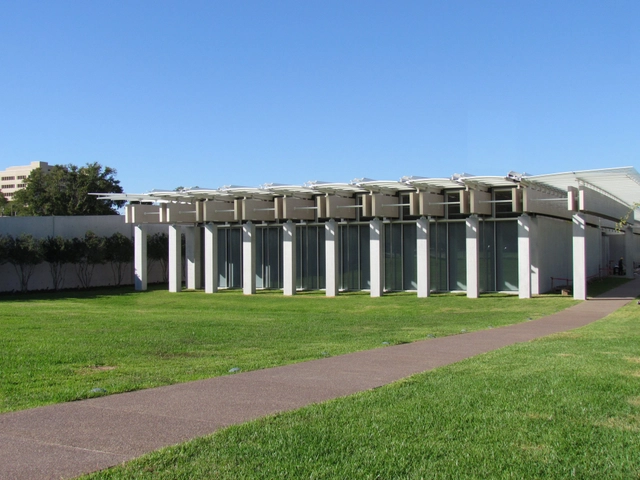
For architects, Louis Kahn's Kimbell Museum has long been hallowed ground. For Renzo Piano, who designed the museum's first major expansion, it was also an enormous difficulty to overcome. His addition to the museum could be neither too close to Kahn's building, nor too far. It had to solve a parking problem, yet respect Kahn's distaste for cars. It had to respond to Kahn's stately progression of spaces—and that silvery natural light that make architects' knees go wobbly. And yet it could not merely borrow from Kahn's revolutionary bag of tricks.
Pritzker Prize winning architect Renzo Piano has been named a senator for life by Italian President Giorgio Napolitano, giving him the right to vote in the Parliament’s Upper House. Napolitano also appointed three others to the position, including Claudio Abbado (an accomplished conductor), Elena Cattaneo (a biologist specializing in stem cell research), and Carlo Rubbia (a Nobel Prize winning particle physicist).
In a statement, the president said that he is sure that all four "will make a special contribution to their extremely significant fields," noting that the positions were allocated "in absolute independence of any party political considerations" in wake of the Senate’s current tension surrounding former President Silvio Berlusconi.
https://www.archdaily.com/423913/renzo-piano-named-italian-senatorAD Editorial Team
The Council on Tall Buildings and Urban Habitat (CTBUH) has named _ distinctive towers from Canada, China, the UK and UAE as the best tall buildings in the world for 2013. Each selected project, judged by a panel of industry executives, have been selected for their “extraordinary contribution in the advancement of tall buildings and the urban environment, as well as for achieving sustainability at the broadest level.”
“The winners and finalists include some of the most striking buildings on the global landscape,” said Jeanne Gang, awards jury chair and principal of Studio Gang Architects. “They represent resolutions to a huge range of contemporary issues, from energy consumption to integration with the urban realm on the ground.”
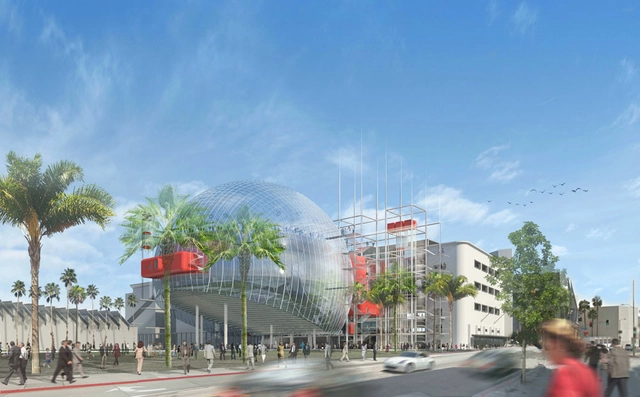
It's surprising to think that Los Angeles - the home of the U.S film industry - doesn't have a museum solely dedicated to its homegrown artform. However, all that is about to change should the Academy of Motion Pictures have their way.
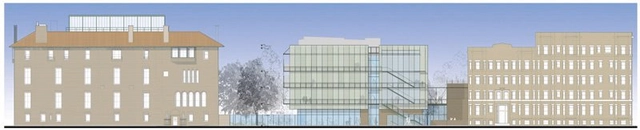
Last Thursday, plans were unveiled for the long-touted Academy Museum of Motion Pictures, a new museum designed by Renzo Piano and native Los Angeleno architect Zoltan Pali, which will be located in the streamline-moderne Wiltshire May Company building at Wilshire Boulevard and Fairfax Avenue, on the campus of the Los Angeles County Museum of Art (LACMA). Although the designs are at an early stage, the released drawings propose to convert the historic building into a museum, while marrying it with a 140-foot-diameter glass dome.
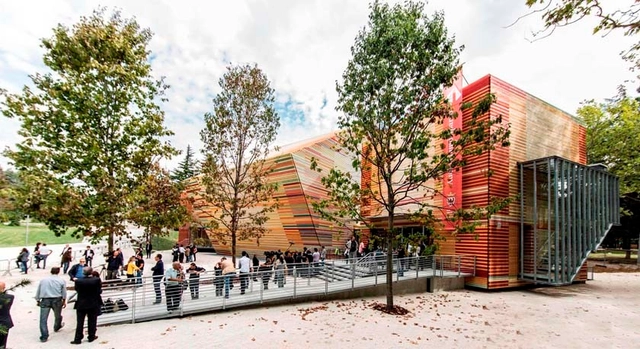
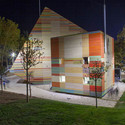
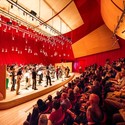
Text description provided by the architects. In April 2009, the central Italian city of L’Aquila was devastated by a crippling earthquake, claiming lives and causing extensive damage to thousands of buildings, including the leveling of the city’s main auditorium venue. Nearing the four anniversary of this tragic disaster, the Italian city of Trento has donated a Renzo Piano-designed auditorium, which was inaugurated in October, in an effort to aid the reconstruction of the medieval city.
Creating an illusion of instability, the auditorium is formed by three interconnected cubes made entirely of wood (1.165 cubic meters in total) that ironically appears as they had “haphazardly tumbled down” and came to rest upon each other. The entire structure was prefabricated and then assembled onsite by Log Engineering, who pieced it together with 800,000 nails, 100,000 screws and 10,000 brackets.
BBC’s Sarah Montague interviews Renzo Piano, the mastermind behind London’s most controversial and newest skyscraper: The Shard. Prior to the interview, Montague spotted Piano blending into the crowd during the opening of the 310-meter skyscraper “spying” on the onlookers. When asked about this moment, Piano revealed the great advice he received from the prominent Italian film director Roberto Rossellini upon the completion of the Pompidou Center in Paris: “You do not look at the building, you look at the people looking at the building.” It was during this moment that Piano observed “surprise” and “wonder, but not fear” amongst the onlookers - a reaction he seemed to be content with.
Despite Piano’s attempt to refrain from controversy, it is hard to avoid when your design intends to celebrate a “shift in society.” Change tends to stir mixed emotions and spark debate. However, being part of the “human adventure” as an architect is what Piano finds most rewarding. He states: “You don’t change the world as an architect, but you celebrate the change of the world.”
Today, six months after the laser light extravaganza that marked the completion of The Shard in London, the controversial glass tower celebrated its official opening to the public. Architecture enthusiasts and residents were welcomed to join the mayor of London 244 meters above the capital on the 72 floor observation deck for the official ribbon cutting.
Designed by Italian architect Renzo Piano, the 310 meter needle-point structure is currently the tallest in Western Europe. The two million square meter mixed-use development offers ample office space, restaurants, a five-star shangri-la hotel and residences.
The Menil Collection Houston, designed by architect Renzo Piano, has been selected for the 2013 AIATwenty-five Year Award. Recognizing architectural design of enduring significance, the Twenty-five Year Award is conferred on a building that has stood the test of time for 25 to 35 years as an embodiment of architectural excellence. Projects must demonstrate excellence in function, in the distinguished execution of its original program, and in the creative aspects of its statement by today’s standards. The award will be presented this June at the AIA National Convention in Denver.
Metro officials have released six conceptual visions that suggest how the historic Los Angeles Union Station could be transformed by 2050. Preliminary “Vision Boards” were released in a public forum at Union Station last week, and although they are not part of the formal evaluation process, they have ignited an immense amount of public interest in the competition.
In an article posted on The Source, Los Angeles Mayor and Metro Board Chair Antonio Villaraigosa described that this competition is “about preparing for the future.” As plans for the California High-Speed Rail System evolve, it is imperative that Union Station is redeveloped to meet the standards of a 21st century transportation hub.
Continue after the break to view each Vision Board provided by the six well-known practices shortlisted for the competition.
Opening in 2012, the $118 million steel, glass, and copper-clad expansion to Boston’s Isabella Stewart Gardner Museum by Renzo Piano Building Workshop will more than double the size of the current facility. Included in the project are a new entrance, music hall, gallery space, and other amenities for an institution that has remained largely unaltered since opening in 1903.


_oma__photo_by_philippe_ruault.jpg?1372972907)