The Rudy Bruner Award for Urban Excellence celebrates urban places that are distinguished by quality design and their social and economic contributions to our nation’s cities. Winners offer creative placemaking solutions that transcend the boundaries between architecture, urban design and planning and showcase innovative thinking about American cities.
Husqvarna invites you to take their survey, The Future of Parks, and share your insights into how parks will look and function in the year 2030. The UN has set a goal to make cities more sustainable in the coming decades, and parks will play an integral role in making that happen. Together with students from around the world, you will help to co-create a vision of what is to come!
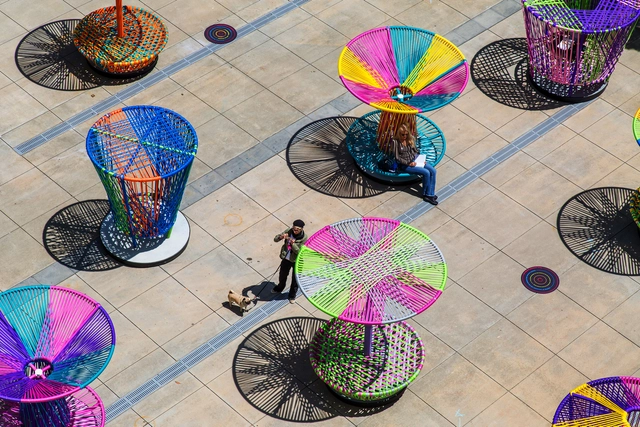
Colorful, woven spinning tops decorated the lawn at Houston’s Discovery Green park from November 14, 2015-March 22, 2016 as part of an interactive art installation by Mexico City designers Héctor Esrawe and Ignacio Cadena. Dubbed Los Trompos, the installation featured twenty, 3D structures that also doubled as seating. Only two or more people working together could make the tops spin, “fostering an engaging connection.”
The City of Vancouver has agreed to purchase the Arbutus Corridor from Canadian Pacific Railway for $55 million to make way for a future public greenway. According to a report by CBC, this ends a long-standing dispute between the city and CP Rail over the worth of the nine kilometer stretch of land, which hasn't been used for nearly 15 years.
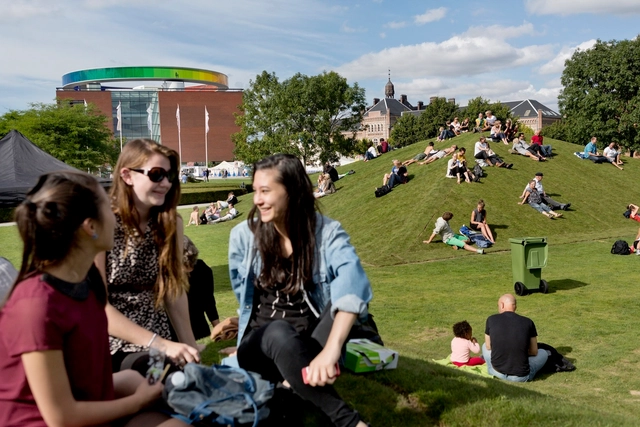
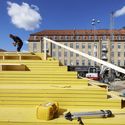
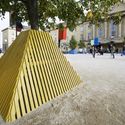
Since 2010, the Danish architects from Schønherrhave been developing a series of large-scale urban interventions for the Aarhus Festival, the largest cultural festival in Denmark. These temporary projects have transformed the streets and parks into extraordinary public spaces, changing the natural topography of the city to attract citizens and bring them together.
We present their last four projects: "The Forest" (2010), "The City Park" (2012), "The Plaza" (2014) and "Bishops Square" (to be completed this 2016).
Dallas Architecture Forum, a non-profit organization dedicated to providing public education about architecture, design and the urban environment, will continue its 2015-2016 Panel Discussion Series on January 26, 2016 with “Making Fair Park Work.” Moderated by Mark Lamster, Dallas Morning News Architecture Critic, this panel is presented in partnership with the Dallas Festival of Ideas and the College of Architecture Planning and Public Affairs (CAPPA) at the University of Texas at Arlington.
Patano Studio Architecture has created a proposal for a 45-acre, two-mile park spanning over the top of the Interstate-5 freeway in Seattle. Called C.A.P., the plan “proposes a city-wide architectural infrastructure solution to multiple issues facing the fast growing city.”
The Irish Architecture Foundation has opened a new competition to design a play and skate park in Dublin, Ireland in collaboration with The Matheson Foundation and Dublin City Council. Located on “The Lawns” in Le Fanu Park of Ballyfermot, the project is a unique opportunity for inter-disciplinary design work. A wide range of creative practitioners are invited to apply – designers, architects, play therapists, skate/BMX professionals, wild-life experts, musicians or anyone else with a passion for working in community contexts.
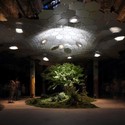
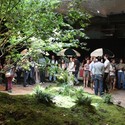
The New YorkLowline, a project which was first announced in 2011 and was rekindled last year, have now launched a Kickstarter campaign in order to make their dream of using solar technology to "transform an historic trolley terminal into the world's first underground park" closer to a reality. Their proposal, which seeks to unlock the potential of underused subterranean urban spaces, would see the creation of a living, green public space built beneath the streets of New York City. They are currently seeking funding to build a long-term solar device testing laboratory and public exhibition in order to test and present their designs.
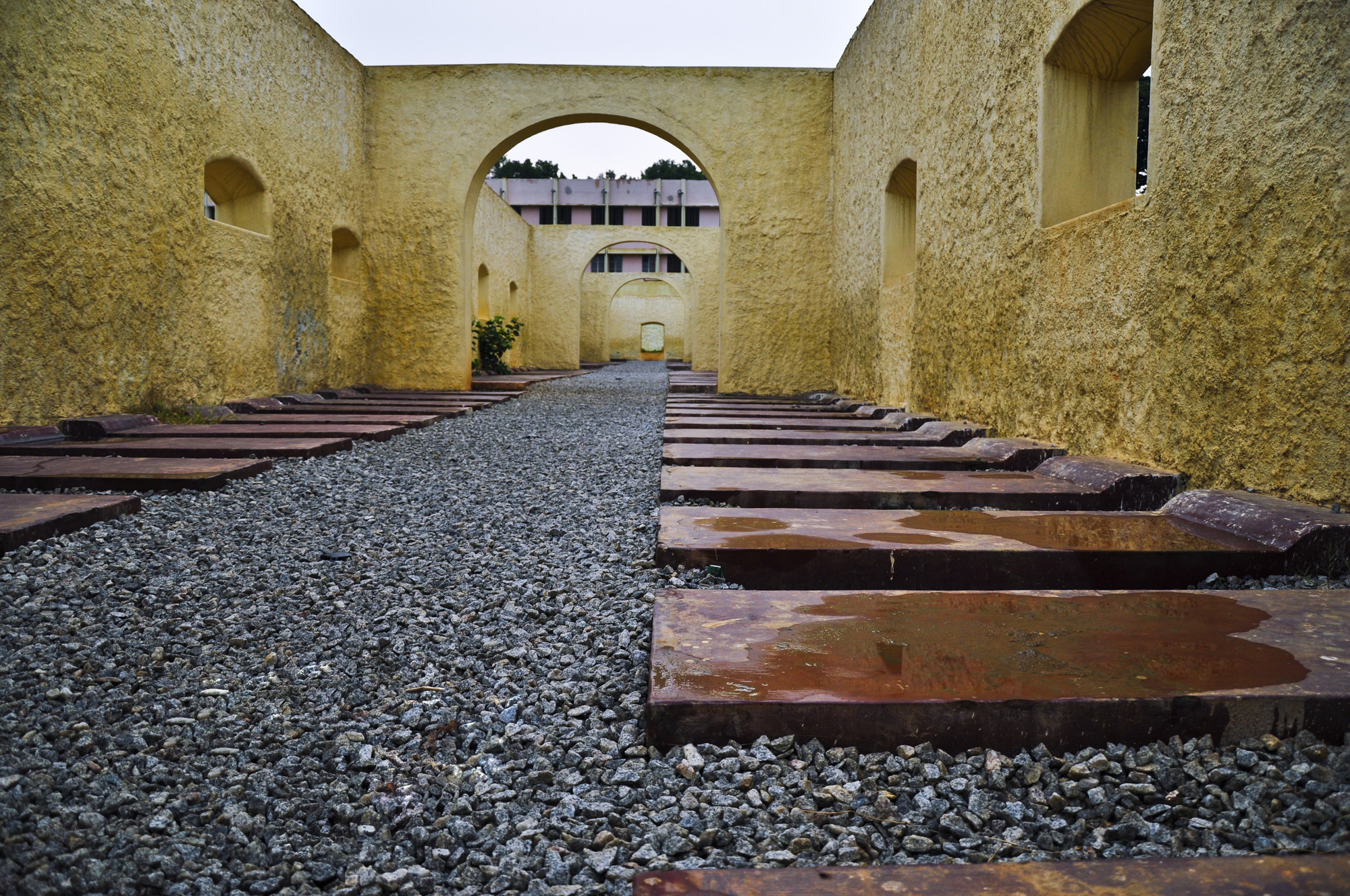
Prisons are often seen as problematic for their local communities. After centuries of correctional facilities discouraging economic growth and occupying valuable real estate as a necessary component of towns and cities, many of these institutions have been relocated away from city centers and their abandoned vestiges are left as unpleasant reminders of their former use. In fact, the majority of prisons built in the United States since 1980 have been placed in non-metropolitan areas and once served as a substantial economic development strategy in depressed rural communities. [1] However, a new pressure is about to emerge on the US prison systems: beginning in 2010, America's prison population declined for the first time in decades, suggesting that in the near future repurposing these structures will become a particularly relevant endeavor for both community development and economic sustainability. These abandoned shells offer architects valuable opportunities to reimagine programmatic functions and transform an otherwise problematic location into an integral neighborhood space.
Why repurpose prisons rather than starting fresh? The answer to this question lies in the inherent architectural features of the prison typology, namely the fact that these structures are built to last. People also often forget that prison buildings are not limited to low-rise secure housing units - in fact, prisons feature an array of spaces that have great potential for reuse including buildings for light industrial activity, training or office buildings, low-security housing, and large outdoor spaces. These elements offer a wide variety of real estate for new programmatic uses, and cities around the world have begun to discover their potential. What could the US learn from these examples, at home and overseas?
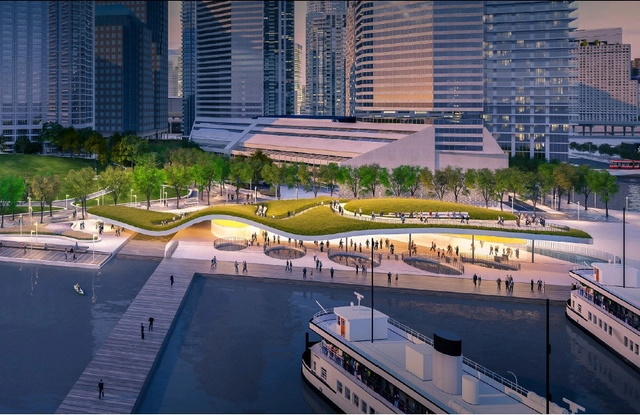
Harbour Landing Ferry Terminal / KBMP Architects, West 8, Greenburg Consultants. Image Courtesy of WATERFRONToronto
Waterfront Toronto has unveiled five proposals for the Jack Layton Ferry Terminal and Harbour Square Park design competition. The finalists were tasked with transforming Toronto'swaterfront by revitalizing the existing ferry terminal and park through an extensive gradually-implemented masterplan. See all five proposals, including designs by nARCHITECTS and Diller Scofidio + Renfro, after the break.
High Line co-designer, James Corner Field Operations has been selected to design the proposed 10-mile “Underline” in Miami. Chosen by a local jury from 19 submitted entries, JCFO has been asked to envision a bicycle route and linear park that will replace the threadbare M-Path under the Metrorail tracks from Dadeland to the Miami River. The project has yet to achieve funding, but it is hoped that JCFO’s plan will spark more investor interest.
With over 275 million visitors to the United States' 401 national parks per year, what will be the experience of visitors in the 21st century? The Van Alen Institute has teamed up with the National Park Service to launch a new competition: National Parks Now - a central component of Elsewhere: Escape and the Urban Landscape, the Institute's initiative to investigate how the form and organization of the built environment shapes a need and desire for escape. Operating on the belief, stated by Van Alen Institute Executive Director David van der Leer, that "too few people realize what a huge resource these smaller national park sites are for local communities and for larger urban networks," this initiative seeks to make parks relevant for the 21st century audience. More on the competition after the break.
Did you know Millenium Park in Chicago, Illinois was actually a desolate industrial wasteland until the turn of the century? The 24.5 acre public park, host to a state-of-the-art collection of architecture, landscape design, and art, is now a popular destination for residents and tourists alike -- all thanks to an unprecedented public-private partnership pioneered by former Mayor Richard Daley. To learn more about how Daley made Millenium Park a reality, with the help of famous designers like Frank Gehry, check out the video above.
SCAPE and Rogers Marvelhave been unanimously selected from 27 international applicants to create a schematic design for one of the most visited destinations on the Mississippi River: Water Works in downtown Minneapolis. The SCAPE-Roger Marvel Team, which also includes New York-based James Lima Planning + Design and Minneapolis-based SRF Consulting, will be responsible for transforming the historically significant Central Mississippi Riverfront Regional Park, within which the Water Works district exists, with a master plan based on a series of “visionary” parks and trails.
Walk into the cafeteria at the Googleplex and you are nudged into the “right” choice. Sweets? Color-coded red and placed on the bottom shelf to make them just a bit harder to reach. “Instead of that chocolate bar, sir, wouldn’t you much rather consume this oh-so-conveniently-located apple? It’s good for you! Look, we labelled it green!”
Like the Google cafeteria guides you to take responsibility of your health, Google wants to transform the construction industry to take responsibility of the “health” of its buildings. They have been leveraging for transparency in the content of building materials, so that, like consumers who read what’s in a Snickers bar before eating it, they’ll know the “ingredients” of materials to choose the greenest, what they call “healthiest,” options.[2]
These examples illustrate the trend of “medicalization” in our increasingly health-obsessed society: when ordinary problems (such as construction, productivity, etc.) are defined and understood in medical terms. In their book Imperfect Health, Borasi and Zardini argue that through this process, architecture and design has been mistakenly burdened with the normalizing, moralistic function of “curing” the human body. [3]
While I find the idea that design should “force” healthiness somewhat paternalistic and ultimately limited, I don’t think this “medicalized” language is all bad – especially if we can use it in new and revitalizing ways. Allow me to prescribe two examples: the most popular and the (potentially) most ambitious urban renewal projects in New York City today, the High Line and the Delancey Underground (or the Low Line).
More on “curative” spaces after the break. (Trust me, it’s good for you.)