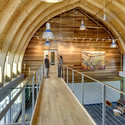
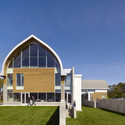
In 1953, six years before the Frank Lloyd Wright-designed Solomon R. Guggenheim Museum opened to the public, two of his structures—a pavilion and model Usonian house—were built on the future site of the museum to house a temporary exhibition displaying the architect’s lifelong work. From July 27, 2012, to February 13, 2013, the Sackler Center for Arts Education at the Guggenheim Museum will present A Long-Awaited Tribute: Frank Lloyd Wright’s Usonian House and Pavilion, an exhibition comprised of selected materials from the Solomon R. Guggenheim Museum Archives, highlighting the first Wright buildings erected in New York City. Text Courtesy of: The Solomon R. Guggenheim Foundation (SRGF). More information on the exhibition after the break.
The Hegeman, designed by Cook + Fox Architects, is a residential community in Brownsville, Brooklyn that provides housing for low-income and formerly homeless individuals. Developed by Common Ground Community – an innovative non-profit whose mission is to end homelessness – the Hegeman Residence will also provide a range of on-site social services in a model known as supportive housing. For a little bit of context, Brownsville has the highest concentration of NYCHA (New York City Housing Authority) developments in New York City. A wave of arson in the 1970s destroyed most of the residential structures; Brownsville is just one of the many neighborhoods that were affected. The urban renewal that followed rebuilt many homes and designated them as low-income housing. The community has had many problems since associated with poverty, including crime and drug addiction, as well as low test scores and high truancy rates in the education system.
What do you think of the number 300? Mayor Michael Bloomberg found the number to be just the right amount of square feet necessary to attract a younger demographic to live in the city. In a city-sponsored competition entitled adAPT NYC, the Department of Housing Preservation and Development is inviting developers to submit proposals for a new construction project in Kips Bay, Manhattan. The challenge is to design what Bloomberg calls “micro-units”, between 275-250 sqf of living space, complete with a place a kitchen and a bathroom, but no closet is necessary. “Developing housing that matches how New Yorkers live today is critical to the City’s continued growth, future competitiveness and long-term economic success,” said Mayor Bloomberg. “People from all over the world want to live in New York City, and we must develop a new, scalable housing model that is safe, affordable and innovative to meet their needs.”
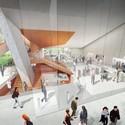
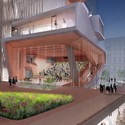
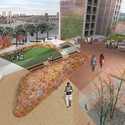
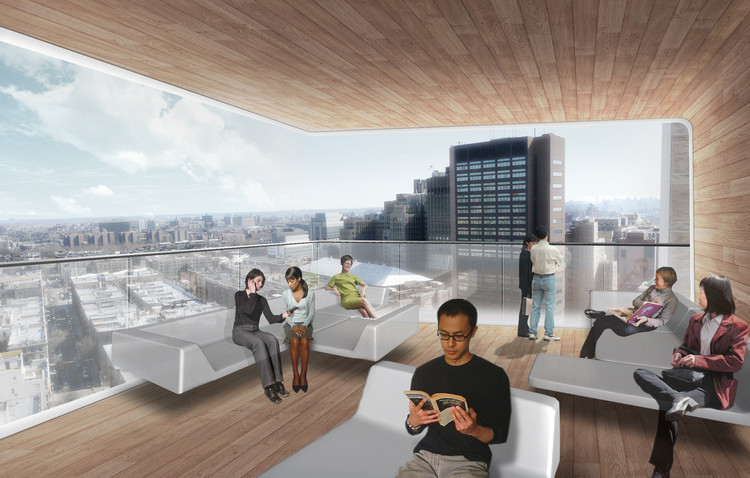
Columbia University has been at the forefront of medical education for more than two centuries, as it was the first medical school in the United States to award the M.D. degree in 1770. Now, the Columbia University Medical Center (CUMC) has announced plans for a new, state-of-the-art medical and graduate education building that reflects how they believe medicine is and should be taught, learned and practiced in the 21st century.
Located on the CUMC campus in the Washington Heights community of Northern Manhattan, the 14-story facility will aim to achieve LEED Gold certification and incorporate technologically advanced classrooms, collaboration spaces, and a modern simulation center. The design is led by Diller Scofidio + Renfro, in collaboration with Gensler as executive architect.
In a call for a Sustainable New York City, Mayor Bloomberg stated: “Given that buildings account for more than 80 percent of all municipal greenhouse gas emissions, constructing buildings with energy-efficient features is essential to reducing those emissions, and DDC plays a critically important role in that work.”
This is a great idea for new construction, but what about the existing, aging buildings? Most older buildings were built in a time when energy costs were low and the exterior walls were used less for energy performance and more for structural integrity. Knocking these buildings down to start over would cause a greater environmental impact due to the tons of waste material that would need to be discarded. So, what is the solution? REskin. DesignByMany‘s challenges you to cleverly reskin a decaying urban building on the corner of Broadway and Reade St in New York City. Submissions can range from a focused investigation to an entire reskinning of the building.
The REskin challenge is sponsored by Autodesk and media partners ArchDaily. Winners will receive a full license of Autodesk Revit Architecture 2013. Check out the building and learn more after the break!
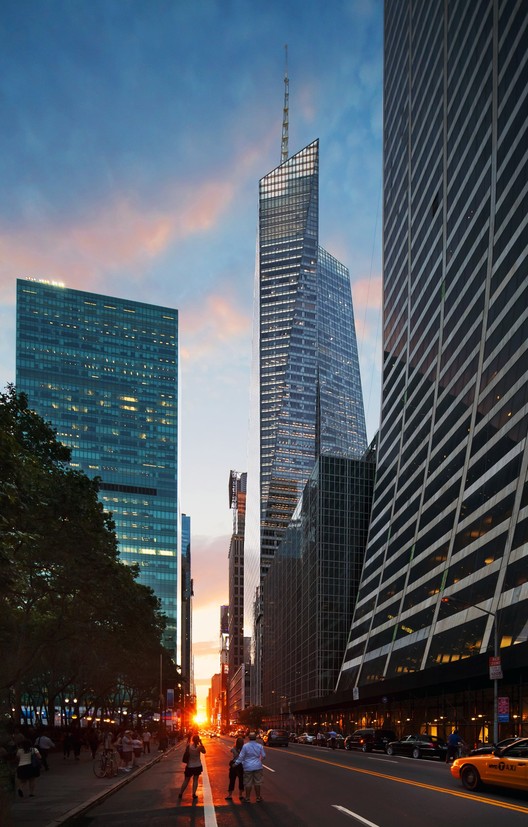
The Bank of America Tower at One Bryant Park in midtown New York, designed by Cook + Fox Architects, is the first commercial high-rise to achieve LEED Platinum certification. The design and high performance of this building is intended to set a new standard for commercial construction and for the office-work environment. By focusing on ways to emphasize daylight, fresh air and a connection to the outdoors, the architects redefine the parameters of the skyscraper as more than a glass box.
More on the strategies implemented in this project after the break.
In an effort to make New York City’s built environment “more livable and hospitable” the Department of Design and Construction (DDC), Health and Mental Hygiene, Transportation (DOT), and City Planning have developed the Active Design Guidelines: Promoting Physical Activity and Health in Design to be referenced in conjunction with the DOT’s Street Design Manual and other guidelines produced by NYC. The guidelines are written for urban planners, designers and architects and are driven by the need to address health concerns such as obesity and diabetes through intelligent design. Our built environments give us cues as to how to inhabit them and have tremendous effects, sometimes subconscious, on our lifestyles. Do you walk, drive, or bike to work? Do you take the stairs or the elevator? We make these types of decisions, which are largely based on comfort, on a daily basis. But the guidelines established in this manual are intended to give designers the tools to encourage healthy lifestyle choices to address the social concerns of NYC. So, what can planners, architects and designers do to create an active and healthy city? Find out after the break.
Yesterday, the final steel beam rose 977 feet into the air and was placed atop 4 World Trade Center – the 72-story tower designed by Pritzker Prize-winning Japanese architect Fumihiko Maki. As gospel singer BeBe Winans sang “God Bless America”, the 8 ton beam, signed by all members of the team and adorned with an American flag, reached its final destination atop the city’s sixth tallest tower.
At over 80 years of age, Maki is making his New York debut in an elegant manner. The tower was designed to serve as a “respectful backdrop” to the National September 11 Memorial and not to compete with 1 World Trade. ”This is a special place with a sacred meaning and we felt we had to be respectful,” explained Osamu Sassa, Maki’s project architect, to The New York Times. Such a ideology offers a strong contrast with the other architectural statements that will eventually rise as part of the World Trade Center complex, such as Norman Foster’s 2 World Trade and Richard Roger’s 3 World Trade. While the minimalism of Maki may have kept the design under the radar during its design and construction stages, the grace of its simplicity will craft a dignified presence while visiting the site. ”The design of the tower at 150 Greenwich has two fundamental elements – a ‘minimalist’ tower that achieves an appropriate presence, quiet but with dignity, and a ‘podium’ that becomes a catalyst for activating the surrounding urban streetscape as part of the revitalization of lower Manhattan,” explained Maki.
The New York Economic Development Corporation and Mayor Bloomberg of NYC announced the completion of the final plan for Willets Point - a peninsula on the Flushing River in Northern Queens, New York. The development of Willets Point is part of the urban renewal project associated with Citi Field – the Mets’ new stadium. Nicknamed the Iron Triangle, the project will include housing for mixed incomes, retail and entertainment amenities, a hotel, a convention center, office space, parks and open space, and a new public school, all of which falls under the umbrella of LEED-certified buildings and infrastructure. As with every redevelopment plan, there are positives and negatives to restructuring the community.
The Green Carceri, designed by TARQUITECTOS, arises as a natural extension of the High Line Park, connecting himself with the High Line and flying over the river, thus enabling a continuation of the public space underneath with the neighborhood to the height of the street and the docks. Winding around a series of vertical communication cores, the building allows both internal transit users and visitors to descend to the level of the street without having to enter the building. More images and architects’ description after the break.
Cameron Michael captures the energy of the city with this time-lapse production. From the highline to the city skyline, this video makes you feel like you’ve just spent your entire Sunday walking through the streets of Manhattan. Although Michael admittedly “bent” a few laws while filming The Manhattan Project, this adventure seems to have been well worth the effort. Enjoy!
Taking place June 15th from 7-9pm at McNally Jackson in New York, CLOG is inviting the public in their celebration of the launch of their third issue, Data Space.
In the past decade New York City’s government, along with numerous organizations and design teams, have taken the initiative to revive the city’s public spaces and reclaim underutilized areas that have long been associated with the city’s manufacturing past. We’re all familiar with the High Line, a project that takes over the elevated rail lines of Chelsea and Meat Packing District that until several years ago stood as a desolate and eroding piece of infrastructure, which was beautiful in its own way but largely underutilized. Then there is the Brooklyn Navy Yard, which has become a mecca for designers, fabricators and research companies and has recently acquired a museum to celebrate its history. And of course, there are the city’s waterways, which, since New York City’s early history, have served its manufacturing and trade economy, have become parks along the waterfront as part of the Hudson River Greenway and the FDR Drive. Manufacturing has long been replaced by Wall Street, but there are parts of the city that still retain the industrial past along the historic waterfront and continue to operate some of the most important facilities that allow the city to function. Now it is time to reintroduce a public use among these industrial zones.