BRUTALISM / CLOG
Brutalism. It’s the architecture movement that the public loves to hate, and architects dare to love. It’s also the latest topic tackled by CLOG, the quirky publication that takes a long slow look at what’s important in architecture now.
While Brutalism, a movement that reached its height in the 60s, may not seem a timely topic, nothing could be further from the truth. With Brutalism’s monolithic beasts reaching their not-so-golden golden years, the question to re-model (often prohibitively expensive, considering these projects’ complexity) or just demolish (as the public often begs for) is an urgent one – as the recent preservation debates over Paul Rudolph’s Orange County Building (successful) and Bertrand Goldberg‘s Prentice Women’s Hospital (not) reveal.
However, while this edition of CLOG of course mentions these debates, Brutalism shines in exploring the bigger questions these debates provoke: Why is Brutalism so loathed? What is it, really? And – can Brutalism be saved? Should it be?
National Mall / CLOG
Nearly a million people crowded the National Mall yesterday to witness the second swearing-in of President Barack Obama. The Mall was transformed – from the oft-trampled, dusty track of land separating the Capitol from the Lincoln Memorial – into a space of civic pride and participation. It’s moments like these that reveal to us the latent potential of the National Mall, and it’s important symbolic value as our Nation’s “backyard.”
The National Mall has suffered decades of over-use and under-funding, but has recently come back on the National agenda. With many projects underway – and soon to be underway – now is the time to consider: What is the National Mall? What is its value? And how should it be designed for the future? With informative graphics, varied insights, and interesting case studies, CLOG: National Mall addresses these vital questions.
Read our review of CLOG: National Mall, after the break…
CLOG: National Mall Launch

UPDATE: An original version of this post said the event took place on January 10th. The event will actually take place on January 20th.
The folks behind CLOG, the publication that “slows things down” and takes a good, long look at the issues facing architecture today, are celebrating the online launch of their latest edition - National Mall - with an event at MoMA PS1 in New York. The event, called “THE FUTURE OF THE MEMORIAL,” which will take place on January 20th, is part of MoMA PS1′s Sunday Sessions and will include a conversation, hosted by CLOG, between Friedrich St. Florian, Nicholas Benson and Lucia Allais.
CLOG: National Mall will examine the highly symbolic space of our National Mall. As their website explains: “The Mall functions as a place of protest and celebration, as well as a place of memorialization and education.” Thus, the edition considers what it means to restore and re-build this space and, more importantly, questions: how should it be done?
Our review of National Mall is still in the works, but why not take a look at our latest CLOG reviews in the mean time?
- CLOG: Rendering “CLOG: Rendering is, in my opinion, the best issue yet. Through dozens of fascinating, concise articles and a handful of illustrative, quirky images, it takes on an enormous question often over-looked in the architectural world: what is a rendering? “
- CLOG: Data Space ”What does it look like to give the virtual, physical form? As every CLOG edition, Data Space explores “from multiple viewpoints and through a variety of means, a single subject particularly relevant to architecture now” (5) and this subject, how to design “the infrastructure of invisible data” (103), could very well be the defining question of our age.”
Call for Submissions – CLOG: SCI-FI Issue

CLOG recently announced their call for submissions for their upcoming SCI-FI issue, which has been inspired by a the recent rise of a number of designs from significant international offices exhibiting a striking resemblance to science fiction icons, such as the Death Star. In doing so, they are demonstrating the impact this genre has had on the creative imagination of a generation. As science fiction continues to both draw upon historic and contemporary architecture while simultaneously influencing future design, it is time to critically examine the improbable made possible: SCI-FI. Submissions are due no later than January 21. For more information, please visit here.
Rendering / CLOG

Every three months, the publication CLOG takes on “a single subject particularly relevant to architecture now.” It’s not a quick look at something trendy, but rather an in-depth look at the issues that are affecting – and will continue to affect – architecture as we know it today.
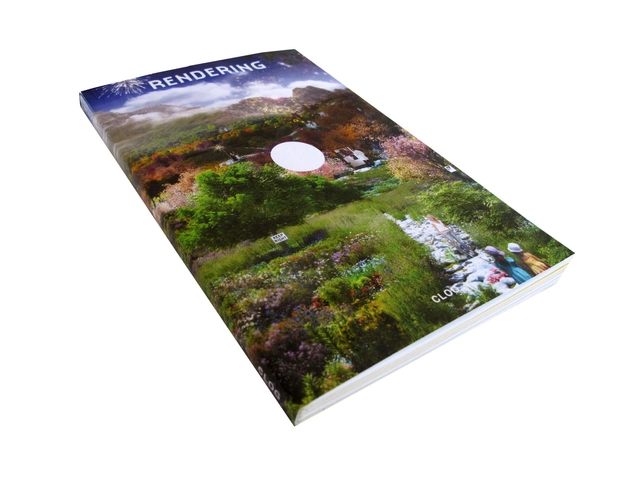
CLOG: Rendering is, in my opinion, the best issue yet. Through dozens of fascinating, concise articles and a handful of illustrative, quirky images, it takes on an enormous question often over-looked in the architectural world: what is a rendering? An alluring device to win over a jury or public? A realistic depiction? Or perhaps it’s an entity unto itself…
Rendering examines how the rendering has become a means of deception – not just for the public, but for ourselves – becoming an aesthetic end-product rather than the representation of an idea in-progress. But at the same time, the rendering is our best tool for entering into the “real” world, for communicating what we do to the public at large.
Is there a way to marry these opposing characteristics? What should the future of rendering be? CLOG takes these questions head-on. More after the break…
Call for Submissions – CLOG: BRUTALISM Issue

This latest architectural publication for CLOG seeks to highlight a defining architectural style of the postwar era — characterized by severe, abstract geometries and the use of cast concrete, block and brick — Brutalism arguably produced some of the world’s least popular public buildings.The style’s international propagation brought modern architecture to ever-larger constituencies, and some argue that the perceived shortcomings of these Brutalist structures led to the demise of the Modernist project. While today often admired (and even loved) by architects, many Brutalist projects are now threatened with demolition. Judging by the work of many contemporary practitioners, however, the influence of Brutalism only seems to grow. Before the wrecking balls swing, it is time to look back on, debate, understand, and learn from Brutalism. Submissions are due November 5. For more information, please visit here.
CLOG: National Mall – Call for Submissions

CLOG is currently seeking submissions for its fifth issue, CLOG: National Mall, which will be published in November 2012. In an election year when America is debating and deciding its trajectory, it’s time to critically discuss the space that perhaps more than any other reflects what the nation was, is, and wants to be – the National Mall. Visited annually by approximately thirty million people, the Mall is also a victim of its own success as its grounds and monuments have been steadily eroded by overcrowding in addition to budgetary and administrative pressures. Submissions are due on July 20, 2012 by midnight. For more information, please visit their website here.
Data Space / CLOG

“Every second, 2.8 million emails are sent, 30,000 phrases are Googled, and 600 updates are tweeted. While being absorbed into this virtual world, most rarely consider the physical ramifications of this data. All over the world, data centers are becoming integral components of our twenty-first city infrastructure [...] As cloud storage and global Internet usage increase, it’s time to talk about the physical space of data.” - CLOG (5)
What does it look like to give the virtual, physical form? As every CLOG edition, Data Space explores “from multiple viewpoints and through a variety of means, a single subject particularly relevant to architecture now” (5) and this subject, how to design “the infrastructure of invisible data” (103), could very well be the defining question of our age.
CLOG: Data Space launch

Taking place June 15th from 7-9pm at McNally Jackson in New York, CLOG is inviting the public in their celebration of the launch of their third issue, Data Space.
The editors of CLOG will be joined by Andrew Blum, author of the recently published “Tubes: A Journey to the Center of the Internet,” and Neil Sheehan, Principal of Sheehan Partners, who designed Facebook’s Prineville Data Center, to discuss the architecture of data centers, a fairly new building typology, which has become a major energy consumer and a burgeoning building type. These facilities can range from small portable modules to massive warehouses full of servers, from sleek new constructions to the reuse of existing infrastructures.
For more information and to order your own copy of the issue, please visit here.
Apple / CLOG

If you are an Apple fanatic and architecture lover you should pick up this book. CLOG publication is filling a niche that has been created by the hyperspeed of digital media. “In the deluge, excellent projects receive the same fleeting attention as mediocre ones.” CLOG slows things down by exploring a single subject from multiple viewpoints, and “on paper, away from the distractions and imperatives of the screen.” This book offers an in-depth look at the development of Apple’s brand of architecture. Mixed into the in-depth look is an amusing four page collection of one sentence quotes from architects and critics about the new Apple Headquarters. Here are a couple: Eric Owen Moss says, “Internal courtyard could be magic, a new world for adventurous kids only, like going out the back of the CS Lewis/Narnia closet.” Mark Goulthorpe asks, “Sphincter?” Jacob van Rijs says, “I love the garden miss the bite…” and J. Mayer H. laments, “So disappointing…”
Call for Submissions – CLOG: Rendering Issue

We have been following the rising popularity of CLOG, beginning with their inaugural thematic issue on BIG and, their second issue on Apple which highlighted Jobs’ Apple Campus 2 in Cupertino by Foster + Partners. This latest architectural publication seeks to slow the pace at which architectural information is distributed, allowing people to pause and absorb the projects and ideas presented and discuss the topics at hand.
For CLOG’s Apple issue, the publication included over 50 international multidisciplinary contributors and discussed topics from ranging an interview with one of Apple Computer’s original three founders, Ronald Wayne, to articles about the innovative glass engineering, and design critique of the project. After the large success of both issues, CLOG is gearing up for their next issue and calling for submissions about renderings. For this addition, the team will address the persuasive power of renderings and their important, and perhaps dominant, role in project presentations.
More about CLOG after the break.
Call for Submissions – CLOG: Data Space Issue

CLOG recently announced their open call for submissions for their third issue, Data Space. All over the world, data centers are becoming integral components of our 21st century infrastructure. These facilities can range from small portable modules to massive warehouses full of servers, from sleek new constructions to reuse of existing infrastructures. What is the significance of this bridge between the virtual and the physical? How does this new typology affect the discourse of architecture and the shaping of our built environment? As cloud storage and global internet usage increase, it’s finally time to talk about the physical space of data. The deadline for submissions is January 9th. For more information, please visit their website here.
Update: CLOG / BIG
Recently, we shared the news of CLOG’s first issue which will focus on Bjarke Ingels Group projects. The publication seeks to break the fast pace at which architectural projects are thrown upon the public to allow for a pointed discussion and examination on a specific topic. As the editors explain, “CLOG slows things down.” BIG seems like the perfect firm to examine for this inaugural issue, as the Danish practice has grown so quickly offering architecture lovers a continuous stream of ideas, approaches to form, and flashy visuals – as the editors of CLOG note, “BIG [is] a firm that keeps pace with the flow of online imagery, but which has largely been left unexamined.” On October 7th, CLOG’s launch event at the Storefront for Art and Architecture will become an open forum of sorts as a “Collective Interrogation” will allow guests to ask Bjarke Ingels 10 previously selected questions.
Do you have a question for Ingels and his firm? Well, here’s your chance to have it answered! Email your thoughts to interrogation@storefrontnews.org and check out the Storefront for Art and Architecture for more info.
CLOG:BIG

So, you know about Bjarke Ingles’ Yes is More…but how about CLOG? The inaugural issue of the publication will focus on BIG projects offering different critiques and contributions from over 40 writers, as well as responses from Bjarke Ingles. The work is a reaction to this fact-paced ago of online press, blogs, tweets, etc. where the public is introduced to alarming amounts of work is such a short period of time. “CLOG slows things down. Each issue explores, from multiple viewpoints and through a variety of means, a single subject particularly relevant to architecture now. Succinctly, on paper, away from the distractions and imperatives of the screen. “ Bringing together contributors from backgrounds including art, architecture, criticism, journalism, parkour, engineering, comics, photography, philosophy, CLOG:BIG presents the first holistic, critical examination of Bjarke Ingels and his firm. And, on October 7, the diagloue will continue at the Storefront for Art and Architecture with Bjarke Ingles and CLOG. Check out the 100+ page book here.