Videos
Courtesy of URBAN POWER for Hvidovre municipality
As the world population grows, designers look to develop the seas. Architecture and planning firm, URBAN POWER strategically designed nine man-made islands off the southern coast of Copenhagen to combat many of the city’s impending challenges. The islets, called Holmene, address demands for tech space, fossil-free energy production, flood barriers, and even public recreation space.
In a design proposal for Soprema’s new company headquarters in Strasbourg, France, Vincent Callebaut Architectures envisions an 8,225 square-meter ecological utopia. The building, called Semaphore, is described in the program as a “green flex office for nomad co-workers” and is dedicated to urban agriculture and employee well-being.
An eco-futuristic building, Semaphore is inspired by biomimicry and intended as a poetic landmark, as well as aiming to serve as a showcase for Soprema’s entire range of insulation, waterproofing, and greening products. The design is an ecological prototype of the green city of the future, working to achieve a symbiosis between humans and nature.
Dealing with the context of a project’s site is an essential part of architecture, be it by denying or incorporating preexisting elements and the environment’s conditions in the design. However, understanding what lies around as an active agent of the decisions and space organization goes beyond simply considering the good views, natural ventilation, solar orientation, etc; it is about seeing these conditions as co-authors.
These cases are most notable when practices think of the architecture's surrounding environment as an active agent.
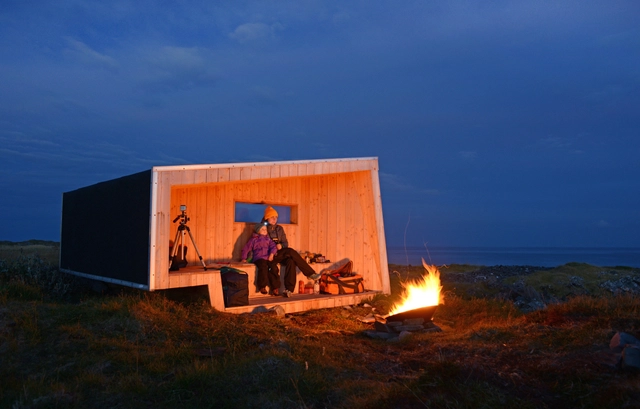
Jacob Witzling may lack formal architectural training, but his passion for nature and cabin architecture has provided him with all the tools needed to both design and construct idyllic living spaces. Witzling’s cabins can be found throughout the United States; these structures are often sequestered to the woods, providing a remote escape from urban centers and suburban sprawl.
Witzling’s interest in cabins began at the age of 16. His father, an architect and engineer, provided him with a preliminary exposure to the world of designing and building. “I needed to exist in the woods, and even though I had never built anything other than a blanket fort, I knew that my passion to create would be sufficient,” says Witzling. “I remember pouring over the pages of my dad’s favorite book, 'Handmade Houses: A Guide to the Woodbutcher’s Art.' I would gaze at the pictures from inside my blanket fort and daydream about building one of my own.”
MAD Architects have completed their restoration work on the Kiyotsu Gorge Tunnel in Japan’s Niigata prefecture, transforming the historic lookout tunnel into a trail of artistic spaces. The “Tunnel of Light” was opened as part of the 2018 Echigo-Tsumari Triennale, cutting through 750 meters of rock formations to offer a panoramic view across one of Japan’s great landscapes.
MAD’s scheme seeks to “transform points along the historic tunnel through the realization of several architectural spaces and artistic atmospheres." Inspired by the five elements of wood, earth, metal, fire, and water, the scheme explores the relationship between humans and nature, and "re-connects locals and visitors alike with the majestic beauty of the land."
Fake news, alternative facts, virtual realities... Media that were meant to connect us are taking on a life of their own. They blur borders between the actual world and its image and they answer questions about true or false with the loudest voice or strongest image. Our workshops this year offer a reality-check. They dip your hands into matter, confront ancient knowledge with high-tech, engage you with innovative companies and let you connect to real people - here and now!
Continuing towards its goal of creating design-forward structures that are available to the public and installable anywhere, Revolution Precrafted's series has unveiled its latest pavilion design by Ben van Berkel, founder and principal architect of UNStudio. The limited edition Ellipsicoon (a portmanteau of Ellipse and Cocoon) is available now through Revolution Precrafted’s website, joining the selection of prefabricated pavilions and single-family home designs by the likes of Zaha Hadid, Jean Nouvel, and Daniel Libeskind.
The Big Ghibli Warehouse. Image Courtesy of Studio Ghibli / Aichi Prefecture
A Studio GhibliTheme Park is Coming to Japan in 2022. New images released by Studio Ghibli and Aichi Prefecture showcase the park themed around the Japanese animation film studio, best known for its anime feature films. Located on a 200-hectare area of land previously used to host the 2005 World’s Fair, the park seeks to “inherit the philosophy of the World Expo to the next generation,” with an emphasis placed on leisure, walking, and history.
https://www.archdaily.com/893743/a-studio-ghibli-theme-park-is-coming-to-japan-in-2022Niall Patrick Walsh
The shortlisted schemes for the RIBACompetition to design the new Innovative Nature and Wellbeing Center, located in Sevenoaks Wildlife Reserve, are now on display to the public. The competition launched last October by Kent Wildlife Trust, in partnership with The Royal Institute of British Architects (RIBA), as an open design competition "seeking worldwide architects and teams to put forward designs that promote learning, wellbeing, curiosity and nature" for a new visitor center at Sevenoaks.
Designed by Czech designers Atelier SAD and distributed by mmcité1, this mobile, nature-inspired gazebo is a playground must-have for children and adults alike. 109 waterproof, plywood scales are treated with resistant glaze and connected by galvanized joints to create a self-supporting, sustainable structure.
As the shadows of the past loom around what’s left of the overgrown houses and pathways, videographer Joe Nafis has perfectly captured the rare charm of the abandoned fishing village of Houtouwan using his drone. From above, you can appreciate the extent of the foliage carpeting the walls, roofs, and openings. It was the promise of this unlikely setting that first led Nafis to visit the village as part of a fashion shoot.
Throughout the spring and summer of 2018, the Palazzo Strozzi in Florence, Italy will host a new site-specific project seeking to further our understanding of ecology, and the relationship between humans and the natural world. “The Florence Experiment” will connect internal and external spaces of the famed Renaissance palace through two separate experiences: an intertwined set of 65-foot-high (20-meter-high) slides, and a “live analysis” of the impact of human emotion on plant growth.
The Florence Experiment has been devised by German artist Carsten Höller and plant neurobiologist Stefano Mancuso, with the vision of turning the Palazzo Strozzi’s façade and courtyard into engaging areas of scientific and artistic experiment. Inspired by the Renaissance alliance between art and science, the project aims to create a new awareness of the way we see, understand, and interact with plant life.
Throughout the design process, MVRDV drew inspiration from the natural world, recognizing the potential for public spaces in the rapidly-expanding Taoyuan City to blur the boundaries between the built and natural environment.
As part of our 2018 Venice Architecture Biennale coverage we present the proposal for the Nordic Pavilion. Below, the participants describe their contribution in their own words.
Finnish architect Lundén Architecture Company has been chosen to design the Nordic contribution to the 2018 International Architecture Exhibition in Venice. Eero Lundén’s proposal, entitled Another Generosity, explores the relationship between nature and the built environment.
The goal is to explore new ways of making buildings that emphasise the delicate but often invisible interactions between the built and natural worlds.
https://www.archdaily.com/890813/nordic-pavilion-at-the-2018-venice-biennale-to-explore-natures-relationship-to-the-built-environmentAD Editorial Team
Sou Fujimoto and Coldefy & Associés Architects Urban Planners’ proposal for a pale sweeping canopy enclosing a stacked glazed volume was among the four finalists for the new Palais de justice in Lille, France organized by the Public Agency for Justice’s Real Estate (APIJ). Though the competition drew 139 international proposals, from which OMA was ultimately selected, Fujimoto and Coldefy & Associés' graceful structure was designed to house the high and district courts as well as public spaces within a facility in dialogue with its natural surroundings.
As a generation that has the most flexibility in day-to-day life, live-work dwellings are becoming more and more popular; a topic that is expected to be seen everywhere in 2018. We can now work anywhere as long as we have a decent internet connection and something to type on. Penda’s latest design, Yin & Yang house, calls upon millennials to take advantage of this ability and move back to the countryside for a better quality of life.
Douglas Barnhard, the owner of the home decor company Sourgrassbuilt, designs and builds birdhouses. Built out of repurposed materials, his designs are inspired by mid-century modernism and pay homage to the likes of Frank Lloyd Wright, Joseph Eichler and the Bauhaus School in Germany yet mix with Barnhard's experience of the rich surf and skate scene in Santa Cruz.