-
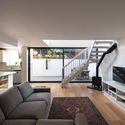
Architects: De Rosee Sa
- Area: 110 m²
- Year: 2016
-
Manufacturers: Barbers-flooring, Crittall, Fired Earth, Gareth Langdon, Silva Timber, +3
-
Professionals: Assent, BCS Consulting, Behan Partnership, eb7, Permenex


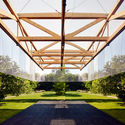
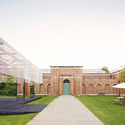
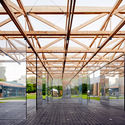
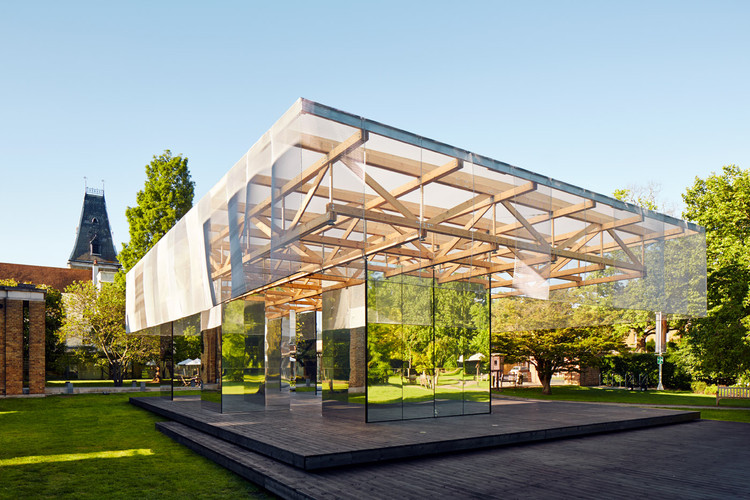
In a prototype developed for the 2016 London Design Festival, Arup Associates designed The Circular Building, one of the first buildings in the UK built to satisfy Circular Economy principles, in which “all components need to be implemented and utilized to their full potential and to the duration of their life cycle, while creating a comfortable and aesthetic environment for the user.”
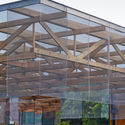
In order to achieve these goals, designers and engineers worked together to refine the application of prefabricated construction techniques, producing details that utilize finely tuned engineering rather than mechanical fixings. Through this methodology, the team was able to create a low-waste, self-supporting, and demountable structurally integrated panel (SIPs) wall system (which used cladding provided by Accoya) with reusable clamp connections between the wall and recycled steel frame elements, as well as sustainably sourced, heat treated timber for the cladding and decking.


In this essay by the British architect and academic Dr. Timothy Brittain-Catlin, the very notion of British postmodernism—today often referred to as intimately tied to the work of James Stirling and the the thinking of Charles Jencks—is held to the light. Its true origins, he argues, are more historically rooted.
I grew up in a beautiful late Victorian terrace with ornamental brickwork, shaped ‘Dutch’ gables and pretty arts and crafts stained glass windows – and so I didn’t think then, and I don’t think now, that I had much to learn from Las Vegas. It turns out that I wasn’t the only one. Of British architects who made their names as postmodernists in the 1980s, not a single one would say now that they owed much to Robert Venturi, the American architect widely considered to be a grandfather of movement.

Russian designer Konstantin Kolesov has created a collection of finely-crafted souvenirs celebrating iconic architectural landmarks from around the globe. The Jsouv Collection consists of 15 pieces, depicting landmarks from New York, London, Tokyo, Dubai and more. Crafted from solid aluminum, the souvenirs are accompanied by a natural walnut base engraved with a 2D emblem of the city in question. With the souvenirs currently being crowdfunded on Indiegogo, Jsouv is also offering a t-shirt collection with unique prints of each city and landmark.

The Barbican Centre in London is celebrating its 35th anniversary. Widely regarded as the pinnacle of the Brutalist movement, the mixed-use development is home to 4,000 residents, the Guildhall School of Music & Drama, and the London Symphony Orchestra. Located in the heart of London, the Barbican is just one example of how Brutalist architecture forms a central part of our cities. To celebrate this progressive, modernizing, sometimes controversial style, GoCompare has created an online gallery illustrating Brutalist icons from across the world.

Alison Brooks Architects has revealed designs for their first London highrise as the project receives planning permission. The mixed-use scheme will consist of a cluster of 4 residential towers of varying heights, with co-work and leisure at the ground floor and podium levels, contributing community value to the regeneration of London’s Greenwich Peninsula, the site of Roger Stirk Harbour + Partners’ O2 Arena and a future £1 Billion Mixed-Use Project by Santiago Calatrava.

The Leadenhall Building, designed by Rogers Stirk Harbour + Partners, has been sold to a Chinese property magnate for a price of £1.15 billion, in what has become the second-biggest sale of a UK building in history, as well as one of China’s largest acquisitions of UK real estate. The transaction involved developer British Land and its partner Oxford Properties, who sold the tower to CC Land, a Hong Kong based company.
Tim Roberts, head of offices and residential at British Land, said: “British Land and Oxford Properties took a bold step at the early stages of the UK’s economic recovery to develop the Leadenhall Building to generate a high-quality, long-term income stream,” said Tim Roberts, head of offices and residential at British Land. “This sale shows continued investor appetite for best-in-class, well-located property in London.”
Earlier this month, Hong Kong-owned developer Knight Dragon revealed plans for an billion-dollar urban-development scheme that will completely transform London’s Greenwich Peninsula. In this edition of Section D, Monocle 24's weekly review of design, architecture and craft, the team speak to Santiago Calatrava—who will be designing the core of this grand new project—about this and his public-spirited design philosophy. Why, they ask, has he’s always wanted to leave a mark on the "Big Smoke?"


A year since the passing of David Bowie, one of music and pop culture’s greatest icons, fans have launched a fundraising campaign to support the erection of a permanent memorial statue in London, in honor of the late musician.
“We’re taking the lightning flash from the cover of Aladdin Sane, and turning it into a three-storey tall sculpture,” explains Charlie Waterhouse of This Ain’t Rock ‘n’ Roll, one of the organizations behind the campaign, working in conjunction with David Bowie’s team.
It's common knowledge that China has "at least 10 White Houses, four Arcs de Triomphe, a couple of Great Sphinxes and at least one Eiffel Tower," report the New York Times. But now photographs of a copy of London’s famous Tower Bridge (a Victorian riparian gateway to the city) in the Chinese city of Suzhou have emerged – and it's been adapted to suit a five-lane highway. Almost identical—from a distance, at least—to its British counterpart the new structure, which was completed in 2012, has been doubled – a feat which has also required some spectacular architectural additions.

London-based firm Studioshaw has won a competition to design a hub facility for children and young people in Dundee, Scotland. The Interactive Hub will be located on the site of a former railway depot at the Seabraes Yards Digital Media Park. The competition, hosted by the Dundee Institute of Architects (DIA) and Scottish Enterprise, was one of 400 events taking place across Scotland as part of the RIAS 2016 Festival of Architecture.

The Harvard University Graduate School of Design in Massachusetts has announced the winners of the Richard Rogers Fellowship 2017. Launched in October 2016, the Fellowship seeks to act as an international platform assembling experts and practitioners from a broad range of disciplines, using the built environment to positively impact on the quality of human life. The six inaugural Fellows, selected from 200 applicants worldwide, will undertake three months of research at the Wimbledon House, a Grade II listed residence in London gifted to the School by world-renowned British architect Richard Rogers.

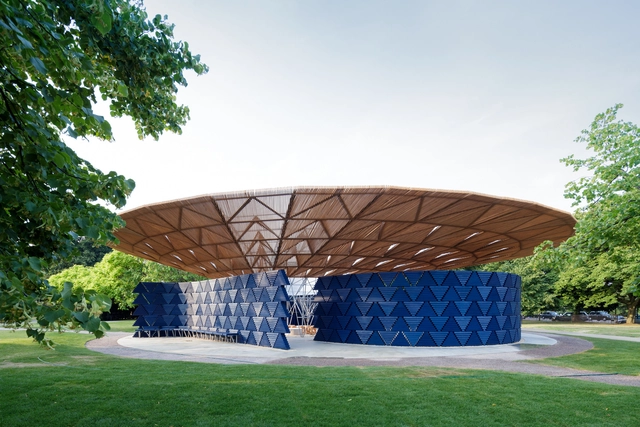
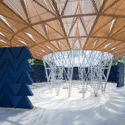
The Serpentine Galleries have announced that the 2017 Serpentine Pavilion will be designed by Diébédo Francis Kéré (Kéré Architecture), an African architect based between Berlin, Germany, and his home town of Gando in Burkino Faso. The design for the proposal, which will be built this summer in London's Kensington Gardens, comprises an expansive roof supported by a steel frame, mimicking the canopy of a tree. According to Kéré, the design for the roof stems from a tree that serves as the central meeting point for life in Gando. In line with the criteria for the selection of the Serpentine Pavilion architect Kéré has yet to have realised a permanent building in England.
.jpg?1487076478&format=webp&width=640&height=580)
As reported by the Architects' Journal, Rogers Stirk Harbour + Partners (RSHP)—the London-based practice led by Richard Rogers—have been selected, "following a developer-led competition," to expand the iconic British Library complex in London – designed by Colin St. John Wilson in 1962 and eventually completed in 1997. The national library is widely considered to be the largest public building ever constructed in the United Kingdom over the course of the 20th Century. In 2015, the buildings were awarded the highest level of Listed (protection) status.

In the 1960s James Stirling asked Ludwig Mies van der Rohe why he didn’t design utopian visions for new societies, like those of Frank Lloyd Wright’s Broadacre City or Corbusier’s Cité Radieuse. Mies replied that he wasn’t interested in fantasies, but only in “making the existing city beautiful.” When Stirling recounted the conversation several decades later it was to the audience of a public enquiry convened in London – he was desperately trying to save Mies’ only UK design from being rejected in planning.
It couldn’t be done: the scheme went unbuilt; the drawings were buried in a private archive. Now, for the first time in more than thirty years, Mies’ Mansion House Square will be presented to the public in both a forthcoming exhibition at the Royal Institute of British Architects (RIBA)—Mies van der Rohe and James Stirling: Circling the Square—and, if it is successful, a book currently being funded through Kickstarter by the REAL foundation.