Videos
Courtesy of Start.Home - Solar Decathlon Team Stanford
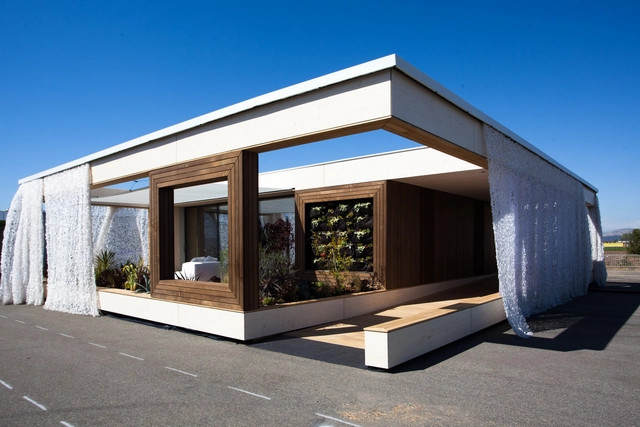
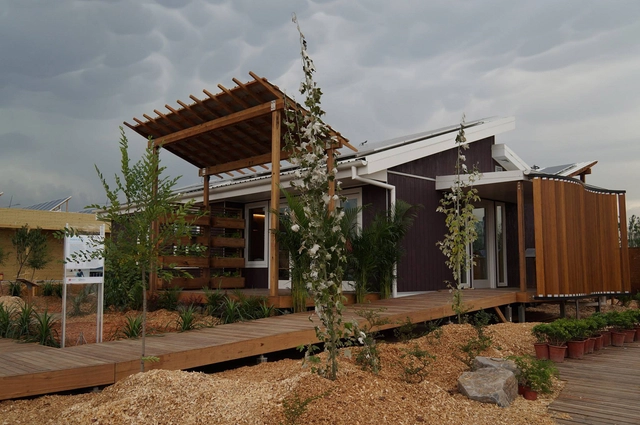
Stanford University's Start.Home has won fifth place overall and tied for first place in affordability in the 2013 Solar Decathlon. Read the team’s description to learn more:
For the U.S. Department of Energy Solar Decathlon 2013, Stanford University designed the Start.Home to provide energy efficiency at the push of a button to a new generation of environmentally conscious occupants. With modular architecture and advanced controls to optimize each component, the house aims to spark a revolution by lowering the entry barrier for an ultra-efficient house and making sustainability trendy, social, and affordable.
https://www.archdaily.com/440652/solar-decathlon-2013-stanford-university-places-fifth-overall-tied-first-in-affordabilityJose Luis Gabriel Cruz
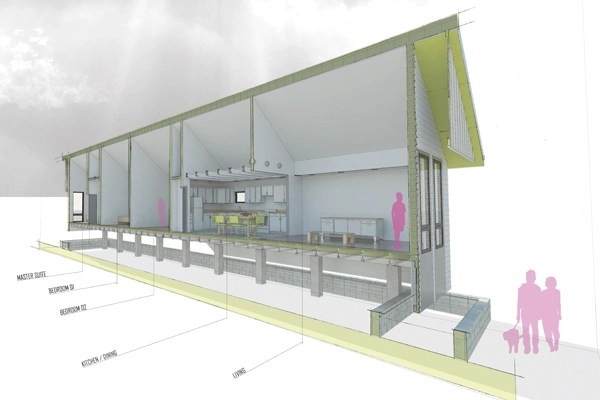
Text description provided by the architects. This "L-shaped" energy smart house by the Stevens Institute of Technology (SIT), dubbed Ecohabit, won second place in the architecture category and fourth overall in this year's Solar Decathlon competition. The L-concept divides the house into two modules, "wet" and "dry". Read the team's description to learn why:
https://www.archdaily.com/440261/solar-decathlon-2013-stevens-institute-of-technology-places-second-in-architecture-places-fourth-overallJose Luis Gabriel Cruz
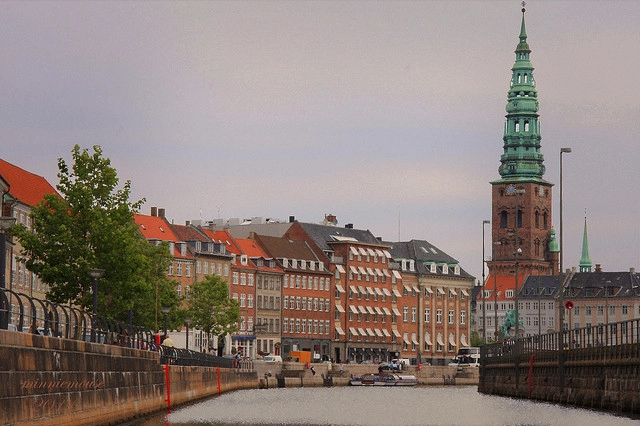
As explained by this article in the Guardian, planners in Copenhagen are thinking ahead - to the years 2050 and even 2100 - to propose plans that will cope with the storms and floods that will threaten the low-lying city due to climate change. From "percolating pavements," "pocket parks" and "cloudburst boulevards," read about some of the innovative measures they are proposing, many of which are now being adopted around the world, here.
Text description provided by the architects. Placing second overall, just a few points behind the winning 2013 Solar Decathlon team, students from the University of NevadaLas Vegas (Team Las Vegas) have won the “Market Appeal” contest at the Department of Energy’s (DOE) sixth solar-home competition. Known as “DesertSol”, the project was lauded for its “livability, marketability and constructability” as well as its “appeal within the housing market of the target client chosen by team.” It is designed to be a self-reliant, energy-efficient second home for upper-middle income Americans who pursue active lifestyles in the sparsely populated Mojave Desert. Read on for the team’s project description.
A team of Austrian students from Vienna University of Technology (Team Austria) has won top honors for “designing, building, and operating the most cost-effective, energy-efficient and attractive solar-powered house” at the 2013 U.S. Department of Energy (DOE) Solar Decathlon. The net-positive home, known as “LISI – Living inspired by sustainable innovation,” prides itself for being a simple, smart house that is capable of adapting to a variety of lifestyles and climate zones.
Prior to being crowned as winner, LISI competed against eighteen other student-built, solar-powered homes over the course of ten days in Irvine, California. This was the first time an Austrian university has participated in the U.S. Solar Decathlon. Learn more about the winning design by reading the team’s project description after the break.
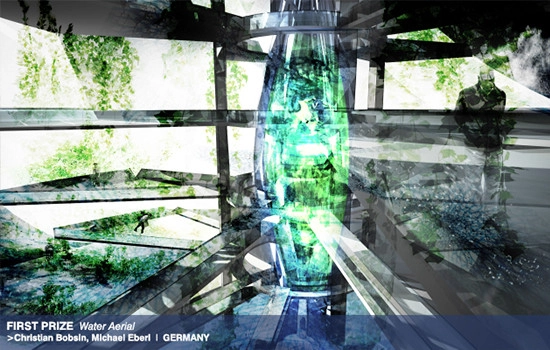
d3 has announced the winners of its Natural Systems Competition for 2013, an annual award that offers architects, designers, engineers and students the chance to investigate natural processes from the microscopic to macroscopic scale, and propose innovative and nature-based solutions in architecture, urbanism, interiors and product design for sustainable living.
The jury, a panel of architects and designers engaged in sustainable practices and computational explorations, has this year selected a top three as well as fourteen special mentions. Join us after the break for images from all 17 designs.
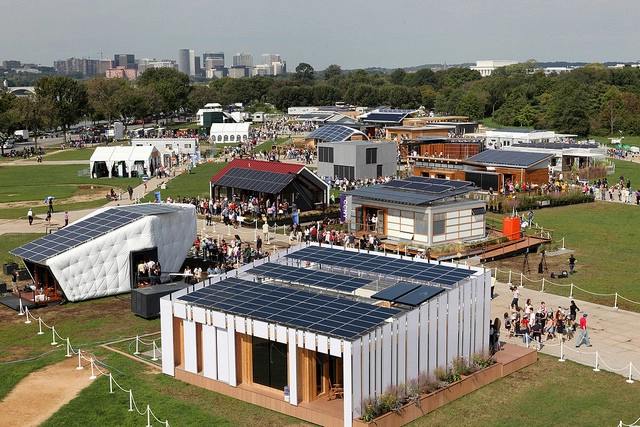
I don’t mean to poo poo the US Department of Energy’s Solar Decathlon project, but the more I hear about it the more I wonder if this isn’t an indication of just how far behind the United States is in terms of energy policy and the design of smart environments. Are we really that far behind that we need a program like this to prove this stuff really works? Are people still disbelieving? Do they really need demonstration homes to show how photovoltaics produce electricity or how sustainable principles can be applied to architecture? I suppose it makes sense in a country that still obsesses about the Case Study Houses and has debates about climate change.
The purpose of the Solar Decathlon is primarily to educate the public on high-performance building practices. Since 2002 when the DOE held the first one, it’s been putting “green” building in front of people who otherwise would not get to experience it—or, in reality, a self-selecting population of people who are probably already into such things.
The Oslo Architecture Triennale opened to the public last week, under the title “Behind the Green Door – Architecture and the desire for sustainability”. Rotor, the curators of the Triennale, collected over 600 objects carrying claims of sustainability from over 200 architecture offices, companies and environmental organizations across the world (read our interview with Rotor about the curation).
Experts from different fields share with us which the objects from the collection caught their attention and why. In this second and final part, Nanne de Ru (Powerhouse Company, Director of the Berlage Institute), Arild Eriksen and Joakim Skajaa (Eriksen Skajaa), Andres Lepik (Director of the Münich Architecture Museum), Nanna Bjerre Hjortenberg (The Danish Architecture Center), Willem Bruijn (Partner, Baumschlager Eberle) and Gilles Perraudin (Perraudin Architectes) tell us their what they think. From co-housing utopias, to a hospital that tries to stand over time due to its design and more.
The Triennale is open until December 1st, full programme here. Check the rest of the videos below:
Videos
At the Clinton Global Initiative (l to r) Robert Ivy, FAIA; New Orleans Mayor Mitch Landrieu; Cameron Sinclair, co-founder Architecture for Humanity; Former U.S. President Bill Clinton; Martyn Parker, Chairman Global Partnerships at Swiss Re; Alex Karp, co-founder Palantir; Judith Rodin, Ph.D, President of The Rockefeller Foundation. Image Courtesy of AIA
The AIA has decidedly found its latest buzz word: Resiliency.
Just this week at the 2013 Clinton Global Initiative Annual Meeting, former-president Bill Clinton announced the American Institute of Architects' participation in the 100 Resilient Cities Commitment: an initiative of the Rockefeller Foundation to provide 100 cities with "chief resilience offers," responsible for developing and financing new, resilient urban infrastructures. So far, over 500 cities have requested to participate; on December 3rd, the Rockefeller Foundation will announce the winning cities.
Along with Architecture for Humanity, the AIA will then train those cities' resilience officers, "architects in their communities," by creating "five Regional Resilient Design Studios that build on our profession’s collective expertise in helping communities recover in the wake of major disasters."
The Oslo Architecture Triennale opened to the public last week, under the title “Behind the Green Door – Architecture and the desire for sustainability”. Rotor, the curators of the Triennale, collected over 600 objects carrying claims of sustainability from over 200 architecture offices, companies and environmental organizations across the world (read our interview with Rotor about the curation).
Experts from different fields share with us which the objects from the collection caught their attention and why. In this first part Kjetil Trædal Thorsen (Snøhetta co-founder), Carolyn Steel (architect, author of The Hungry City and TED speaker), Karl Otto Ellefsen (Dean of Oslo School of Architecture and Design) and Arjen Oosterman (ARCHIS, Volume Magazine) tell us their what they think. From glass technology to filter light, to locally produced food and more.
The Triennale is open until December 1st, full programme here. Check the rest of the videos below:
Straw Paneling System Among Finalists. Image Courtesy of Ecococon via Cradle to Cradle
In attempts to better define what it really means to be green, the Cradle to CradleProducts Innovation Institute, in partnership with Make it Right, has selected products from ten companies as finalists in the Product Innovation Challenge. 144 applicants were screened by toxicologists and building professionals, proposing new alternatives from insulation grown from fungi and bricks from living organisms, to roofing made from waste limestone and recycled plastic. The ten finalists represent the shared values of practical sustainability and entrepreneurship, creating "a building product that is safe, healthy, affordable, effective and designed to be returned safely to nature or industry after use."
Three winners will ultimately be announced on November 15, 2013 at the Institute's Innovation Celebration in New York City, offering a $250,000 cash prize: $125,000 for first place, $75,000 for second and $50,000 for third. The jury members, who include executives from Google, US Green Building Council and the Schmidt Family Foundation, will judge each product based on five categories: material health, material reutilization, water stewardship, renewable energy and social fairness.
Without further ado, the 10 finalists are…
https://www.archdaily.com/429522/finalists-create-next-generation-of-sustainable-building-productsJose Luis Gabriel Cruz
Videos
Courtesy of Green Roof Consultancy and Treebox
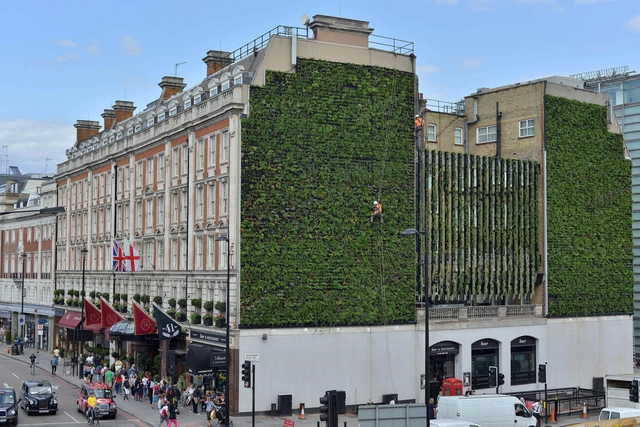
The Rubens at the Palace Hotel in Victoria, London, has unveiled the city's largest "living wall" - a vertical landscape, composed of 16 tons of soil and 10,000 plants, designed to reduce urban flooding. Taking two months to construct and covering a 350 square foot area, the 21 meter high wall will beautify the cityscape year round with seasonal flowers such as strawberries, butter cups and winter geraniums.
Because of the lack of absorbent surfaces in the Victoria area of London, the Victoria Business Improvement District (BID) decided to step in with the design of this incredible wall that combats urban flooding with special water storage tanks. Designed by Gary Grant of Green Roof Consultancy, these tanks can store up to 10,000 liters of water that are then channeled back through the wall to nourish the plants. Not only will the wall do a great job of keeping the surrounding streets flood-free, it boosts the area's green appeal and attracts wildlife into the dense urban environment.
Hugo Oliveira: Architects like Alison and Peter Smithson believed that they could transform people’s lives for the better through architecture. Is this sort of innocence important?
Alain de Botton: The Smithson’s ambition is terrific. The problem is that architects can’t change the world until they become developers. At the moment, the best of our architects are merely hired jesters designed to enliven the egos and bank balances of large property developers.
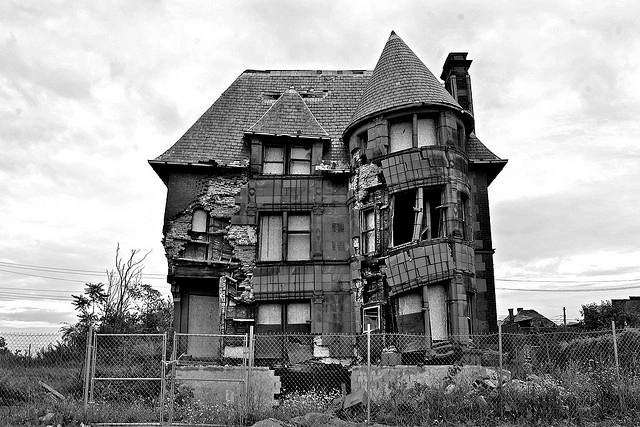
As architects we generally see ourselves as providers of new buildings; we also often see architecture as a way to remedy social ills. For many architects, when presented with a social problem, we try to think of a design for a building which addresses it. But what happens when the problem itself is a surplus of buildings?
This is exactly the situation that Detroit finds itself in today. Thanks to the rapid decline in population since its heyday in the mid 20th Century, the City of Detroit is home to some 78,000 vacant structures. While politicians worldwide win public support by promising new construction and growth, Detroit Mayor Dave Bing proudly announced his plans to demolish 10,000 empty homes before the end of his term.
The process will be inherently wasteful. Fortunately, some are making the best of the situation, with sustainable initiatives that create jobs and economic benefits for residents. Read on after the break to find out how.
In this interview with BD, Richard J Williams discusses his recent book "Sex and Buildings," which analyses how some places, such as his home town of Edinburgh, "wear their morality on their sleeve," while other places. such as Brazil, have an idea that "modernism can be sexy." He also talks about the US attitudes to sex and modernism, bringing up the 'Playboy townhouse' of the 1960s and the TV show Mad Men, as well as architects Richard Neutra, Rudolph Schindler and John Portman. You can read the full interview here.
One of the United States’ most polluted bodies of water is about to receive a much needed make-over: In early 2014, construction will begin on a pollution-preventing greenscape that will run alongside Brooklyn’s Gowanus Canal. The proposal, dubbed Sponge Park, was envisioned more than five years ago by Susannah Drake of dlandstudioand has just now “soaked up” enough funds to move forward.
Team UOW from the University of Wollongong in Australia has been awarded first place at the 2013 Solar Decathlon China, taking top honors for its net-zero, water-conserving design. Selected from 22 teams and 35 universities, Team UOW’s winning entry - the Illawarra Flame House - was the first retrofitted house ever to be submitted in decathlon history.