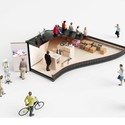
Structural prototype by the makeLab™at LTU. Image courtesy of LTU
Detroit is a long-standing symbol of innovation in America, especially in the production of automobiles, music, and, at one point in history, airplanes. It has, correspondingly, been called the Motor City, Motown, and the Cradle of Democracy. Over the last half-century, racial tension, urban migration, and disinvestment have shifted the city’s identity, causing it to become a symbol of post-industrial America and the attendant urban deterioration. Together, these elements render Detroit’s more recent nickname—the Renaissance City—tragically ironic.
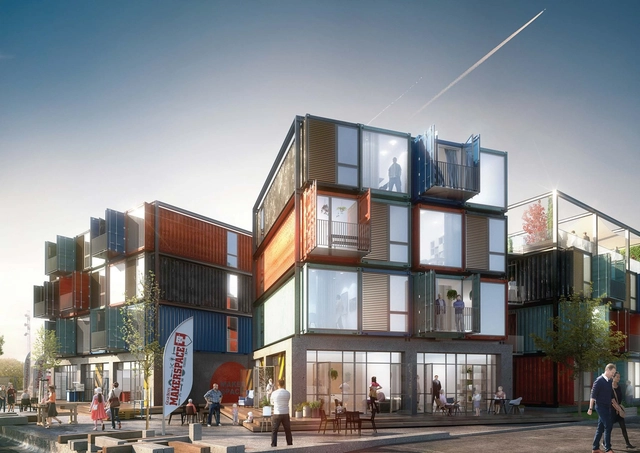
Beat Box: 30 apartments in 48 containers to transform the Danish neighborhood of Musicon, adjacent to the famous Roskilde Festival area. Designed by Arkitema Architects and constructed by Container Living, Beat Box is an integral part of Roskilde’s goal to revamp Musicon over the next 15 years by adding 1,000 jobs and 1,000 homes.
Recycling material in architecture is becoming increasingly valued in order to enable the creation of sustainable projects. Certainly, naval containers have been one of the elements that have gained prominence in recent years for the design of private and public buildings that respect the environment. In addition to the ecological appeal, containers are a viable choice due to the speed and ease of assembly, the option of a cleaner construction site, or even the different design solutions that this material provides. With their standardized sizes, it becomes possible to create a modular structure that allows infinite possibilities of intervention, so that it suits different uses.
We have gathered here 20 examples of works that adopt the use of containers and some tips that will certainly help you on your next project.
Blossoming from the rugged terrain of the California desert, Whitaker Studio’sJoshua Tree Residence is taking shipping container architecture to the next level. Set to begin construction in 2018, the home is laid out in a starburst of containers, each oriented to maximize views, provide abundant natural light or to create privacy dependent on their location and use.
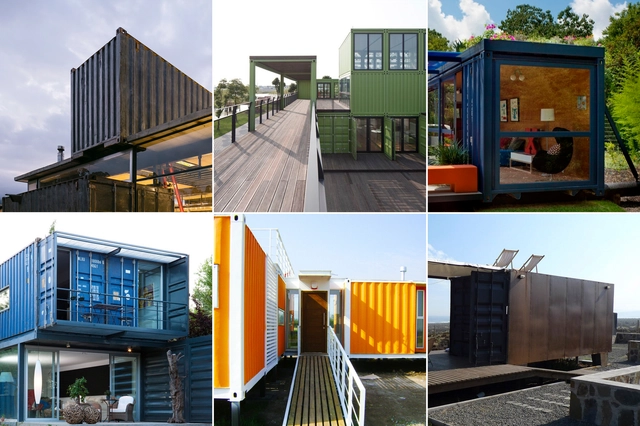
Photographs: Lorena Darquea Schettini - Rubén Rivera Peede - Chris Cooper - Bartosz Kolonko - Pablo Errázuriz - Pablo Sarabia. Image
Shipping container architecture has developed its own niche in both design and representation. Colorful or grungy? Economical or gentrified? Either way, you look at it, designing with shipping containers is a serious exercise in modular planning. The physical constraints of the object make designing projects with containers a complex task, which demands specific studies in spatial organization.
The responses using this element in architecture are great and diverse, so we have selected a number of different project plans, both helpful and inspirational, that rise to the shipping container-challenge of design.
Check out selection of 10 architectural project plans using shipping containers below:
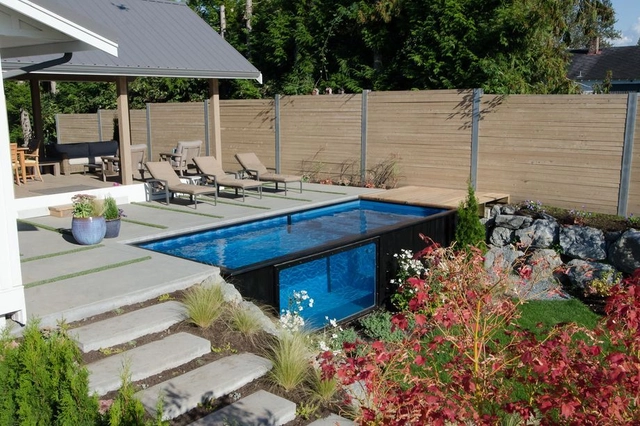
From high rises to housing to kiosks and disaster relief, shipping containers have become a more common architectural tool over the past few years. Now, Canada-based company Modpool has unveiled yet another use for shipping containers—backyard swimming pools and hot tubs.
Designed to be modular and simple to install, the pools are shipped with all necessary equipment—including a UV water cleaning system built in so that only light ground prep and power and gas access are necessary before the spaces are ready to use.
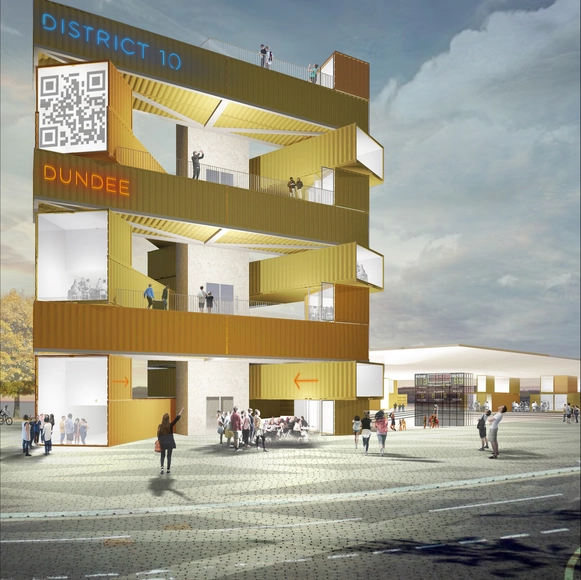
Flexible studios to aid Dundee's thriving digital creative sector. Image Courtesy of Studioshaw
London-based firm Studioshaw has won a competition to design a hub facility for children and young people in Dundee, Scotland. The Interactive Hub will be located on the site of a former railway depot at the Seabraes Yards Digital Media Park. The competition, hosted by the Dundee Institute of Architects (DIA) and Scottish Enterprise, was one of 400 events taking place across Scotland as part of the RIAS 2016 Festival of Architecture.
Videos
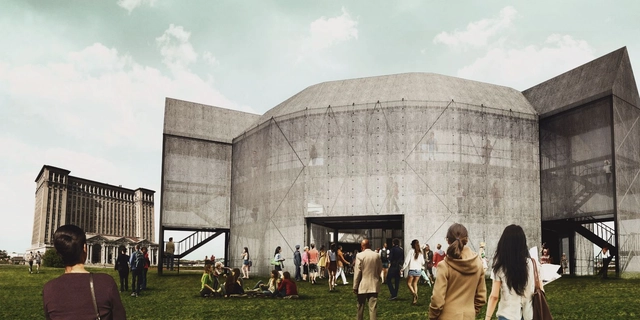
Globe by Michigan Station, Detroit. Image Courtesy of The Container Globe
All the world’s a stage – quite literally so, in the case of the Container Globe, a proposal to reconstruct a version of Shakespeare’s famous Globe Theatre with shipping containers. Staying true to the design of the original Globe Theatre in London, the Container Globe sees repurposed containers come together in a familiar form, but in steel rather than wood. Founder Angus Vail hopes this change in building component will give the Container Globe both a "punk rock" element and international mobility, making it as mobile as the shipping containers that make up its structure.
The Go Beyond: Design Challenge is unique from usual design competitions because it funds the construction of a working prototype in addition to offering prize money. This is an international design competition organized by the Singapore-based ONG FOUNDATION for architects, engineers, designers and innovators to create new-to-the-world solutions. Every year, about two million shipping containers are no longer used. What if these could be upcycled into sustainable architecture to reduce the total carbon footprint of global development?
Four Dutch designers—Chris Collaris, Ruben Esser, Sander Bakker and Patrick van der Gronde—have envisioned a sustainable design of re-use for a discarded oil tanker in the Southern Gulf Region, which they have entitled The Black Gold. They believe that the oil tanker is the "perfect icon" for representing "the geographic, economic and cultural history of the Arabic oil states" – an icon which they predict will become more and more obsolete as the supply of crude oil is moved away from shipping and into pipe infrastructure.
At ArchDaily, we believe it's important to keep our readers up to date on all the most interesting developments in architecture. Sometimes, we will present ideas and projects with a critical eye; however, in many cases we simply present ideas neutrally in the hope that it will spark some discussion or critical response within the profession. Recently, a series of connected news articles about proposals for high-rise shipping-container housing provoked just such a response from Mark Hogan, principle at San Francisco-based firm OpenScope. Originally posted on his blog Markasaurus here's his reasoning for why, contrary to the hype, "shipping containers are not a 'solution' for mass housing."
What’s wrong with shipping container buildings? Nothing, if they’re used for the right purpose. For a temporary facility, where an owner desires the shipping container aesthetic, they can be a good fit (look, I’ve even done a container project!). For sites where on-site construction is not feasible or desirable, fitting a container out in the factory can be a sensible option, even though you’ll still have to do things like pour foundations on site. It probably won’t save you any money over conventional construction (and very well might cost more), but it can solve some other problems.
The place where containers really don’t make any sense is housing. I know you’ve seen all the proposals, often done with an humanitarian angle (building slum housing, housing for refugees etc) that promise a factory-built "solution" to the housing "problem" but often positioned as a luxury product as well.
Ganti + Asociates (GA) Design has won an international ideas competition with a radical shipping container skyscraper that was envisioned to provide temporary housing in Mumbai's overpopulated Dharavi Slum. Taking in consideration that steel shipping containers can be stacked up to 10 stories high without any additional support, GA's winning scheme calls for a 100-meter-tall highrise comprised of a series of self supported container clusters divided by steel girders placed every 8 stories.
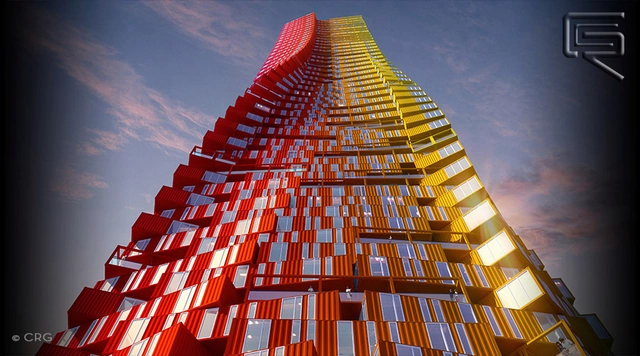
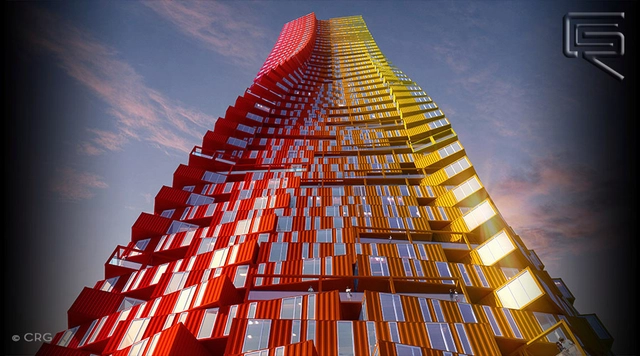
CRG Architects has won third prize in an ideas competition focused on providing temporary housing in Mumbai, India. Set with in the heavily populated Dharavi Slum, CRG's “Containscrapers” propose to house 5,000 city dwellers by stacking 2,500 shipping containers up to heights of 400-meters. If built, the radical proposal would be supported by a concrete structure and offer a range of housing options, from flats to three bedroom residences.
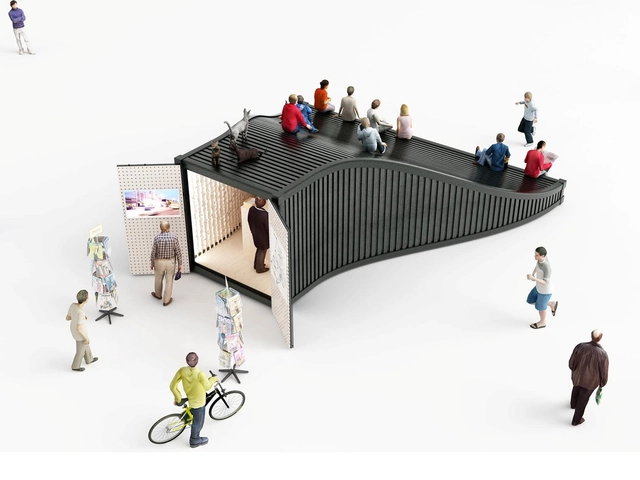
Information kiosk. Image Courtesy of NL Architects
Fashion, design and architecture collide in Zaha Hadid's recently completed Dongdaemun Design Plaza, one South Korea's most popular tourist destinations. Commissioned by the Design Plaza's Supervisor of Public Space Young Joon Kim of yo2 Architects, the latest development for the plaza is a series of compact kiosks designed to activate the expansive public space surrounding the new building. One of ten teams invited to submit ideas for these new kiosks, Amsterdam-based NL Architects developed a series of impermanent but practical solutions for the plaza. Using new methods for reuse of standard shipping containers, the team proposed a host of kiosks, with two of their designs - an information booth and a miniature exhibition space - being accepted for construction.
See all of NL Architects' Zaha-inspired shipping container kiosks after the break
2013 KOBE Biennale visitors had the opportunity to experience the magic of a kaleidoscope in a whole new way thanks to Saya Miyazaki and Masakazu Shiranes' award-winning installation. The psychedelic polyhedral installation was designed for the Art Container Contest, which challenged participants to create interesting environments within the confines of a single shipping container. As visitors meandered through the installation, they became active participants – rather than passive observers – in the kaleidoscope's constantly changing appearance. For more images and information, continue after the break.
Courtesy of Citiq Property Developers, via Inhabitat
Inhabitat has just featured an unlikely new student housing project in Johannesburg: Mill Junction, a student complex that consists of two former grain silos topped with shipping containers. According to its developers, Citiq Property Developers, the energy and money-saving project re-directs money towards communal facilities, proving popular with students. As a result, Mill Junction, the second shipping-container housing project built by the Developers, may be the second of many more. More info at Inhabitat.
Czech architect Ales Javurek has been awarded first prize in the [AC-CA] Architectural Competition for his design of a two-story, 340 square meter vacation home utilizing shipping containers in Sydney, Australia. The proposal situates the home on the edge of a 1500 square meter hillside to maximize the striking panoramic view of Bondi Beach. By preserving current trees and the slope's profile, consisting of "three platforms," the proposal successfully addresses the main brief: to design a contemporary, sustainable vacation house which sensitively fits into its context and considers Sydney's climate conditions.
Learn more after the break…
https://www.archdaily.com/461443/sustainable-house-design-by-czech-architect-selected-for-sydney-s-bondi-beachJose Luis Gabriel Cruz















.jpg?1474243524 "Globe in Waitangi Park, Wellington NZ. Image Courtesy of The Container Globe")