9 years ago today, ArchDaily launched with a challenging mission: to provide inspiration,knowledge and tools to the architects tasked with designing for the 3 billion people that will move into cities in the next 40 years. Over these 9 years, as we have developed innovative approaches to help architects tackle the urban challenges facing our world, our work has brought us into contact with some of the most creative and respected architects in the world. To help us celebrate our 9th birthday, we asked 9 architects who are renowned for their creative and imaginative abilities to create drawings inspired by our logo, to show the world what ArchDaily means to them.
https://www.archdaily.com/866860/9-drawings-to-celebrate-our-9th-birthdayAD Editorial Team
It is often said that architecture only makes projects more expensive; that architects only add a series of arbitrary and capricious complexities that could be avoided to lower costs, suggesting that the project could function exactly the same without them. Is this true in all cases? Although they may be more profitable economically, human beings don't seem to be happy inhabiting cold concrete boxes without receiving sunlight or a breeze every now and then, or in an unsafe neighborhood where there's no possibility to meet your friends and family outdoors. Quality in architecture is a value that sooner or later will deliver something in return.
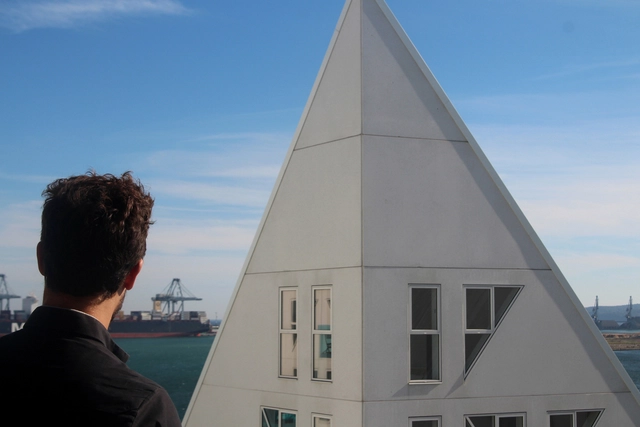
Balance is key, and a good design will never be complete if it's not economically efficient. How do we achieve this ideal? We reviewed the design process for 'The Iceberg' in Aarhus, Denmark, a project that managed to convince the authorities and investors by proposing a high-impact and tight-budget design, which seeks to respond to the objective of guaranteeing the quality of life of its users and their neighbors.
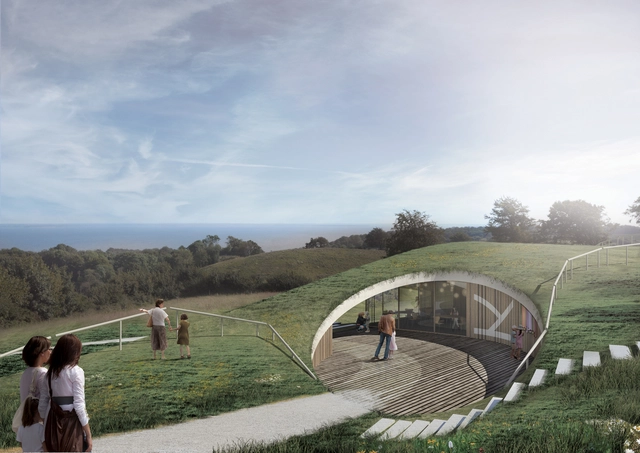
CEBRA Architects has won the competition to design the Skamlingsbanken Visitor Center near Sjølund in Southern Denmark. At 113 meters above sea level, Skamlingsbanken is the highest point in South Jutland and historically has been an important meeting place, serving as the backdrop for some of Denmark's key historical public speeches. The new visitor center is posited as a way to restore this historic importance, and once again make Skamlingsbanken a local meeting place.
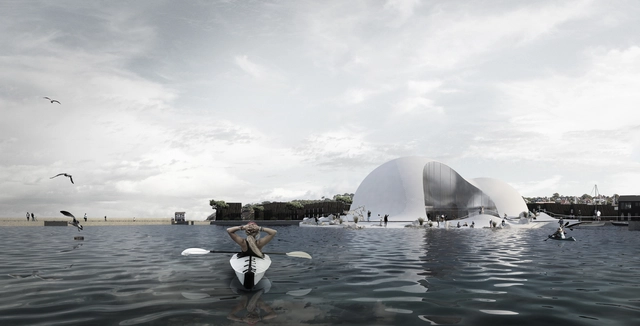
Danish firm CEBRA has released images of ARCTIC, a new museum and research center dedicated to the study and education of Greenland and the Arctic, to be located along the Hundested harbour in Halsnæs, Denmark. Although Greenland has been a part of the Kingdom of Denmark for over 600 years, ARCTIC will be the first museum or center that communicates the relationship between these countries through historic, contemporary and future perspectives.
Courtesy of CEBRA (Architecture) & SLA (Landscape)
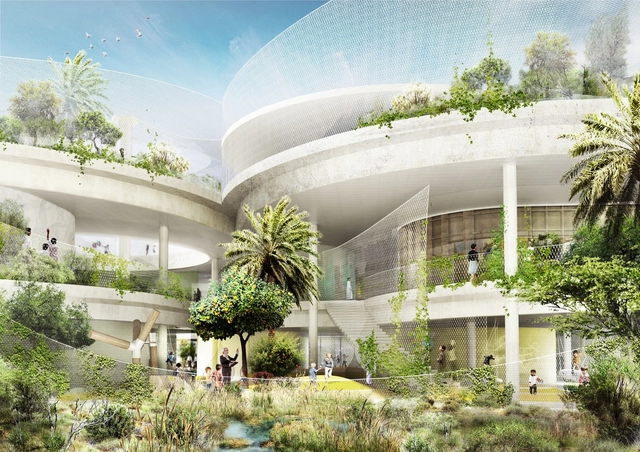
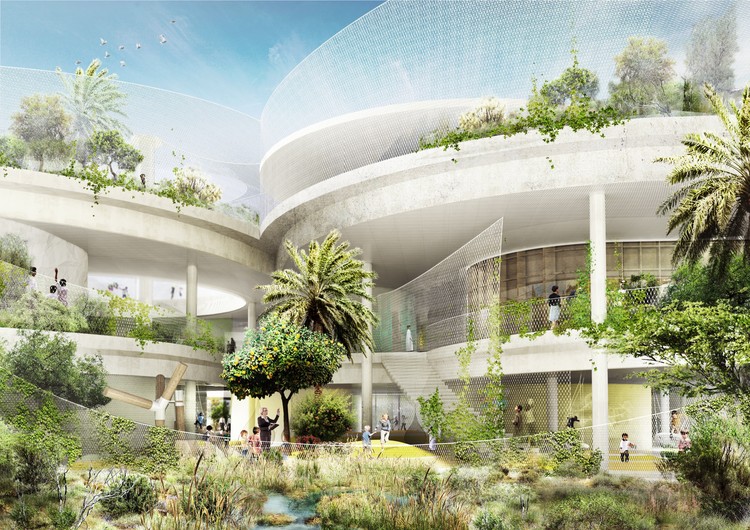
CEBRA, in collaboration with landscape architect SLA, has designed the Sustainable School for The Sustainable City in Dubai. In opposition to hot-climate educational environments that are often large, air-conditioned structures, CEBRA’s vision for The Sustainable City proposes a permeability between outdoor and indoor learning environments, utilizing both in equal measure.
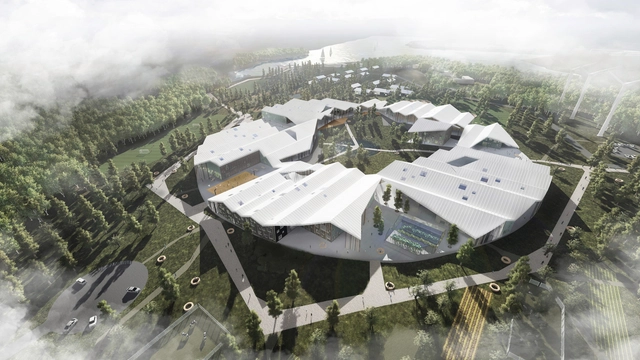
Denmark-based architectsCEBRA have won a competition to design a Smart School educational complex in Irkutsk, Russia. Their winning design, dubbed Smart School Meadow, fulfills the competition’s call for a new typology of school that combines architecture and landscaping into a learning environment and local community center.
The design integrates buildings and landscape together through a ring of individual structures connected by a large, ridged rooftop. With this roof, spaces between the buildings can be used as multifunctional, semi-covered learning spaces, activity zones, and flow areas, all of which diffuse into the central and outer landscaped areas.
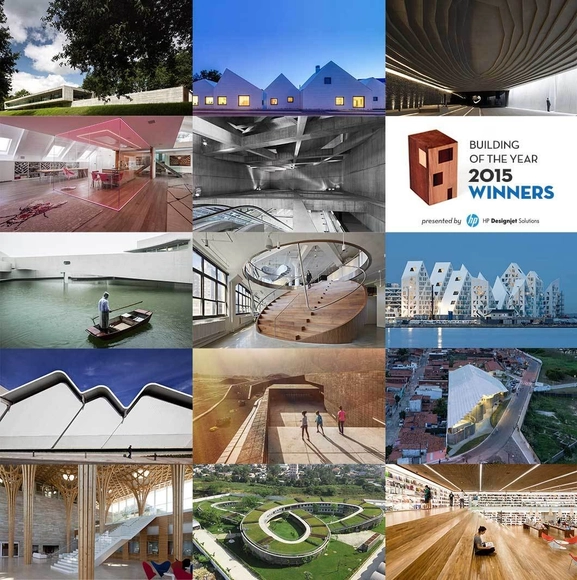
With our annual Building of the Year Awards, over 30,000 readers narrowed down over 3,000 projects, selecting just 14 as the best examples of architecture that ArchDaily has published in the past year. The results have been celebrated and widely shared, of course, usually in the form of images of each project. But what is often forgotten in this flurry of image sharing is that every one of these 14 projects has a backstory of significance which adds to our understanding of their architectural quality.
Some of these projects are intelligent responses to pressing social issues, others are twists on a well-established typology. Others still are simply supreme examples of architectural dexterity. In order that we don't forget the tremendous amount of effort that goes into creating each of these architectural masterpieces, continue reading after the break for the 14 stories that defined this year's Building of the Year Awards.
After two weeks of nominations and voting, we are pleased to present the winners of the 2015 ArchDaily Building of the Year Awards. As a peer-based, crowdsourced architecture award, the results shown here represent the collective intelligence of 31,000 architects, filtering the best architecture from over 3,000 projects featured on ArchDaily during the past year.
The winning buildings represent a diverse group of architects, from Pritzker Prize winners such as Álvaro Siza, Herzog & de Meuron and Shigeru Ban, to up-and-coming practices such as EFFEKT and Building which have so far been less widely covered by the media. In many cases their designs may be the most visually striking, but each also approaches its context and program in a unique way to solve social, environmental or economic challenges in communities around the world. By publishing them on ArchDaily, these buildings have helped us to impart inspiration and knowledge to architects around the world, furthering our mission. So to everyone who participated by either nominating or voting for a shortlisted project, thank you for being a part of this amazing process, where the voices of architects from all over the world unite to form one strong, intelligent, forward-thinking message.
Danish architectsElkiær + Ebbeskov (E+E) andLeth & Gori have won an invited competition to design a large multifunctional sports building in Langvang, Denmark. Competing against teams led by Dorte Mandrup Arkitekter, CEBRA, COBE and Kontur, their winning proposal features a combined sports hall and community centre consisting of a series of multifunctional arenas for activities and events. The scheme also includes a masterplan of the surrounding area centeredaround sports and recreation.
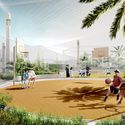
CEBRA’s latest landscape project situated in Kildebjerg Ry near Arhus, Denmark, is a bit out of the ordinary. Moving beyond providing flora, walkways and simple playground amenities, the Pulse Park will feature three distinct activity zones that will provide a place for fitness, meditation and play to benefit the residential and business areas nearby. These zones create an activating framework for physical activities and exercise while forming an integrated part of the surrounding landscape.
Architect: CEBRA Location: Tuborg Havnevej 7, Hellerup, DK Client: Experimentarium Area: Approximately 30.000 m2 modernization and extension Program: Center for Natural Science and Technology Competition Year: 2011 Completion Year: 2015
After placing first in the design competition to transform an old mineral water bottling plant into a Science Center, CEBRA will move forward with the adapted proposal upon receipt of a substantial donation from the The A.P. Møller and Chastine Mc-Kinney Møller Foundation. The original building will be restored to serve as an interactive national center for science, technology and culture and house the Experimentarium’s diverse exhibition and education activities for the neighboring communities. CEBRA’s solution of layering a new expression on the historic entity brings science to the forefront while acknowledging contextual cues that create links back to its surroundings.
Our friends from CEBRA will team with Tækker and Grassat to design the Prinsesse Charlottes Gade 42 day care and after-school center in Copenhagen. The project will convert two existing preservation-worthy buildings from 1875 into a day care center complete with outdoor areas for approximately 225 children. CEBRA has a strong portfolio of educational design - some of our favorites include the Youth Recreation & Culture Center designed with Dorte Mandrup; Design Kindergarten; Egmont High School and the Kristiansand Cathedral School Gimle - so we are looking forward to what this design process will bring about. As the project unfolds, we will keep you informed with the latest.
In cooperation with engineers LB Consult, CEBRA recently won the competition for 48 new student housing units in Esbjerg, Denmark’s 5th largest city. The eye-catching proposal consists of 26,910 sq. ft. apartments spread across ten floors and outdoor areas with terraces and activity zones such as a street basket field. The project is commissioned by the housing association Ungdomsbo and they expect that the first students can move in in January 2014. More images and architects’ description after the break.
Danish firm, CEBRA, was recently awarded first prize for their new education center in Odense. The building explores how curved forms can penetrate and define the rectilinear confines of the 134,550 sqf school building. Soft curving levels open to floors below and provide a mixing of visual and auditory experiences in a dynamically changing environment. Moreover, such levels provide a flexible learning environment, with “the human-being placed at the center.”
More about the project after the break, including CEBRA’s awesome hand renderings.
We recently received a monograph of Cebra’s work. This young firm is energetic, pushes the boundaries, goes after competitions, and has been successful in pushing many projects into reality. We are fan their work and have featured Cebra 16 separate times here on archdaily. Additionally, David Basulto, co-founder of ArchDaily, has become good friends with Mikkel Frost through an email correspondence interview that took place over the 4 months. The interview is prominently featured in the introduction of the book and makes for an interesting read.
https://www.archdaily.com/181664/cebra-files-02Christopher Henry
We’ve been coveringCEBRA + JDS + SeARCH + Louis Paillard’s geometric harbor project for Arhus, Denmark. The huge project, which measures over 21,000 sqm, will include mixed dwellings types and commercial space. CEBRA has shared a few short video clips with us, highlighting the progress of the project. This featured clip is shot from the bridge connecting the future harbor promenade across the nearby canal. The grey concrete wall shown is the beginning of the southern facade (the actual floor is on top of the wall) and behind the wall is where the parking is situated.
Another video, as well as a few construction photos, after the break.
Denmark-based CEBRA shared with us their winning proposal for a competition to design an office building in Holstebro. More images and architect’s description after the break.











.jpg?1423165556&format=webp&width=640&height=580)
.jpg?1423154144)


