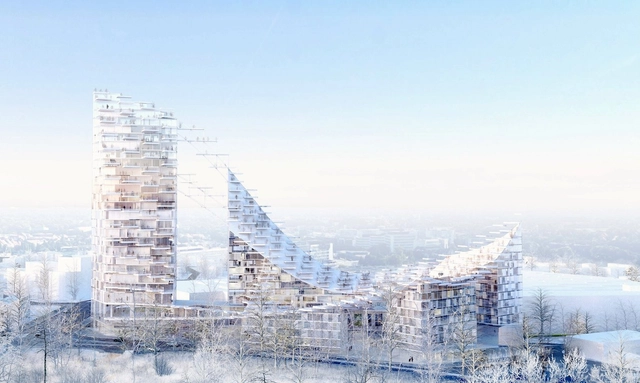
The Japanese/Belgian team of Sou Fujimoto Architects and AWAA has been selected as the winners of an international competition for the design of a new tower to be located at a significant crossroads in the outer Brussels municipality of Auderghem.
Led by developer Unibra and construction company Thomas & Piron, the competition asked architects to propose a new mixed-use urban development of between 25,000 and 50,000 square meters that would activate the the prominent triangular site at the corner of the Herrmann-Debroux viaduct and the Boulevard du Triomphe.
Early renderings for the project show a series of sloping residential highrises growing out of a mixed-use podium, including one taller tower and a longer building featuring a concave roof. The various structures appear to be connected at key points via lightweight terraces housing plantings.
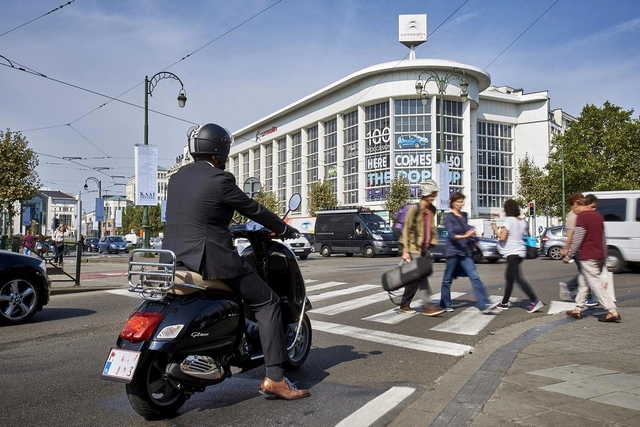
The Urban Development Corporation (SAU-MSI) has announced the seven shortlisted teams competing for the design of the latest Centre Pompidou outpost in Brussels, Belgium. The finalist teams were selected from 92 entries to the competition, which sought proposals to transform the existing Art Deco Citroën Yser garage in the heart of the city into a mixed-use museum complex focusing on contemporary art and architecture.
To be known as the Citroën Cultural Centre, the $135 Million project will consist of 375,000 square feet (35,000 square meters) of public cultural, education and recreation space, including 160,000 square feet (15,000 square meters) designated for the new Centre PompidouBrussels. An additional 108,000 square feet (10,000 square meters) will host a museum run by Brussels’ International Centre for Urbanism, Architecture & Landscape.
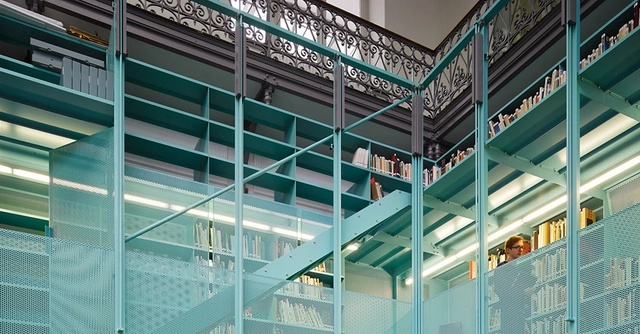
Courtesy of OFFICE Kersten Geers David Van Severen
In this episode of GSAPP Conversations, Kersten Geers—co-founder of OFFICE KGDVS—and Amale Andraos discuss their shared obsession with books, and the integral role that book-making plays in their professional offices and teaching. In this podcast, Geers echoes Aldo Rossi’s call to evaluate architecture within a cultural context, positioning books as the best tool to create a place in which architectural work acquires value and meaning; a device to establish a context of ideas.
https://www.archdaily.com/875464/kersten-geers-office-kgdvs-on-the-role-of-book-making-in-architectural-practice-amale-andraos-gsapp-conversationsAD Editorial Team
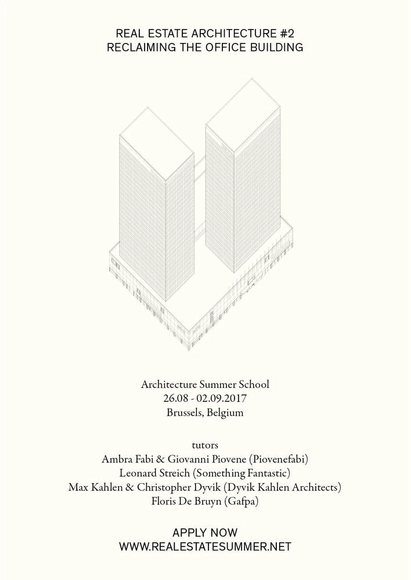
The international Summer School will take place in Brussels from from August 26th to September 2nd. Forty students and recently graduated architects will be invited to rethink the future of the office buildings, products of the real estate boom of the 1960s. Participants will be led by four talented architects: Piovenefabi (Milan), Gafpa (Ghent), Something Fantastic (Berlin) and Dyvik Kahlen (London).
Courtesy of Wikimedia user Zinneke (licensed under CC BY-SA 3.0)
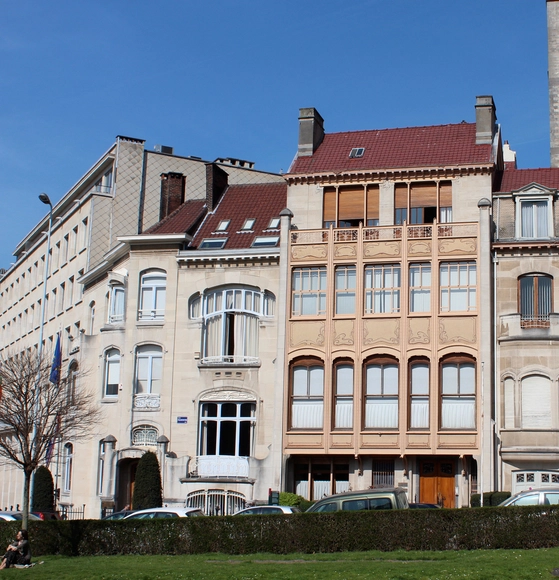
To the contemporary observer, the flowing lines and naturalistic ornamentation of Art Nouveau do not appear particularly radical. To some, Art Nouveau may even seem to be the dying gasp of 19th Century Classicism just before the unmistakably modern Art Deco and International Styles supplanted it as the design modes of choice. The Hôtel van Eetvelde, designed in 1897 by Victor Horta—the architect considered to be the father of Art Nouveau—suggests a different story. With its innovative spatial strategy and expressive use of new industrial materials, the Hôtel van Eetvelde is a testament to the novelty of the “New Art.”
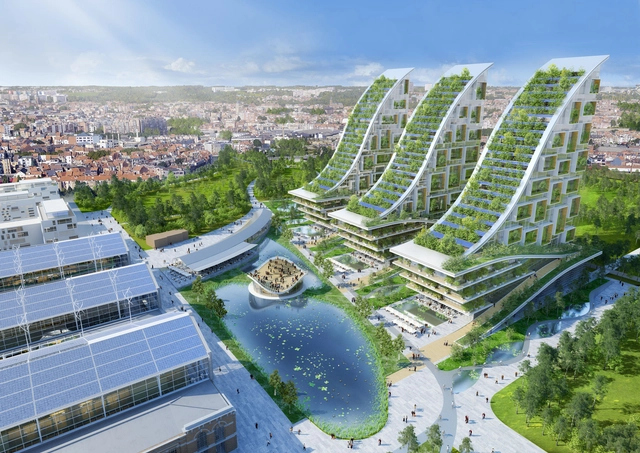
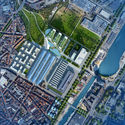
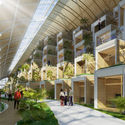
Vincent Callebaut Architectures has released plans for the development of a radical eco-neighborhood at Tour & Taxis, Brussels, Belgium. Covering an area of 135,000 square meters, the proposal will see the redevelopment of the early twentieth-century Gare Maritime, and the construction of three residential “vertical forests” reaching 100 meters in height. The architect’s ultimate vision is a neighborhood which embraces technological progress, sustainable building principles, and renewal of the built heritage.
Situated northwest of Brussels city center, and constructed in 1907, the industrial park at Tour & Taxis originally operated as a shipping and customs complex. Whilst the lifting of European customs borders has rendered its original function obsolete, the Gare Maritime (Marine Terminal) still embodies the architecture of the industrial era.
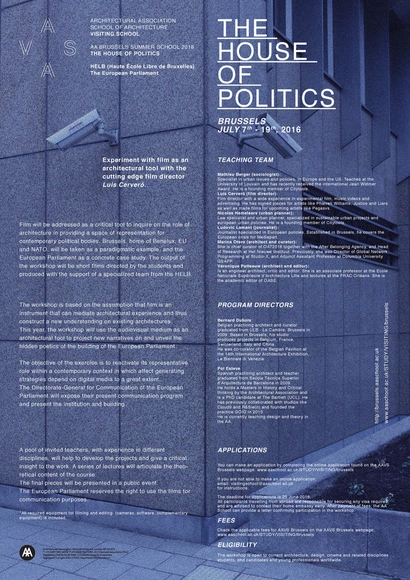
In AAVS Brussels you will experiment with film with the cutting edge film director Luis Cerveró. Film will be addressed as a critical instrument to inquire on the role of architecture in providing a space of representation for contemporary political bodies. Brussels, home of Benelux, EU and NATO, will be taken as a paradigmatic example, and the European Parliament as a concrete case study. The output of the workshop will be short films directed by the students and produced with the support of a specialized team from the HELB.
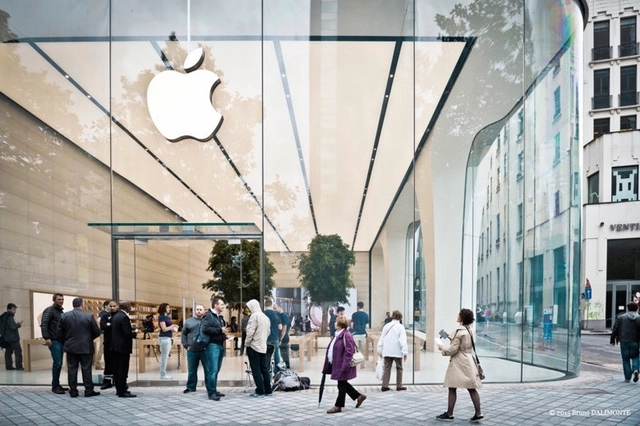
Jony Ive, Apple's Chief Design Officer, has celebrated the opening of his first store in Brussels, Belgium. Like The Verge reports, at first glance the store's design seems somewhat predictable - large panes of glass, a simplistic and open feel. However, under Ive's guidance, the new store (and future stores) now feature a grove of potted trees and a heightened focus on natural materials, in particular wood. Read on to take a closer look.
For this edition of The Urbanist, Monocle 24's weekly "guide to making better cities," the team investigate politics in global "power cities." Visiting Brussels, capital of Belgium and administrative capital of the European Union, they explore how politics have changed the city over the last four decades. Further south, they travel to Vienna which, "diplomatically remains very important and wields power." Yet even though the UN have an outpost there, is the Austrian capital still a stage for international diplomacy? The episode also makes a quick stop at Embassy Row in Washington D.C. to examine the architecture of diplomatic design.
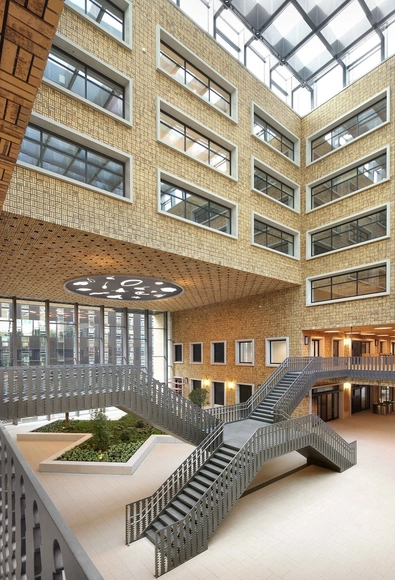
Neutelings Riedijk Architects has begun construction on the Herman Teirlinck Building, which, when complete, will be the largest passive office building in Belgium, serving as a mixed-use center for the Flemish government.
The 66,500 square-meter building, located in Brussels, will be built along the canal on the site of Tour & Taxis, one of the last large-scale development locations in the heart of the city, in hopes that it will transform the area into “a new high-quality green urban district with mixed functions.”






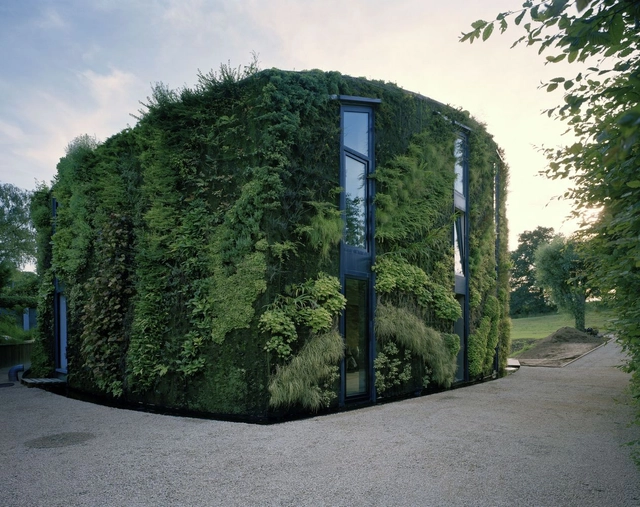
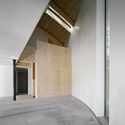
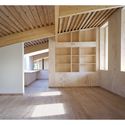
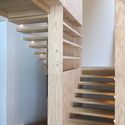










.jpg?1465360444 "© Tim Van de Velde")
.jpg?1465360218 "© Tim Van de Velde")