This article was originally published on November 25, 2014. To read the stories behind other celebrated architecture projects, visit our AD Classics section.
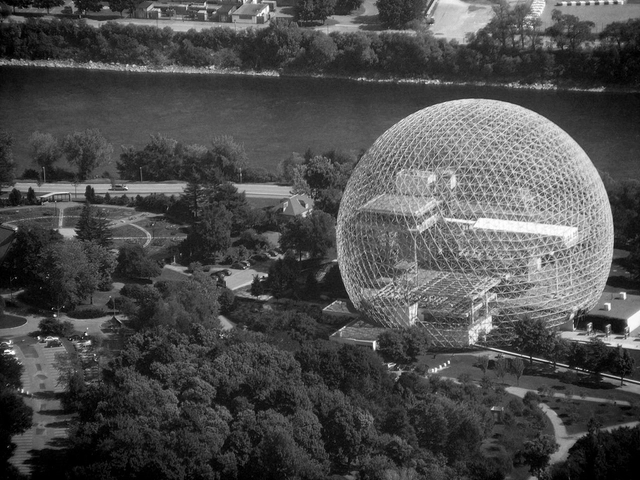
Architects have never enjoyed a position of such supreme prominence as they did in the worldview of Buckminster “Bucky” Fuller. To him, architects alone were capable of understanding and navigating the complex interrelationships of society, technology, and environment as viewed through the comprehensive paradigm of systems theory. Architecture, in this model, was intended to exist in close contact with both mankind and nature, playing civilization’s most critical role in elevating the state of humanity and promoting its responsible stewardship of the environment. Emerging from the ethical positivity of postwar modernism, this melioristic perspective marks perhaps the zenith of optimism’s ascent in mid-twentieth century thought, and gave Fuller a uniquely moral blueprint for his revolutionary designs.
This article was originally published on September 28, 2013. To read the stories behind other celebrated architecture projects, visit our AD Classics section.
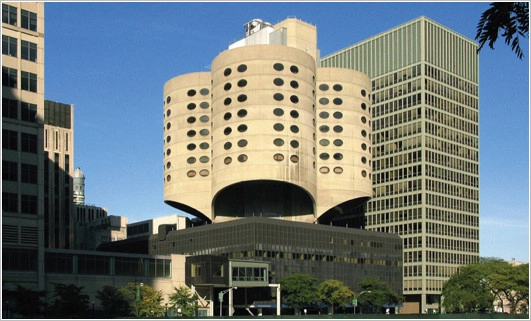
Hospital buildings, with their high standards of hygiene and efficiency, are a restrictive brief for architects, who all too often end up designing uninspiring corridors of patient rooms constructed from a limited palette of materials. However, this was not the case in Bertrand Goldberg's 1975 Prentice Women's Hospital. The hospital is the best example of a series of Goldberg-designed medical facilities, which all adhere to a similar form: a tower containing rooms for patient care, placed atop a rectilinear plinth containing the hospital's other functions.
On August 15, 1947, on the eve of India’s independence from the United Kingdom, came a directive which would transform the subcontinent for the next six decades. In order to safeguard the country’s Muslim population from the Hindu majority, the departing colonial leaders set aside the northwestern and eastern portions of the territory for their use. Many of the approximately 100 million Muslims living scattered throughout India were given little more than 73 days to relocate to these territories, the modern-day nations of Pakistan and Bangladesh. As the borders for the new countries were drawn by Sir Cyril Radcliffe (an Englishman whose ignorance of Indian history and culture was perceived, by the colonial government, as an assurance of his impartiality), the state of Punjab was bisected between India and Pakistan, the latter of which retained ownership of the state capital of Lahore.[1] It was in the wake of this loss that Punjab would found a new state capital: one which would not only serve the logistical requirements of the state, but make an unequivocal statement to the entire world that a new India—modernized, prosperous, and independent—had arrived.





















.jpg?1487999073&format=webp&width=640&height=580)

.jpg?1538837694 "© Derek Swalwell")

.jpg?1538837367 "© Derek Swalwell")



















































































.jpg?1487999184 "© Laurian Ghinitoiu")
.jpg?1487999406 "© Laurian Ghinitoiu")
.jpg?1487999574 "© Laurian Ghinitoiu")
.jpg?1487999153 "© Laurian Ghinitoiu")
.jpg?1487999073)