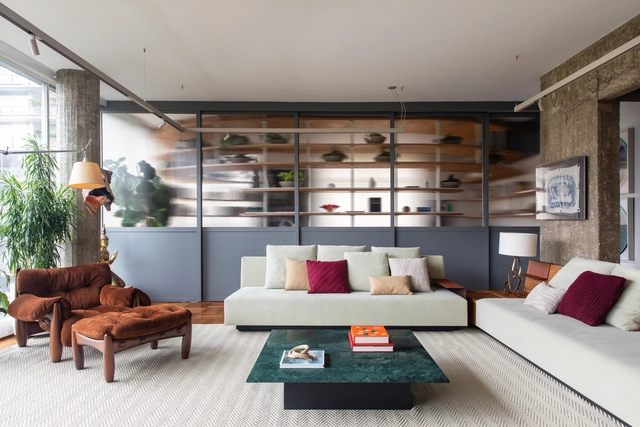
Smart homes leverage technology to provide residents with increased convenience, savings, comfort, and security. With automated environments, household routines are streamlined. What once seemed like a distant future is now within reach as smart devices have become more accessible. They enable a new level of interaction between the home and its inhabitants through Wi-Fi and Bluetooth connections.
https://www.archdaily.com/1010597/how-to-create-a-smart-home-a-complete-guide-for-beginners-in-home-automationArchDaily Team
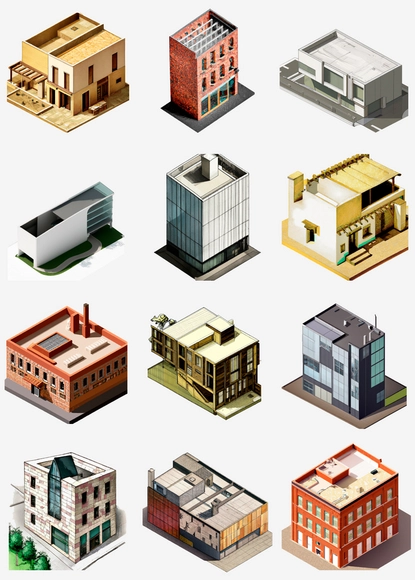
A contemporary building immersed in a built environment. This building is made of (material). An isometric view with realistic textures. Image via DALL.E 2
As AI has become more accessible, we have witnessed examples illustrating its diverse applications. Prominent among these are generative AIs, which excel in their ability to “create” images through prompts, many distinguished by their composition and vividness. These AI systems are neural networks with billions of parameters, trained to create images from natural language, using a dataset of text–image pairs. Thus, although the initial question posed by Turing in the 1950s, “Can machines think?” still recurs today, the generation of images and text is grounded in existing information, limiting their capabilities.
What has surprised many is the increasingly apparent closeness to overcoming the Turing test and the growing similarity, in terms of visualizations, to what an architect with skills in this field can achieve. In this context, while the debate persists in the architectural community about whether AI can process architectural concepts, this article explores how it interprets materials to develop these visual representations. With that in mind, a single prompt was developed for this experiment (with materiality as its variable) to delve into the obtained results.
https://www.archdaily.com/1010723/does-ai-correlate-materiality-with-contemporary-architecture-an-experiment-with-six-building-materialsEnrique Tovar
Manufacturers: Adamakis, Casa Trópico, Decameron Design, Dpot, Dpot Objeto, +15Edel-Stein, Estúdio Paulo Alves, Etel, Excellent Esquadrias, Fernando Jaeger, Lumini, Mil Grau, Pair Home, Phenicia Concept, Pizzinatto, Studio de La Cruz, Tidelli, Tok&Stok, Vírgula Ovo , La Bottega-15
The future has always been impossible to predict with absolute certainty. While various films, books, and theories have attempted to decipher it—and many have come close—we continue to be surprised by what actually emerges. Take, for instance, artificial intelligence tools. As we wrap up 2023 and head into 2024, does this dynamic remain the same? Can these tools also drive social change?
Every year, ArchDaily features thousands of new projects that make up the largest online architecture library in the world. Our team of curators review, seek, and make sure to explore some of the most innovative and relevant architectural works around. Just like the projects that appeared in our first ArchDaily book, our aim is to open up our platform and highlight (What is) Good Architecture.
https://www.archdaily.com/1011322/best-architectural-projects-of-2023ArchDaily Team
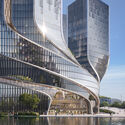
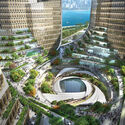
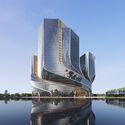
Büro Ole Scheeren has won the international competition for the design of Tencent’s new global headquarters in Shenzhen, China. The new structure, occupying a 14-hectare site, will become part of a new urban development along Qianhai Bay. Envisioned as a centerpiece within the future technology and financial district, Büro Ole Scheeren’s Tencent Helix will become the center of the multinational company’s expanding ecosystem.
The Royal Institute of British Architects has announced the winners of the 2023 President’s Medals, highlighting the best student architecture projects worldwide. In its 187th edition, RIBA’s President's Medals have stood as the hallmark of architectural excellence, remaining the oldest within the institution realm. Overall, the winning projects demonstrate a strong focus on "how architecture can address the needs of people and their communities."
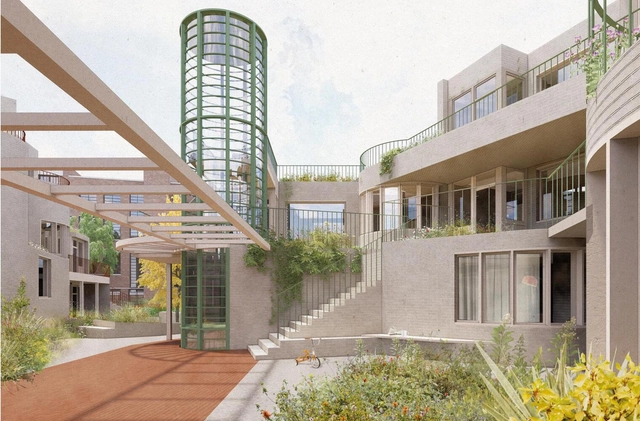
For the 2023 Cycle, the highly acclaimed RIBA Silver Medal for the best design project produced at RIBA Part 2 was awarded to Ellie Harging at the London School of Architecture. Titled “Nobody Wants to Live in a Care Home,” the project designs supportive housing for people living with young-onset Alzheimer's. The RIBA Bronze Medal was awarded to Kacper Sehenke, while the Dissertation Medal was awarded to Chloe Shang.
Some materials change the course of architecture from the moment they begin to be employed. The initial materials used in construction certainly did so: clay, stone, and wood. The ability to build is the origin of the discipline. With technological development, techniques were also refined, and in the 19th century, industrialization spread the use of other materials, transforming and expanding the realm of construction: iron and glass.