Although known for their iconic skyscrapers of glass and steel, SOM has begun to redefine our idea of the high-rise by pushing for wood as an alternative material for tall buildings. Not only could it help solve the worldwide problem of housing for those who are or will live in cities, but wooden skyscrapers could also address climate change by reducing a building's carbon footprint. Click here to read about the structural system that SOM has come up with and don't check out our previous coverage on the equally fascinating Timber Tower Research Project!
Videos
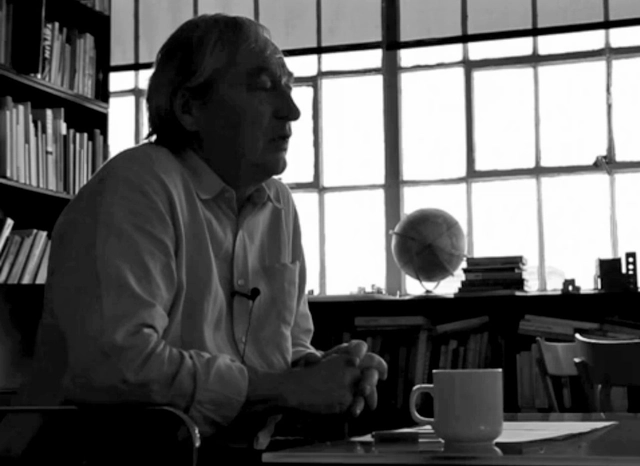
Mark Wigley with Kenneth Frampton, during the filming of The Glass House: “Conversations in Context”. Image Courtesy of http://vimeo.com/44405886
Mark Wigley announced Monday that he will be stepping down as dean of Columbia University's Graduate School of Architecture, Planning and Preservation (GSAPP) at the end of the academic year in 2014.
"In every context, he has represented the School and the institution in ways that make us all proud to be part of such a vibrant place," wrote Columbia President, Lee Bollinger, "And to all of it he has brought his unique humor and made us laugh."
https://www.archdaily.com/431160/mark-wigley-steps-down-as-dean-of-columbia-university-s-gsappJose Luis Gabriel Cruz
The Pinakothek der Moderne in Münich by Stephan Braunfels (2002) recently went through a complete renovation, and for the re opening of the museum Audi debuted the design wall, an installation that has become part of the permanent collection of the Die Neue Sammlung (The International Design Museum).
This AD Architecture City Guide is dedicated to the vibrant city of Tel Aviv, originally established as a garden-city on the sandy shores of the Mediterranean in 1909. Although widely known as “The White City” for boasting the world’s largest collection of International Style Buildings, Tel Aviv is not merely a monochromatic Bauhaus colony: it presents a rich mosaic of locally interpreted styles, from Eclectic to Brutalist to contemporary, which are the result of foreign and locally-born architects who adapted to the local cultural and climatic conditions.
Join us for our architectural city guide through the "Non-Stop City" after the break…
Something surprising has happened with many so-called “sustainable” buildings. When actually measured in post-occupancy assessments, they’ve proven far less sustainable than their proponents have claimed. In some cases they’ve actually performed worse than much older buildings, with no such claims. A 2009 New York Times article, “Some buildings not living up to green label,” documented the extensive problems with many sustainability icons. Among other reasons for this failing, the Times pointed to the widespread use of expansive curtain-wall glass assemblies and large, “deep-plan” designs that put most usable space far from exterior walls, forcing greater reliance on artificial light and ventilation systems.
Partly in response to the bad press, the City of New York instituted a new law requiring disclosure of actual performance for many buildings. That led to reports of even more poor-performing sustainability icons. Another Times article, “City’s Law Tracking Energy Use Yields Some Surprises,” noted that the gleaming new 7 World Trade Center, LEED Gold-certified, scored just 74 on the Energy Star rating — one point below the minimum 75 for “high-efficiency buildings” under the national rating system. That modest rating doesn’t even factor in the significant embodied energy in the new materials of 7 World Trade Center.
What's going on with these supposedly "sustainable" buildings? Read on, after the break...
"It's not where you start in life, it's where you end up and all the places you went in between." - United States General Colin L. Powell
For the closing keynote speaker of the stimulating, three-day “Building Leaders” convention in Colorado, the American Institute of Architects (AIA) selected one of America’s most admired public figures to share wisdom and insight to becoming a great leader.
General Colin L. Powell, a first-generation American born from Jamaican immigrants in 1937, is the epitome of the American dream. Starting life in the South Bronx, Powell paved his way to becoming a highly respected, four-star general in the United States Army and the first African American to serve as Secretary of State. A natural storyteller, Powell effortlessly captivated the audience of architects with a series of experiences and lessons he had learned throughout his lifetime of service.
General Colin Powell’s top ten lessons of leadership after the break...
Thousands have flocked to the Mile High City in Colorado to attend the American Institute of Architects (AIA) 2013 National Convention. The three-day event was enthusiastically kickstarted this morning by AIA president Mickey Jacobs who honored Tod Williams Billie Tsien Architects with the 2013 Architecture Firm Award; highlighted this year's theme of leadership; and featured words of advice from TOMS founder and chief shoe giver, Blake Mycoskie.
Learn TOMS Founder Mycoskie’s top advice for architects after the break.
Japan, inventor of the world's first bullet train, recently unveiled plans for an even faster and more radical train model: a floating train, powered by magnets, that will travel 100 mph faster than current bullet trains (about 300 mph). The maglev train, standing for "magnetic levitation," will run between Tokyo and Osaka, an estimated distance of 315 miles, cost $64 billion, and be completed by 2045.
High-speed rail has already revolutionized national and international transportation in many parts of the world - for example, China has a maglev that already goes 270mph - and now high-speed is transitioning into hyper-speed. Last year, we reported that Elon Musk, CEO of SpaceX and co-founder of both PayPal and Tesla Motors, shared with the public his desire to patent a new mode of transportation - the “Hyperloop” that would get passengers from San Francisco to LA in only 30 minutes.
So what might the future hold for train travel? And, more importantly, how will it affect our cities and the people who live in them?
For more on the maglev train and the future of rail, read on.
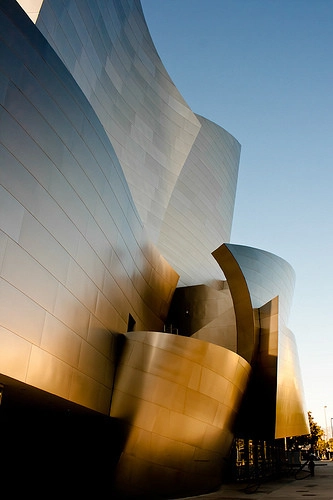
Architect Frank Gehry has voiced concerns that the new Los Angeles subway, scheduled for construction in two to three years, may disturb concerts in his famous Disney Hall. The planned subway line would run 125 feet below the venue's parking garage and recent simulations have shown that the rumblings could be audible inside the concert hall. Mr. Gehry has called for the review of previous noise projections for the metro project, which two years ago predicted no audible impact on his design. “It would be a disaster for Disney Hall,” Gehry told the LA Times. “The flag is up and we should go over it and make sure.”
This article, which originally appeared on GreenBiz, is by Lance Hosey, the chief sustainability officer of the global design leader RTKL.
Sustainability leader Hunter Lovins once called the building industry "dynamically conservative — it works hard to stay in the same place."
But old habits cannot fully address new challenges. According to 350.org, fossil fuel corporations currently have in their reserves five times the amount of carbon that, if burned too quickly, may raise atmospheric temperatures to a catastrophic level where Hurricane Sandy-scale storms could become the norm. Quicker, deeper progress is imperative.
Architecture is an essential arena for sustainable innovation. Buildings represent about half the annual energy and emissions in the U.S. and three-quarters of its electricity. With the built environment growing — the U.S. building stock increases by about 3 billion square feet every year — architects have a historic opportunity to transform its impact for the better.
Keep reading to find out the 6 Steps architects can take to transform the profession, after the break...
Ole Bouman is an influential figure in the world of Architecture. As an architecture historian, editor, curator, teacher and lecturer, Ole has been heavily involved in contemporary architectural discourse, working for organizations such as Volume Magazine and the Archis Foundation. But it was his role as the director of the NAi - Netherlands Architecture Institute (2006-2012) where Ole played a critical role.
We know you’ve been anxiously waiting to have ArchDaily with you everywhere you go - whether on the road or on your couch. Well, we’ve listened, and we’re more than proud to announce the launch of our first iPad application!
Our new App will give you in-depth access to the winners and finalists of The Building Of The Year Award, the most important architecture award in the online world (since 2009). It’s an award that recognizes architects - both established heavyweights and emerging talents - as the best and brightest of today, and they’re all chosen by you, our community of ArchDaily readers. While you'll have to wait a bit longer until you can vote for your favorite 2012 projects (TBA early 2013), the App offers the perfect distraction: full access to the 2011 winners.
Find out more about our “Building of the Year” App, after the break...