Back for its fourth year, the creative camp Hello Wood was held last month in Hungary, set in the countryside north of Lake Balaton. At Hello Wood, 120 young designers and architects worked with leading experts to create installations which approach issues of society and community in architecture, ideas encompassed by this year's motto "Step Closer!" Twelve teams had one week to create these installations using timber as their primary material, with the projects being judged and a winner awarded at the end of the week.
Read on to find out about the installations, and which one was judged the winner, after the break
Now, please consider that I am butchering his essay by removing this quote from the stream of his thinking, but, that being said, this paragraph stands out:
Architectural writing should aid everyone’s understanding of buildings and assist architects to design better ones. This is not to say that it should be an instruction manual or ignore the importance of the myriad intellectual endeavours which explore the human predicament –about which architects should always be conscious. Rather it is to say that architectural commentary should aim for clarity and precision of expression by means of lucid terminology and simplicity of structure.
This strikes me as a very technical and precise way of producing writer’s block. If this is the extent of good architectural writing, or writing that is in the service of architecture, then “Abandon all hope, ye who enter here.”
Cover of Young Frank, Architect, published by The Museum of Modern Art
Inspiring builders of all ages, MoMA has released their first storybook, following the adventures of a young, New York City architect and his architect grandfather: Young Frank and Old Frank. The creative pair - with matching bow ties, straw boater hats and, of course, Le Corbusier-inspired glasses - optimistically views the world as an endless supply of inspiration and possibilities. Everything, from macaroni to old boxes, inspires them to create - especially after discovering the works of Frank Gehry and Frank Lloyd Wright at The Museum of Modern Art.
Young Frank, Architect was written by the renowned children’s author and illustrator Frank Viva. More information can be found here on MoMA.
Beginning with Charles McKim, William Mead, and Stamford White and concluding with Michael Arad, Makers of Modern Architecture, Volume II examines the people behind the work at the forefront of 20th and early 21st century architecture. Critic Martin Filler masterfully integrates each person’s unique biography and distinctive character into the architectural discussion. Here is his revealing profile of Michael Arad, the young architect whose design for the National September 11 Memorial at Ground Zero brought him into the national spotlight. It was originally published on Metropolis Mag's Point of View Blog.
I wept but about what precisely I cannot say. When I first visited Michael Arad’s newly completed National September 11 Memorial of 2003–2011 at Ground Zero, which was dedicated on the tenth anniversary of the disaster—the ubiquitous maudlin press coverage of which I had done everything possible to ignore—it impressed me at once as a sobering, disturbing, heartbreaking, and overwhelming masterpiece. Arad’s inexorably powerful, enigmatically abstract pair of abyss-like pools, which demarcate the foundations of the lost Twin Towers, came as an immense surprise to those of us who doubted that the chaotic and desultory reconstruction of the World Trade Center site could yield anything of lasting value.
Yet against all odds and despite tremendous opposition from all quarters, the design by the Israeli-American Arad—an obscure thirty-four-year-old architect working for a New York City municipal agency when his starkly Minimalist proposal, Reflecting Absence, was chosen as the winner from among the 5,201 entries to the Ground Zero competition—became the most powerful example of commemorative architecture since Maya Lin’s Vietnam Veterans Memorial of 1981–1982 in Washington, D.C.
Imagine driving your car into a sizable aluminum pod and being shot 800 miles per hour through an elevated, shotgun-like barrel to arrive at a city 400 miles away within 30 minutes. According to Elon Musk, CEO of SpaceX and co-founder of Tesla Motors, Californians will be doing this within the next decade.
Railroad Track in Detroit. Image Courtesy of Shutterstock.com
There is an intimate connection between people, power, poverty and place and there is no better city in the world to see this than Detroit. With the impending bankruptcy we cannot lose sight of the human issues that face our city.
For decades money and power have moved away from Detroit’s center. The complex reasons for this are well known so there is no need to rehash them here. Even in the face of city government’s failure to manage its assets properly, this is changing. There is slow and halting movement back to the center.The movement back to the center is a good thing for many reasons. It will help bolster the tax base and that is the basic financial problem the city faces. But more importantly it will create a stronger spatial connection between power and poverty that we haven’t had in this region for a century.
Power will see poverty and poverty power. They will feel each other’s existence. They will see the humanity of each side and be nudged to recognize the shared responsibility caring for this shared place. This is how successful vital, dense urban cities operate. There is an acceptance of diversity on all levels. Barriers are reduced and human interaction encouraged. This is how creativity is bred. Exposure to diverse people, places and ideas excite and promote the imagination and a sense of the common good that includes everyone.
One surprising result which they uncovered is that, in opposition to the trend of workplaces being designed to encourage collaboration, workers are actually spending more time on focused, individual tasks than they were 5 years ago. Consequently, over 50% of respondents said that they were distracted by others when they needed to focus. What's more, the survey found that when employees could not focus individually, collaborative work was also less productive.
Read on after the break to find out more results from the survey
U.S. Housing and Urban Development (HUD) has announced ten shortlisted teams to compete in the multi-stage regional design competition “Rebuild by Design.” Each team will aim to “promote innovation by developing regionally-scalable but locally-contextual solutions that increase resilience in the region, and to implement selected proposals with both public and private funding.”
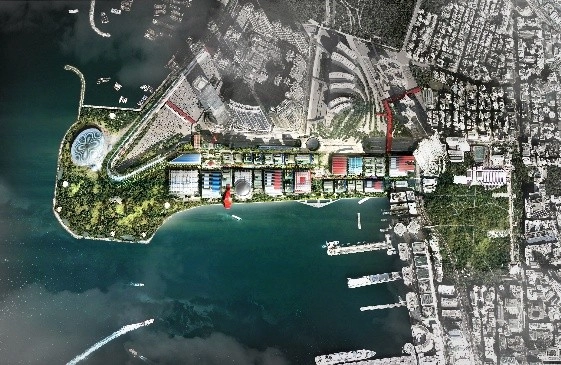
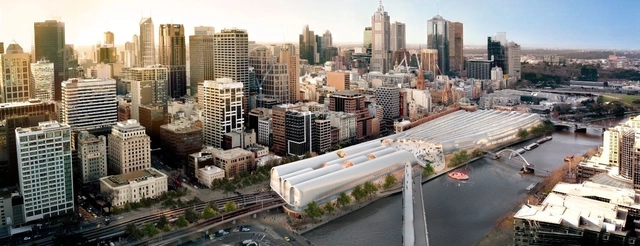
The winning proposal for the Flinders Street Station competition comes from HASSELL + Herzog & de Meuron. The design integrates the station with the surrounding urban context, which has evolved and changed significantly since the building was designed 100 years ago. The station concept draws from many aspects - the site's historic fabric, location, and linear nature; the original 19th century design and existing heritage fabric; the river and city edge, rail, public and river-based operations as well as the station's place within the city fabric and public realm. More images and architects' description after the break.
Interiors is an online film and architecture journal, published by Mehruss Jon Ahi and Armen Karaoghlanian. Interiors runs an exclusive column for ArchDaily, analyzing and diagramming films in terms of space.
The rise of the director in music videos came in the early 1990s, when MTV started crediting directors alongside artists and song titles. The influx of visionary directors such as Michel Gondry, Spike Jonze and David Fincher emphasized that music videos were becoming an auteur’s medium, much in the same way as film. The shift from stylized and performance-based music videos into narrative-based works, however, came much later, as the medium became more “cinematic” in its look and narrative structure.
The Victorian Coalition Government’s design competition to re-imagine Melbourne’s historic Flinders Street Station has entered its final phase as the public submits their last minute votes for the “People’s Choice Award” today. Though each proposal is dramatically different, ranging from Zaha Hadid Architects’ carefully calculated, sinuous curves to Herzog & de Meuron’s extrusion of vaulted canopies, all promise to elevate the stations status to the 21st century whilst respecting its historic context.
Form your own opintion and vote for your favorite after the break...
With the help of crowdfunding, Luke Shepard journeyed with a friend through 36 cities in 21 countries over the course of three months to capture over 20,000 images of some of Europe’s greatest structures. The end product resulted in a four-minute film entitled Nightvision, which aims to inspire appreciation for the "brilliance and diversity of architecture found across Europe".
The list of buildings featured in this film can be found on Shepard's site here.
“Increasingly we experience cities mediated by digital technology — whether that's via smartphone maps, digital transit signage, or texting a friend that you've arrived at a destination. How our city is built to support residents, businesses, and visitors [...] is now part physical and part digital.”
John Tolva, the Chief Technology Officer for the City of Chicago, is on a mission: a mission to bring the physical and digital worlds into conversation.
To embed more and more digital information into the physical world, a growing number of digital specialists are beginning to embrace the worlds of architects, planners and urbanists. But, so far, it has not been a two way street to make the digital leap.
Find out why architects should be at the forefront of the digital/spatial overlap, after the break...
In an article by the Architects' Journal, Tony Fretton is quoted as saying there ought to be fewer architecture schools in the UK, with more difficult entry requirements and a higher failure rate. "There should be a shortage of architects in the UK," he says, "fewer bad architects, fewer good architects".
Citing Switzerland and the Netherlands as countries which do well with just 2 or 3 major architecture schools, he believes that architectural education should be concentrated into just a few schools in order to give students more access to the best tutors.
Read more about Fretton's proposal after the break
Midtown West; Courtesy of Flickr User David Boeke, Licensed via Creative Commons
A recent study by the Real Estate Board of New York (REBNY) concluded that by preserving 27.7% of buildings in Manhattan, “the city is landmarking away its economic future.” REBNY is challenging the Landmarks Preservation Commission, arguing it has too much power when it comes to planning decisions, and that by making business so difficult for developers it is stifling the growth of the city.
Yet not three days before releasing this study, president of REBNY Steve Spinola said in an interview with WNYC that “if you ask my members, they will tell you [the twelve years of Mayor Bloomberg's tenure] has been a great period of time for them”. The conclusion of WNYC is that the past decade has actually been a period of increased growth for developers, rather than a period of stagnation.
It would be easy to echo the opinion of Simeon Bankoff, executive director of the Historic Districts Council, who believes the actions of REBNY come down to greed, even comparing its members to Gordon Gekko, the anti-hero of the film Wall Street. But is greed really what’s behind this attack on the Landmarks Preservation Commission? Find out after the break.
Marina Abramovic, one of the most seminal performance artists of our time, has launched a Kickstarter campaign to help fund the transformation of an abandoned New York theater into an interdisciplinary performance and education center: Marina Abramovic Institute (MAI).
The institute, designed by Shohei Shigematsu and Rem Koolhaas of OMA, will be dedicated to the presentation and preservation of long durational work. Visitors will spend a minimum of six hours partaking in the Abramovic Method, a method that helps participants “develop skills for observing long durational performances through a series of exercises and environments designed to increase awareness of their physical and mental experience in the moment.” Needless to say, MAI will be unlike any other institute in existence.
A virtual tour of OMA’s design and more information after the break...
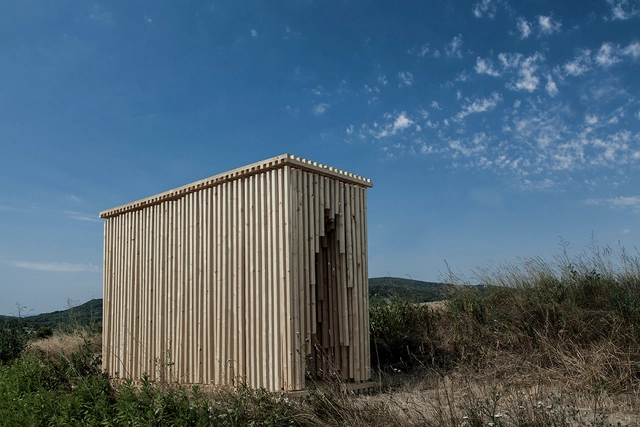
.jpg?1376483290 "POLIPHONY. Image © Kékesi Donát")
.jpg?1376483081 "e-motion TRACK. Image © Kékesi Donát")
.jpg?1376483159 "Panorama Peep Hole. Image © Kékesi Donát")
.jpg?1376483070 "BigO. Image © Kékesi Donát")