After training at the prestigious Bezalel Academy of Arts and Design in Israel and moving to New York in 2000, Eran Chen founded ODA New York, a boutique architectural firm based in NYC. Chen has quickly become a recognized name associated with creating buildings that are not only innovative but also ecologically responsible. ODA has participated in high profile projects such as the "super-skinny and super-tall" Manhattan Tower and "a city within a city" in Brooklyn.
Videos

Video: Eran Chen on How to Transform New York City: "One Green Space at a Time"
https://www.archdaily.com/792341/video-eran-chen-on-how-to-transform-new-york-city-one-green-space-at-a-timeAmanda Pimenta
Watch How Diller Scofidio + Renfro's "Shed" Transforms at New York's High Line
Diller Scofidio + Renfro in collaboration with Rockwell Group has released a new animation of “The Shed” (previously known as “The Culture Shed”), a convertible cultural center designed for New York City’s Hudson Yards development overlooking The High Line. When complete, the building will contain 170,000 square feet of exhibition space for temporary installations, concerts, performances and other cultural productions. Watch in the video as The Shed grows out of its partnering residential skyscraper, also designed by Diller Scofidio + Renfro and Rockwell Group, and transforms to serve various program types.
A part of Phase 1 of the Hudson Yards project, construction on The Shed began in mid-2015 and is scheduled to be completed in 2019. The venue will serve as the new home of several high profile events, including New York Fashion Week.
https://www.archdaily.com/792485/watch-how-diller-scofidio-plus-renfros-shed-transforms-at-new-yorks-hudson-yards-high-linePatrick Lynch
This Brick-Laying Robot Can Construct an Entire House in Just 2 Days
Thanks to a new robot named Hadrian X, we made soon be able to construct an entire brick house in just 2 days. Developed by the appropriately named Australian firm Fastbrick Robotics, the giant truck-mounted robot has the ability to lay up to 1,000 bricks an hour. Its innovation comes via the machine’s 30-meter telescopic boom, which allows the base to remain in a single position throughout the brick-laying process.
https://www.archdaily.com/792249/this-brick-laying-robot-can-construct-an-entire-house-in-just-2-daysPatrick Lynch
Bart Lootsma Dissects, Unpicks and Evaluates the 2016 Venice Biennale
.jpg?1469542883&format=webp&width=640&height=580)
In two lectures delivered by Bart Lootsma, Professor and Head of Institute for Architectural Theory and History at the University of Innsbruck, the 2016 Venice Biennale—Reporting From the Front—is dissected, unpicked and evaluated through the national participations (pavilions) and Alejandro Aravena's central exhibitions. Lootsma, who has broadcast the lectures as publicly available resources on architecturaltheory.eu, is the co-curator of the 2016 Pavilion of Montenegro.
https://www.archdaily.com/791670/bart-lootsma-dissects-unpicks-and-evaluates-the-2016-venice-biennaleAD Editorial Team
Video: Adjaye Brothers Discuss Their Upcoming Vinyl Collaboration
The Spaces has recently released a short film in which architect David Adjaye and his musician brother Peter Adjaye discuss their upcoming vinyl collaboration, which fuses music and architecture together to represent a multi-sensory experience.
In the film, the Adjaye brothers delve into several topics, like explaining their inspirations, David’s early ambitions as a DJ, and their upcoming soundtrack for the soon-to-be-opened National Museum of African American History and Culture in Washington, DC.
https://www.archdaily.com/791730/video-adjaye-brothers-discuss-their-upcoming-vinyl-collaborationSabrina Santos
Video: Incidental Space — The Swiss Pavilion at the 2016 Venice Biennale
In a recent interview presented in collaboration with PLANE—SITE, architect Christian Kerez and curator Sandra Oehy speak about Incidental Space, their exhibition for the Swiss Pavilion in the Giardini at the 2016 Venice Biennale.
Kerez explains, “what we tried to do for this year’s Swiss Pavilion at the Venice Biennale is to really make a building, actually—to build a space, to offer an experience of architecture. Basically, a space at the Biennale doesn’t have to be very functional. You don’t have to live there; you don’t have to work there. It’s really about experience. This is also about the question, how much can you imagine? How can you create a space with the utmost architectonical complexity?”
https://www.archdaily.com/791581/video-incidental-space-the-swiss-pavilion-at-the-2016-venice-biennaleSabrina Santos
Video: Daily Life, Daily Tao – Jingyu Liang Discusses the Chinese Pavilion at the 2016 Venice Biennale
In this interview, curator Jingyu Liang of Approach Architecture Studio discusses the concept behind "Daily Design, Daily Tao – Back to the Ignored Front," the theme of the Chinese Pavilion at the 2016 Venice Biennale. Responding to 2016 Biennale director Alejandro Aravena's overall theme of "Reporting From the Front," the pavilion takes an introspective look at China's own architectural front, and the impact that the country's ongoing development boom has had on Chinese architecture.
https://www.archdaily.com/791457/video-daily-life-daily-tao-nil-jingyu-liang-discusses-the-chinese-pavilion-at-the-2016-venice-biennalePatrick Lynch
Video: Speculative Detroit – The Architectural Imagination at the 2016 Venice Biennale
In this interview, presented in collaboration with PLANE—SITE, Cynthia Davidson and Monica Ponce de Leon—curators of the US Pavilion at the 2016 Venice Biennale—explain why the United States' contribution to the 2016 Venice Biennale has brought together "visionary" American architectural practices to speculatively address the future of the city of Detroit. They argue that these projects have "far-reaching applications for cities around the world."
https://www.archdaily.com/791116/video-speculative-detroit-architectural-imagination-2016-venice-biennaleAD Editorial Team
Watch Almost 6,000 Years of Human Urbanization Unfold Before Your Eyes in This Video
From the Cradle of Civilization in ancient Mesopotamia to the modern urban explosion in China, cities are among the most obvious and dramatic evidence of human existence. In a recent paper published in Scientific Data, a team led by Yale University researcher Meredith Reba mapped the emergence of cities between 3,700 BC and 2,000 AD based on when their populations were first recorded in historical accounts.
Taking the data from this study, Max Galka of Metrocosm has produced this fascinating animation showing the history of cities worldwide. "Most datasets available go back only a few years or decades at most. This is the first one I've seen that covers 6 millennia," Galka told CityLab. "I'm a big fan of history, so after reading the study, I thought it would be interesting to visualize the data and see if it offers some perspective." The steady flow of time may seem a little slow at first, but stick with it through the early BC years and the shifts in urban development start to get intriguing. And—spoiler alert—buckle up as you approach the 20th century.
https://www.archdaily.com/791063/watch-almost-6000-years-of-human-urbanization-unfold-before-your-eyes-in-this-videoRory Stott
Video: Designing Through Time – Home Economics at the 2016 Venice Biennale
In this interview, presented in collaboration with PLANE—SITE, Jack Self—co-curator of the British Pavilion at the 2016 Venice Biennale—reveals how the frontline of architecture in Britain today is not just a housing crisis, but "a crisis of the home." In provocatively presenting "the banal," Self reveals why the British participation at the 2016 Venice Biennale proposes five new models for domestic life, each curated through time of domestic occupancy, alongside how it seeks to address the ways in which we might live in the future.
https://www.archdaily.com/790670/video-designing-through-time-home-economics-2016-venice-biennaleAD Editorial Team
Video: Christo Explains the Vision Behind "The Floating Piers"
“They are projects that cannot be bought, cannot be owned, cannot be possess, to be kept; they are projects in total freedom. Nobody can own this, because if you own something, it’s not free.” -Christo
In this latest video from NOWNESS, Bulgarian artist Christo explains the fleeting nature of his most recent work, The Floating Piers, a floating dock system wrapped in yellow fabric that connects the towns of Sulzano and Peschiera Maraglio to the island of San Paolo in Italy’s Lake Iseo. First conceived by Christo alongside his late wife and creative partner Jeanne-Claude in 1970, The Floating Piers is in the midst of its 16 day run, lasting until July 3rd. After the conclusion of the exhibition, all components will be removed and industrially recycled, leaving its site precisely the way it was found.
https://www.archdaily.com/790405/video-christo-explains-the-vision-behind-the-floating-piersPatrick Lynch
Video: Ascend the Ziggurat in the Nordic Pavilion at the 2016 Venice Biennale
In this film, Jesús Granada visits the Nordic Pavilion, “In Therapy”, at the 2016 Venice Biennale. The video presents a series of measured stills in 4K resolution which introduce the central installation of the exhibition—a stepped pyramid, or ziggurat—and its series of reflective "rooms without walls." The pavilion itself, which was completed in 1969, was designed by Sverre Fehn to partially reflect and concretize certain ideas about Nordic society and its architecture – including a sense of openness. This year, therefore, the pavilion has been orchestrated as an extension of the public space of the Giardini.
https://www.archdaily.com/790249/ascend-the-ziggurat-in-the-nordic-pavilion-in-therapy-at-the-2016-venice-biennaleAD Editorial Team
Redsquare Productions Releases Film Detailing Shigeru Ban's Aspen Art Museum
Redsquare Productions has produced a short film on architect Shigeru Ban’s design for the Aspen Art Museum (AAM) in Aspen, Colorado. The film explores the museum’s architectural design and built environment through the utilization of time-lapse and motion sequences, highlighting Ban’s vision for the space.
https://www.archdaily.com/789204/redsquare-productions-releases-film-detailing-shigeru-bans-aspen-art-museumSabrina Santos
Behind the Scenes: Building the American Copper Buildings' Skybridge
A new video by JDS Development Group, Building Knowhow: Skybridge, begins with an anecdote of a day when the firemen showed up at the site. “We got a call – the buildings are falling down!” the chief fireman told Michael Jones, director of JDS. Jones responded with a chuckle, "they're supposed to be like that!"
Located on the East Side of Manhattan, the American Copper Buildings, designed by New York-based SHoP Architects, test the boundaries of engineering. In an informative video, JDS Development Group documents the building of a skybridge between the towers, outlining their detail-oriented, step-by-step approach. Located 300 feet in the air, it is New York's first major skybridge in 80 years.
https://www.archdaily.com/788768/behind-the-scenes-building-the-american-copper-buildings-skybridgeInez Vilar
Norman Foster Explains How Drones in Rwanda Could Lead the Way for New Cities
Back in September, Foster + Partners released details of their designs for a droneport in Rwanda, a humanitarian initiative that seeks to jumpstart and navigate the infrastructural challenges of emerging economies. In this video, Foster and others involved in the project explain the process of realizing the droneports, giving further details on its inclusion in this year’s Venice Biennale—with engaging new architectural visualizations to boot.
https://www.archdaily.com/789122/norman-foster-explains-how-drones-in-rwanda-could-lead-the-way-for-new-citiesJan Doroteo
Louis Vuitton's Cruise '17 Collection Unveiled at Niemeyer's Niterói Contemporary Art Museum
Oscar Niemeyer’s modernist icon, the Niterói Contemporary Art Museum (MAC) in Brazil, recently played host to the Louis Vuitton 2017 Cruise Collection showing. The show coincided with the museum's 20th anniversary, marking its reopening after extensive renovation. The remarkable nature of the building has drawn crowds to the outlying site, across the Guarana Bay from Rio de Janeiro, since its inauguration in 1996. The convergence of the fashion community to the landmark shows its smaller scale Bilbao effect in force.
https://www.archdaily.com/788715/lv-cruise-collection-at-niemeyers-niteroi-contemporary-art-museumLauren Crockett
Immerse Yourself in This New 360º Video of The Met’s Great Hall
The Metropolitan Museum released a 360º video of their iconic Great Hall on their Facebook page, allowing user to immerse themselves in the building. Designed by Richard Morris Hunt in 1902, the Met’s Great Hall greets over 6 million visitors to the museum each year with its neo-classical design.
The video was shot with the use of two camera tracks: one from the main entrance to the balustrade above the staircase, and another set at 90º that follows the public up the stairs before lifting to an overhead view.
https://www.archdaily.com/788595/immerse-yourself-in-the-new-360o-video-of-the-mets-great-hallEric Oh
A Conversation With Koolhaas, Foster and More at the Biennale's First "Meeting on Architecture"
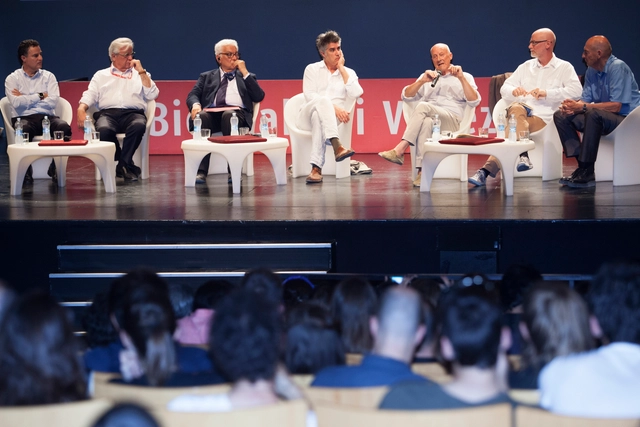
On May 28th, a selection of participants of the 2016 Venice Architecture Biennale, including Rem Koolhaas and Norman Foster convened for the first of Alejandro Aravena's "Meetings on Architecture," a series of talks that will take place throughout the Biennale. Under the theme of INFRASTRUCTURE, each invited speaker was given the chance to explain stories behind their participating projects in the Biennale, and the floor was also opened up for questions from the audience.
However, as Aravena explains about the talks, “we have organized them around themes, but architecture by nature always integrates more than one dimension. These Meetings will thus be a way to get from the authors themselves the richness and complexity of the built environment, and what it takes to get things done.” While highlighting unique projects, topics at the first Meeting converged around the focus on shaping the urbanization of emerging economies and the socio-political process and effect of realizing each project. The rest of the speaking panel was comprised by Joan Clos, Andrew Makin and Grupo EPM.
https://www.archdaily.com/788774/a-conversation-with-koolhaas-foster-and-more-at-the-biennales-first-meeting-on-architectureJan Doroteo