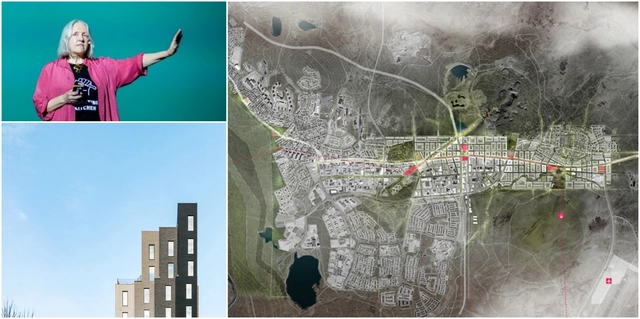
Peter Zumthor, Jean Nouvel, Norman Foster, Diébédo Francis Kéré and three other great architects come together in this Louisiana Channel video to share their thoughts on how to design for different cultures. For most of them, understanding context, collaborating with locals and using architecture to address larger social issues are what makes global architecture a success.
As part of OMA co-founder Rem Koolhaas' sixth interview with Charlie Rose, the Rotterdam-based Architect discusses why the Dutch port-city is his practice's base – and why he switched from journalism and scriptwriting to architecture. In the discussion, of which four snippets have been made available, Koolhaas also explains why he feels that smart technology has a "sinister dimension," and on how he—and his practice—have a tendency to "resist aesthetic."
https://www.archdaily.com/780502/why-rem-koolhaas-switched-from-scriptwriting-to-architectureAD Editorial Team
Referencing architecture's intimate past with the arts, Steven Holl argues the importance of collaborating with other artists for the benefit of the profession alongside choreographer and dancer Jessica Lang. "If we don't intermix the arts and collaborate, we are going to close... The arts are going to fade out individually. We are stronger together."
Watch the Spirit of Space video above to learn more about Holl and Lang's collaboration - Dance with Architecture - that uses dance to explore the four types of architecture: "under the ground, in the ground, on the ground, and over the ground."
A new short film, made by Jeremy Riggall for Alain de Botton's School of Life, gives insight into the working day of Tamiraa – a Civil Engineer working in Mongolia's burgeoning capital city of Ulaanbaatar. Aside from following Tamiraa's daily responsibilities, the film also touches upon issues related to working in a rapidly growing city with an urgent demand for better educational and healthcare provision, alongside new housing and its supporting infrastructure.
In this wide-ranging video, drone videographer Ian Wood captures the diversity of the built environment in Los Angeles, featuring architectural gems on equal footing with freeways and freight trains. The buildings and locations featured in the video span over a century of architectural history in LA, and cover the region’s vast geography, including such icons as Frank Lloyd Wright’s Hollyhock House, Cesar Pelli’s Pacific Design Center, Eric Owen Moss’ Stealth building, and Morphosis’ recently completed Emerson College Los Angeles.
But what truly sets this video apart is how it highlights the many murals spread throughout the city. Often utilizing otherwise blank facades facing parking lots and alleys, these murals are nonetheless an integral part of LA’s urban fabric, as illustrated in this video. Sadly though, as Wood notes on the video description, there were many more murals that vanished before he was able to get them on video.
Last week marked the opening of Santiago Calatrava's Museum of Tomorrow in Rio de Janeiro. Prior to the its opening, ArchDaily sat down with Calatrava to learn more about the museum's design and how the project's fruition resulted in the removal of an elevated highway that once isolated the city from the harbor.
"If you only think in architectural terms, only architecture will come out." - Wolf Prix
Inspired by space suits, Formula One circuits, and many other "mind expanding machines," Wolf D. Prix of Coop Himmelb(l)au explains the thought process that went behind their design of the Musée des Confluences in Lyon, France. With spiraling ramps and bridges throughout, the museum allows visitors to explore the space "freely," despite the constraints of gravity, and, in a sense, "conquer space." Read on for Spirit of Space's full interview with Prix.
Dorkly's latest animation gives the architect responsible for the Death Star an opportunity to defend himself and prove that his "shoddy design" was not to blame for its destruction. Instead, he condemns space wizards - a unworldly force he neglected to consider during planning.
Brut Deluxe has created a colorful light installation, made up of 48 chandelier-like pieces that dangle above Geneva’s Rue du Mont Blanc for the 2015 Geneva LUX light festival. The project continues on Brut Deluxe’s extensive work with ephemeral installations and their study of spatial qualities through light.
Miguel de Guzmán and Rocío Romero, from the photography studio Imagen Subliminal, have shared with us their images and video of the installation.
Until recently, the only options for providing clients and the public with visualizations of what a prospective building would look like were almost exclusively hand drawn renderings, or scale models built by hand. Both of these practices are still in use today, but now there is a much wider range of options with 3D modeling software providing the bulk of renderings, the growing presence of 3D printing, and even video fly-throughs with special effects that rival the latest Hollywood action movie. This 16mm film created by architecture firm Skidmore, Owings & Merrill (SOM) in 1984, and digitized by illustrator Peter Little, reminded us of what the early days of digital 3D modeling looked like.
Following the demolition of the original lifeguard station at the La Jolla Shores beach in San Diego, RNT Architects was commissioned to design its replacement. The project began with several models proposing different directions for the project – its final iteration began with a single, miniature staircase leading to a small shelter on top.
"A counteraction to what is happening today in China," OPEN Architecture's Garden School in Beijing seeks to reconnect its students with nature. Located in a new town that, as founding partner Li Hu says, was built "too fast," the school serves as one of the few spaces students can interact with nature. The school is designed like a garden, from its sloping "floor zero" to rooftop gardens, offering unconventional spaces for teaching and inviting public areas that encourage social interaction.
“What is problematic is that these new towns are designed too fast, without much thinking about how the spaces are going to be used, and what kind of space they are going to create. I think it is a problem for human psychology. Living in a new town with not enough good green space, good social space, we’ll become very problematic urban animals,” Hu told Spirit of Space.
FR-EE / Fernando Romero Enterprise, a global architecture and design firm founded by Fernando Romero that is known for its radically diverse portfolio, is currently working on designs for Mexico City's new international airport. Watch the video above, filmed by German photographer Yannick Wegner and his colleague Julián Cáceres Aravena, for an introduction on the massive project and insight on the firm's overall design approach.
The Louisiana Channel recently made a trip to the hometown of Peter Zumthor for an extensive and rare video interview on the Swiss architect's life journey, passion for learning, and how "different kinds of silence" help him reach his potential.
Los Angeles, as we know it today, was made possible by massive infrastructure projects that provide reliable sources of water to the otherwise semi-arid region. The mastermind behind many of these infrastructure projects in the early twentieth century was William Mulholland, the self-taught engineer who rose through the ranks to become the Chief Engineer and General Manager of the Bureau of Water Works and Supply (the precursor to today’s Los Angeles Department of Water and Power). Mulholland is most commonly remembered for the construction of the Los Angeles Aqueduct, which piped water to the city from the Owens Valley, over 200 miles away. But Owens Lake was drying up faster than expected, and the aqueduct was threatened by both earthquakes and sabotage from angry landowners and farmers in the Owens Valley who orchestrated dynamite attacks on the waterway, in what became known as the California Water Wars.
Mulholland needed a backup plan, so he turned to building reservoirs, most of which still function to this day. Tom Scott’s video above tells the story of how one of those reservoirs, and the failure of the dam that held it back, shaped the development of Los Angeles itself. When the St. Francis Dam collapsed in 1928 the ensuing rush of water killed at least 450 people (though some estimate the total is closer to 600), destroyed 1,200 homes, forever altered the reputations of Mulholland and the city’s water infrastructure, and ultimately cemented the boundaries of the city and its neighbors.
Hiroshi Nakamura, architect of the Ribbon Chapel in Japan, describes the design ideology and his personal favorite elements of the project in this stunning new video by Matthew Allard ACS. Shooting the chapel at various times during the day, its changing characteristics are captured in the movement of the light and camera, the twisting concrete forms seeming to dance.