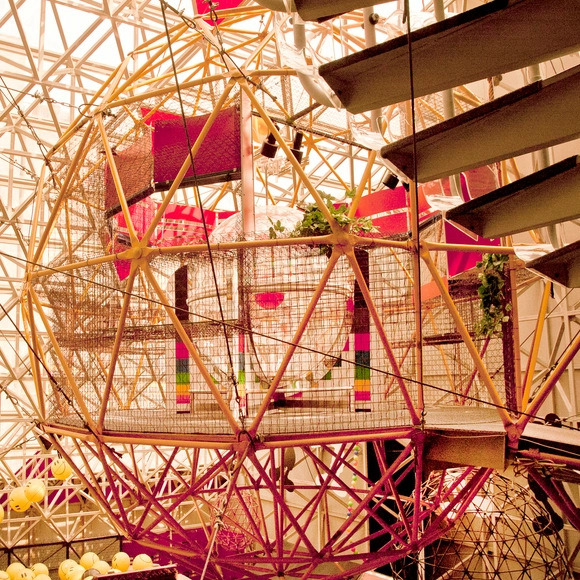


One of the most representative houses by Mexican architect José Díaz Infante that served as an experiment to study urban processes was the 'Earthquake-Resistant House' located at Ámsterdam 270. Also known as 'Kalikosmia,' this house addressed themes that broke with the purist forms common at the time, making it highly controversial. Furthermore, it was the result of an analysis based on the aftermath of the 1985 earthquake in Mexico City.
The Mexican architect defined himself as a "spatial designer," saying, "(...) I am timeless, I am not in history because I am more in science than in style. I do not belong to an era. My work has evolved in accordance with the different structures I have built. I treat each program differently, and in each project, I contribute something that I deny in the next." This was reflected in his career: in addition to being an architect, he collaborated with NASA and studied under Buckminster Fuller. As the designer of major works like the TAPO terminal and the Mexican Stock Exchange, he is today among the forgotten.











.jpg?1528069797&format=webp&width=640&height=580)

.jpg?1528069731 "© Ansis Starks")
.jpg?1528069782 "© Ansis Starks")

.jpg?1528069797)



















.jpg?1528079465&format=webp&width=640&height=580)
.jpg?1528079427 "Courtesy of The Russian Pavilion")
.jpg?1528079373 "Courtesy of The Russian Pavilion")
.jpg?1528079361 "Courtesy of The Russian Pavilion")
.jpg?1528078250 "Courtesy of Anna Mikheeva")
.jpg?1528079465)









.jpg?1528902145)
.jpg?1528902160 "Courtesy of WOHA")
.jpg?1528902003 "Courtesy of WOHA")
.jpg?1528902220 "Courtesy of WOHA")

.jpg?1528903768)