BD’s research reveals that China remains the world’s largest construction market (a title it’s held since 2010); that the Asia-Pacific Market is expected to be the largest by 2020 (with projected value of $4.6 trillion dollars); and that China, India, and Brazil offer the best growth potential for architectural services. Not surprisingly, the survey’s top three ranking firms - Aecom, Gensler, and IBI Group - all have a significant presence in these markets.
However, are these mega-firms really the best models to aspire to? With the economic crisis making it everyday more evident that there are more opportunities abroad than at home, where is a firm to go? China? India? Brazil?
Almost certainly not.
Find out whether/where you should go abroad, after the break...
The 3Doodler isn't just a small pen-like device that's "the most affordable way to 3D print" - it's also a Kickstarter smash. The pen reached its $30,000 goal in just a few hours, and, at the time of publication, has earned $555,301.
We've mentioned 3D Printing before for its exciting potential for architecture in the long-term; however, this little doodler shows how quickly the technology is progressing (and how cheap it's becoming). Plus, it's easy to imagine the 3Doodler becoming an integral part of any architect's life, as the device lets you trace your drawings and then pop them to life. It's not a 2D plan, it's not a 3D visualization, but something - awesomely - in between.
Learn more about this 3-D Printing Kickstarter success, after the break...
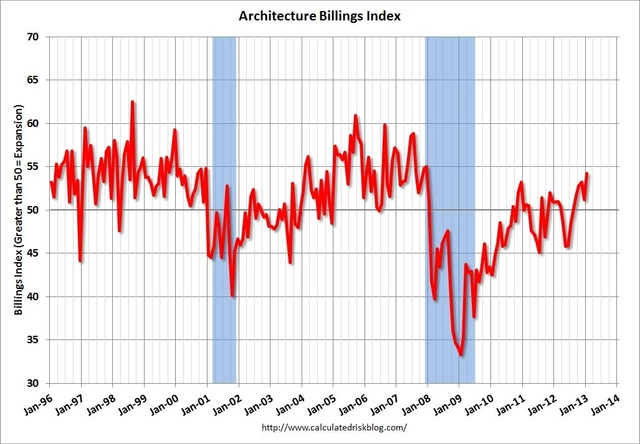
Reflecting the strongest growth since November 2007, the January Architecture Billings Index (ABI) surged to a score of 54.2 - a sharp and welcomed increase from December’s 51.2* mark. Released by the American Institute of Architects (AIA), the ABI is a leading economic indicator of construction activity that reflects the approximate nine to twelve month lag time between architecture billings and construction spending. By remaining above 50, January’s score illustrates the six consecutive month of growth for the United State's design and construction industry. This trend doesn't seem to be going away any time soon, as the new projects inquiry index accelerated beyond last month's reading of 57.9 and reached a score of 63.2.
“We have been pointing in this direction for the last several months, but this is the strongest indication that there will be an upturn in construction activity in the coming months,” said AIA Chief Economist, Kermit Baker, PhD, Hon. AIA. “But as we continue to hear about overall improving economic conditions and that there are more inquiries for new design projects in the marketplace, a continued reservation by lending institutions to supply financing for construction projects is preventing a more widespread recovery in the industry.”
Review the ABI Highlights in greater detail, after the break...
Can a good public space influence social behavior and make a city more secure?
In 1969, Philip Zimbardo, professor at the University of Stanford, performed a social psychological experiment. He placed an unlicensed car with a lifted hood in a neglected street in The Bronx, New York, and another similar car in a wealthy neighborhood of Palo Alto, California. The car in The Bronx was attacked in less than ten minutes, its apparent state of abandonment enabling the looting. The car in Palo Alto, however, remained untouched for more than a week.
Zimbardo then took his experiment one step further and broke a window of the car in Palo Alto. Almost immediately, passersby began to take things out of the car and within a few hours, the car had been completely dismantled. In both cases, many of the looters did not appear to be dangerous people. This experiment lead Harvard Professors George Kelling and James Wilson to develop the Broken Windows Theory in 1982: “If a broken window is left without repair, people will come to the conclusion that no one cares about it and that there is no one watching it. Then more windows will be broken and the lack of control will spread from the buildings to the streets, sending a signal that anything goes and that there is no authority.”
Read more about designing safer cities after the break...
Four of architecture’s finest has been shortlisted to design what Australian businessman James Packer hopes to be the most iconic building in Sydney since the Opera House. Italian Pritzker Prize-laureate Renzo Piano will compete against Chicago-based Adrian Smith + Gordon Gill Architecture, New York-based Kohn Pedersen Fox Associates and London-based Wilkinson Eyre Architects to design a $1 billion, six-star Crown Sydney resort on a 6000 square meter site in the inner-city waterfront precinct of Barangaroo.
"Sydney deserves one of the world's best hotels and with these amazing architects I'm confident we will see the most iconic building constructed here since the Opera House," Packer told The Daily Telegraph. "I want this hotel resort to be instantly recognizable around the world and feature on postcards and memorabilia promoting Sydney. That's how you attract international tourists, create jobs and put Sydney on the map."
32BNYis collaborating with Spirit of Space is relaunching a website in a corner of the internet structured as a videopolemic to explore architectural discourse in a revolutionary way. The first video in the series is a tribute to Lebbeus Woods who passed away late last year. Woods was an aggressive philosophical thinker of architecture and space. He launched worldy ideas into his architecture through imaginative leaps - exploring politics, society, ethics and the human condition as it pertained to architectural space in the form of vivid and dynamic drawings. His work has inspired his contemporaries to think outside of the physical space of architecture. Steven Holl and Sanford Kwinter discuss some of his ideas and philosophies through his quotes and inspirations. The video serves as a reminder, and to some a guide, as to how to build upon the philosophy of architecture beyond the physical.
In recent years there has been a lot of talk in the United States about our aging population in terms of social security funds and medicare. We have asked how we should deal with the impending problem that our elderly will outnumber the population that can take of them. While speculations for a solution have generally settled within the realm of the economy, urban planners and architects are asking a different set of questions and looking for solutions regarding how we design. It is important to note, that while most of the discussion has been framed about the aging "baby-boomer" generation, Jack Rowe, speaking at the symposium for Designing Homes and Neighborhoods for an Aging Population in Washington, DC, pointed out that this concern is a conservative estimate of the bigger problem in our "demographic transformation". In fact, the trend is far more expansive; medical advancements and a longer life expectancy mean that for the next few generations each aging population is expected to outlive its parents and will exceed the population of its children. This makes the issue at hand a more over-arching concern, or as Rowe later states, an issue that all members of society must face.
This is why we must think about architecture and urban planning in terms of adaptability for the aging, as we have already starting thinking about it in terms of handicapped accessibility. More after the break.
The ongoing competition for the redevelopment of the landmark Flinders Street Station in Melbourne, Australia has begun to raise some serious questions about the role of the public in architecture. The international competition, which narrowed down a total of 117 applicants to only 6 finalists, is due for completion in mid-2013. Each proposal will be put on display and the public will be invited to vote on their favorite design; what is raising eyebrows, however, is that the result of this public vote will be kept from the jury, who has the final say. The jury will not know what the public likes or dislikes when they place their own votes, and the public preference will only be revealed at the very end along with the jury's decision.
Although there are pros and cons for keeping this information from the jury members, some Australians feel very strongly about their station - and you can certainly argue that they should have a greater say in its future.
Read more about public participation in architecture after the break...
Although preservationists continue to mourn the seemingly inevitable demise of Chicago’s Prentice Women’s Hospital, a solid victory for Brutalism has finally been confirmed. Lawmakers in Goshen, New York, have passed a proposal to renovate Paul Rudolph’s iconic Orange County Government Center, authorizing $10 million in design funding. The 15-6 vote was secured by the overwhelming evidence that an upgrade would be more cost effect than County Executive Ed Diana’s fallback plan to replace two-thirds of the building and preserving only the court section. In addition, lawmakers felt the pressure of a March 12 deadline that would risk losing up to $2.7 million in federal funds to repair water damage caused by Hurricane Irene and Tropical Storm Lee in 2011.
After an “arduous” public review and a heated debate over affordable housing, New York’s City Council has unanimously awarded final approval to BIG’s tetrahedral-shaped West 57th apartment building in Manhattan. As reported by Crain’s New York Business, a compromise has been made to include 173 affordable housing units within the 32-story, 750-unit residential building and the neighboring industrial building that will be converted into 100 additional rental apartments. As you may recall, the community board and Councilwoman Gail Brewer initially threatened to “torpedo the project” if the apartments were only made affordable for a 35 year period. However, Durst apparently won them over by contributing one million dollars into an affordable housing fund.
"The good news, which is the matra of my office and community board No. 4, is there will be, yes, by law, 35 years of income-restricted affordable housing," stated City Councilwoman Brewer, who represents the area.
In 2006, Dr. Behrokh Khoshnevis, professor at the University of Southern California, introduced the world to Contour Crafting: the idea of applying Computer Aided Design and 3D Printing to homes and eventually larger buildings. As Dr. Khoshnevis explains in this TED Talk, Contour Crafting uses a giant 3D printer that hangs over a designated space and robotically builds up the walls of that building with layers of concrete. The robot can paint the walls and tile surfaces and even knows to construct plumbing and electrical wiring as it goes (Dvice). The idea is that by automating the construction process - one of the only processes humans still do largely by hand - homes will be cheaper and more quickly erected, with significantly lower labor costs. More importantly, Khoshnevis believes that Contour Crafting is essential to creating a more "dignified" architecture by eliminating slums in developing countries and aiding areas in the immediate aftermath of a natural disaster.
Today, President Barack Obama announced his intent to appoint five individuals to key Administration posts, including architecture’s very own Michael Graves, stating: “These fine public servants both bring a depth of experience and tremendous dedication to their new roles. Our nation will be well-served by these individuals, and I look forward to working with them in the months and years to come.”
The five individuals include:
Vinton G. Cerf - Member, National Science Board, National Science Foundation
Marta Araoz de la Torre - Member, Cultural Property Advisory Committee
Michael Graves - Member, Architectural and Transportation Barriers Compliance Board
Laurie Leshin - Member, Advisory Board of the National Air and Space Museum
Lynne Sebastian - Member, Advisory Council on Historic Preservation
Opening February 14, and on view until May 4, Yale School of Architecture‘s ‘White Cube, Green Maze: New Art Landscapes’ exhibition will examine emerging trends in museum design through six new art sites that share the common thread of moving beyond the traditional “white cube” gallery space, and that juxtapose the experience of culture, art, architecture, and landscape. Featuring newly commissioned photography of these sites by Iwan Baan, each site represents a unique expression of the ambitions and collaborations of patrons, architects, landscape architects, artists, and curators. For more information, please visit here.
This past Monday, President Obama made climate change and sustainable energy the focal points of his Inaugural Address when he declared that choosing to ignore these key environmental issues "would betray our children and future generations." This is the first time in the last few months that the President has taken a firm stand for the future of our Earth, a direct result of Super Storm Sandy and a smart choice to reveal controversial policies only after re-election. Although Monday morning was not the time to outline a specific political strategy, President Obama made it very clear that this time around, denial of scientific judgment and Congressional opposition would not be reasons for failure to act.
While this is a sentiment easier said than done and there is doubtlessly a long and difficult road ahead for the President and his administration. The White House has revealed that it plans to focus on what it can do to capitalize on natural gas production as an alternative to coal, on "reducing emissions from power plants, [increasing] the efficiency of home appliances and [on having] the federal government itself produce less carbon pollution" (NYTimes). According to the New York Times, they aim to adopt new energy efficiency standards for not only home appliances but for buildings as well, something that should spark the interests of architects and urban planners already committed to designing with climate change and sustainable energy in mind.
Zaha Hadid's success has been highlighted by yet another award. The Iraqi-born, world-renowned architect was honored with the Aenne Burda Award for Creative Leadership yesterday, January 21, at the international DLD (Digital-Life-Design) Conference in Munich. Since 2006, this annual award has honored female digital entrepreneurs for their visionary and successful ideas. Past recipients include The Huffington Post founder Arianna Huffington, former journalist and Wall Street technology analyst Esther Dyson, business magnate Martha Stewart, and more.
As reported by Herald Online, Rhode Island School of Design president John Maeda stated: "Leaders are needed when times are changing, creative leaders change times themselves. They make things - like Zaha. She's unafraid to disrupt, she's very optimistic. Today we celebrate her incredible optimism."
On August 15th, 2007 a powerful earthquake hit the region of Ica, Perú, destroying the small Maria Auxiliadora School. The first responders left after a matter of months, but the damage remained. Resources were shuffled to the big cities, and the small school waited, for years, for the authorities to take on the reconstruction. They never did.
And so, with help from Architecture for Humanity Design Fellow, Diego Collazo, and with funding from the Happy Hearts Fund and the SURA Group, the community decided to take the school’s - and their children’s - future into their own hands. This SEEDoc, the latest installment of inspirational mini-documentaries from the Design Corps and SEED (Social Economic Environmental Design), tells their story.