HYBRID FORMAT
Zoom: https://us04web.zoom.us/j/79698685674?pwd=X4D5PUIWO4nF5zy7uDxKwnW09bohgJ.1
Meeting ID: 796 9868 5674 | Passcode: 961138
Room 706, Yale School of Architecture, 180 York St, New Haven, CT, USA
HYBRID FORMAT
Zoom: https://us04web.zoom.us/j/79698685674?pwd=X4D5PUIWO4nF5zy7uDxKwnW09bohgJ.1
Meeting ID: 796 9868 5674 | Passcode: 961138
Room 706, Yale School of Architecture, 180 York St, New Haven, CT, USA

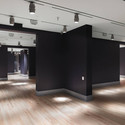
Building a Collective Archive: A Yale Traveler's Mnemosyne is a curatorial project that explores the impact and update of personal references in constructing a collective imaginario - a repository of collective imagination. Curated by architects Gabriel Hernández (Fulbright Visiting Fellow at Yale) and Alberto Martínez (La Caixa Foundation grant), the exhibition will be on display from 31 August through 6 October 2023 at the North Gallery space at Yale School of Architecture (YSoA), located at the iconic Rudolph Hall in New Haven, Connecticut.
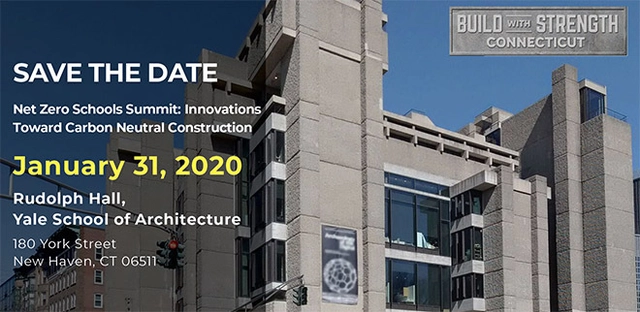
AIA Connecticut, in collaboration with the CT Green Building Council and the National Ready Mixed Concrete Association (NRMCA) is hosting their very first Net Zero Schools Summit at the Yale School of Architecture. A group of thought leaders and experts from across the country will discuss the issues of sustainability, carbon sequestration in construction, and construction methods to achieve Net Zero schools and move the design and construction industries toward a carbon positive future.
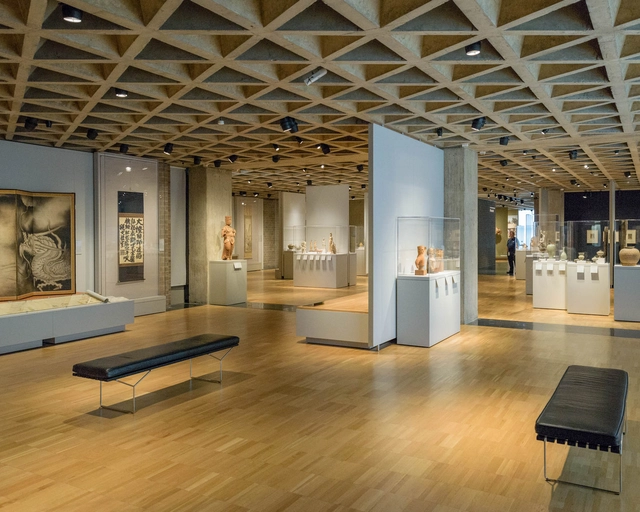
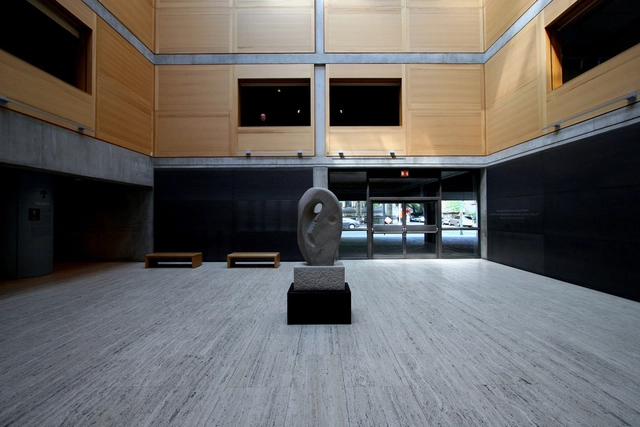
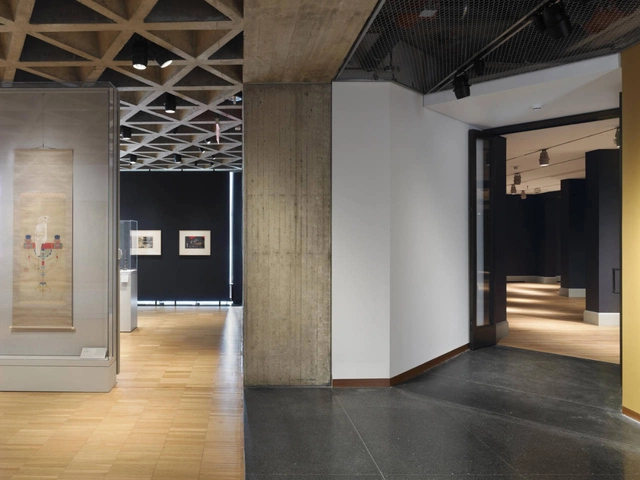
Yale University’s School of Architecture was in the midst of pedagogical upheaval when Louis Kahn joined the faculty in 1947. With skyscraper architect George Howe as dean and modernists like Kahn, Philip Johnson, and Josef Albers as lecturers, the post-war years at Yale trended away from the school’s Beaux-Arts lineage towards the avant-garde. And so, when the consolidation of the university’s art, architecture, and art history departments in 1950 demanded a new building, a modernist structure was the natural choice to concretize an instructional and stylistic departure from historicism.[1] Completed in 1953, Louis Kahn’s Yale University Art Gallery building would provide flexible gallery, classroom, and office space for the changing school; at the same time, Kahn’s first significant commission signaled a breakthrough in his own architectural career—a career now among the most celebrated of the second half of the twentieth century.
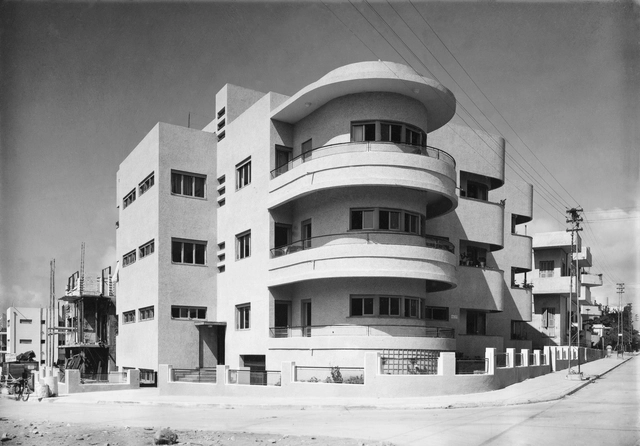
The exhibition Social Construction: Modern Architecture in British Mandate Palestine, tracing the influence of international Modernism on the architectural vernacular that developed in Palestine during 1917–48, is on display at the Yale Architecture Gallery from August 31to November 18, 2017. Originally organized by the Israel Museum, in Jerusalem, the show draws inspiration from the extensive research of architects Ada Karmi-Melamede and Dan Price, whose accompanying book, Architecture in Palestine during the British Mandate, 1917–1948, explores not only the functional aspects of this new architecture but also the social values that shaped the defining language of this new architectural style. The original exhibition was curated and designed by Oren Sagiv, chief of exhibition design at the Israel Museum, with Eyal Rozen.
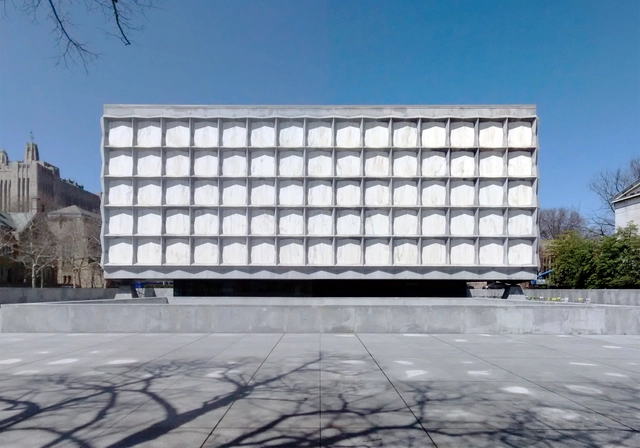
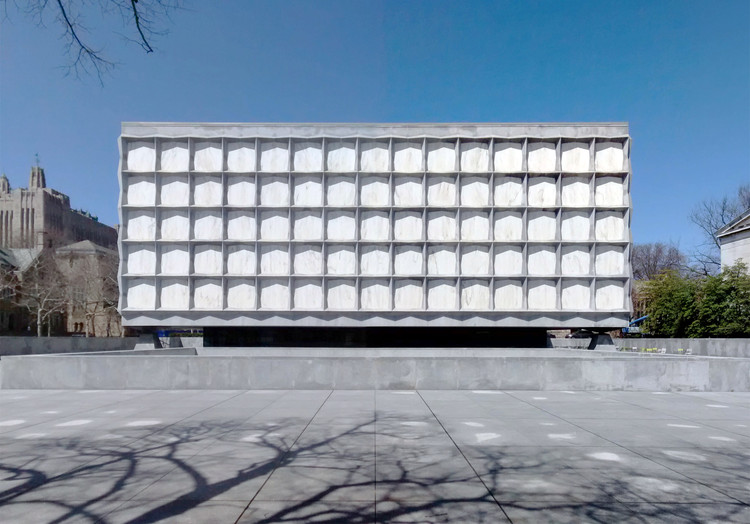
Cloistered by a protective shell of stone, the Beinecke Rare Book and Manuscript Library is one of the world’s foremost collections of rare manuscripts. Opened in 1963, the library is renowned for its translucent marble façade and the world-renowned glass book tower sheltered within – a dramatic arrangement resulting from the particular requirements of a repository for literary artifacts. This unique design, very much in the Modernist lineage but in contrast to the revivalist styles of the rest of Yale’s campus, has only become appreciated thanks to the passage of time; the same bold choices which are now celebrated were once seen as a cause for contempt and outrage.
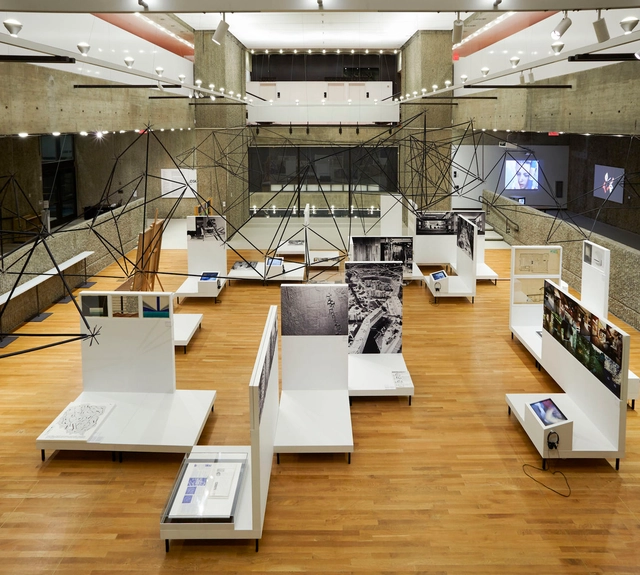
An exhibition highlighting the work of Oskar Hansen (1922-2005), architect, urban planner, and theorist, has opened at the Yale School of Architecture (YSoA) running from 1 September to 17 December 2016.
Oskar Hansen: Open Form traces the evolution of Hansen’s theory of Open Form from its origin in his own architectural projects to its application in film, visual games, and other artistic practices. The exhibition will be on view at YSoA through 17 December in Paul Rudolph Hall, 180 York St. It is free and open to the public Monday-Friday 9.00- 5.00, and Saturday 10.00-5.00.
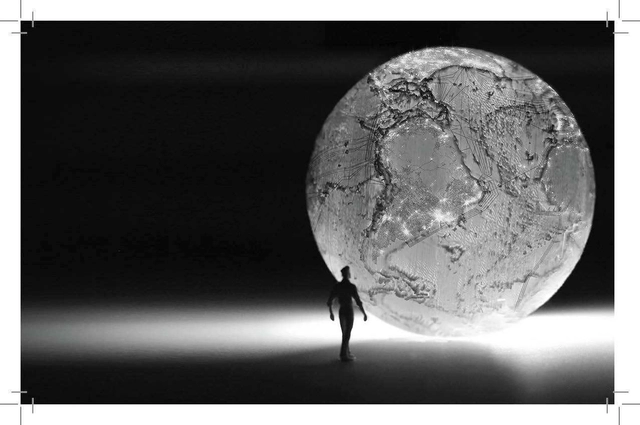
A CONSTRUCTED WORLD
J. Irwin Miller Symposium
Thursday October 1 – Saturday October 3, 2015
Yale School of Architecture
Paul Rudolph Hall, Hastings Hall, 180 York Street,
New Haven, CT, 06511
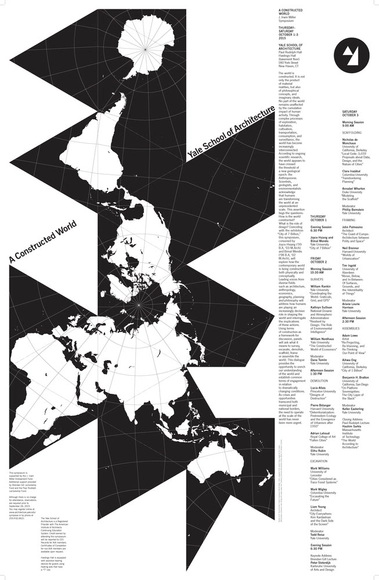
The J. Irwin Miller Symposium, “A Constructed World,” from October 1-3, 2015 is convened by Joyce Hsiang and Bimal Mendis in conjunction with the exhibition, “City of 7 Billion,” at the Yale School of Architecture. The symposium brings together leading voices across multiple disciplines, with the keynote by the philosopher Peter Sloterdijk and closing address by Hashim Sarkis, and includes: Lucia Allais, Pierre Bélanger, Phillip Bernstein, Benjamin Bratton, Nicholas de Monchaux, Keller Easterling, Ariane Lourie Harrison, Tim Ingold, Clara Irazábal, Adrian Lahoud, Adam Lowe, Aihwa Ong, John Palmesino, Neil Brenner, William Rankin, Todd Reisz, Elihu Rubin, Kathryn Sullivan, Dana Tomlin, Annabel Wharton, Mark Wigley, Mark Williams and Liam Young.
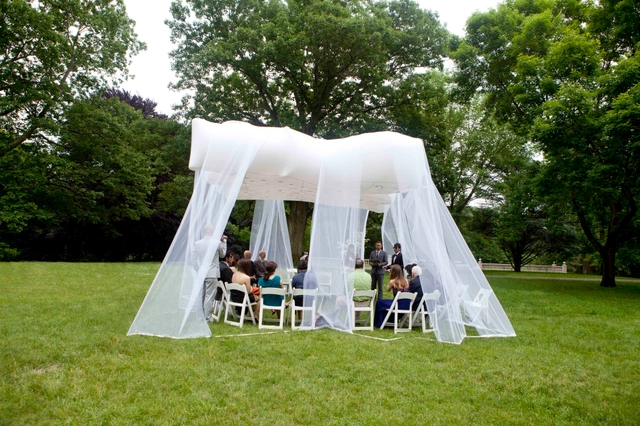
Designed and constructed by QASTIC Lab, ‘Balance Through Buoyancy’ is a temporary researchpavilion called “Floatastic” which was designed and built for a private client to serve as a shade pavilion for a wedding ceremony. Situated in Edgerton Park, in New Haven Connecticut (an Olmsted planned landscape), this deployable structure aims to create a floated shelter which avoids imposing any loads to the ground, which traditional structures require. Instead, it proposes a well-fabricated balloon, which is filled with Helium to raise the imposed loads of fabric veils and any possible dynamic environmental loads toward the sky. More images and architects’ description after the break.
.jpg?1607398340 "© Jeff Goldberg/ESTO")