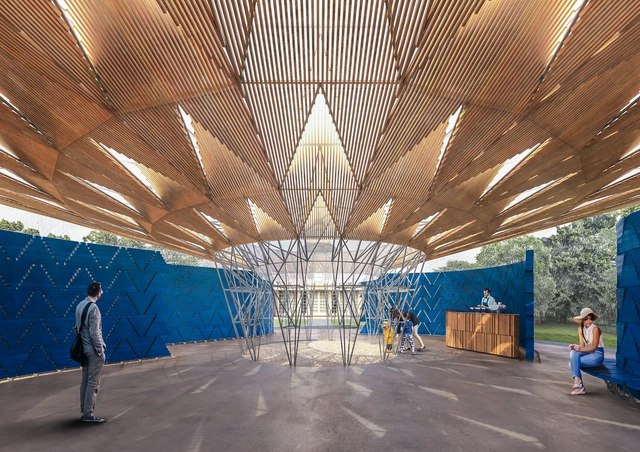
Serpentine Pavilion 2017, Designed by Francis Kéré, Design Render, Interior. Image Courtesy of Kéré Architecture
The Serpentine Galleries have announced that the 2017 Serpentine Pavilion will be designed by Diébédo Francis Kéré (Kéré Architecture), an African architect based between Berlin, Germany, and his home town of Gando in Burkino Faso. The design for the proposal, which will be built this summer in London's Kensington Gardens, comprises an expansive roof supported by a steel frame, mimicking the canopy of a tree. According to Kéré, the design for the roof stems from a tree that serves as the central meeting point for life in Gando. In line with the criteria for the selection of the Serpentine Pavilion architect Kéré has yet to have realised a permanent building in England.
Benjamin Bratton, Professor of Visual Arts and Director of the Center for Design at the University of California, San Diego, is the new Programme Director at Moscow's Strelka Institute. The New Normal is based on the premise that "something has shifted. [...] We are making new worlds faster than we can keep track of them, and the pace is unlikely to slow."
Have our technologies have advanced beyond our ability to conceptualize their implications? "One impulse," the course advocates, "is to pull the emergency brake and to try put all the genies back in the bottle." According to Bratton, this is hopeless. "Better instead to invest in emergence, in contingency: to map The New Normal for what it is, and to shape it toward what it should be."
This week Phyllis Lambert, widely considered to be among the most influential figures in architecture, turned 90. Known primarily for founding the Canadian Centre for Architecture (CCA) in her hometown of Montrèal in 1979, she also acted as Director of Planning for the world-renowned Seagram Building in Manhattan (a tower commissioned by her family). The project is often cited as one of Mies van der Rohe's most important built works. As a practising architect, Lambert designed the Saidye Bronfman Centre (1967) – a performing arts center named after her mother.
Cities across the world are full of white elephants – something which ArchDaily has recently explored. In the latest episode of Section D, Monocle 24's weekly review of design, architecture and craft, the team examine similar cases from the unfinished Palestinian Parliament to redundant projects in Belgrade. This edition also looks at the RIBA's new International Prize, which was awarded this year to Grafton Architects for their University of Engineering and Technology building in Lima.
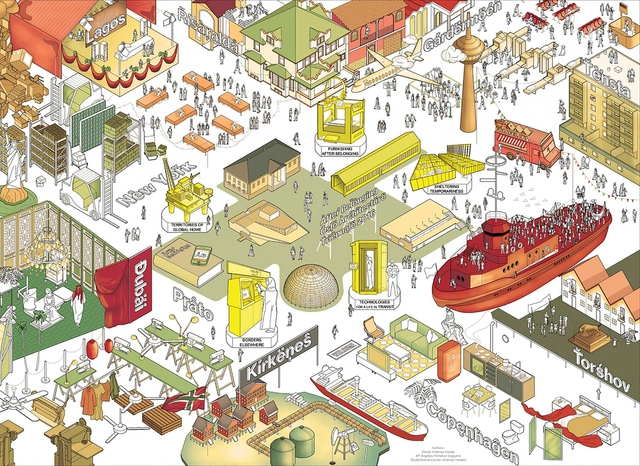
In this film, presented in collaboration with +KOTE, theAfter Belonging Agency—Carlos Minguez Carrasco, Ignacio Galán, Alejandra Navarrese Llopis, Lluís Alexandre Casanovas Blanco, and Marina Otero Verzier—narrate a walkthrough of In Residence, one of the two core exhibitions at this year's Oslo Architecture Triennale: After Belonging – A Triennale In Residence, On Residence, and the Ways We Stay in Transit.
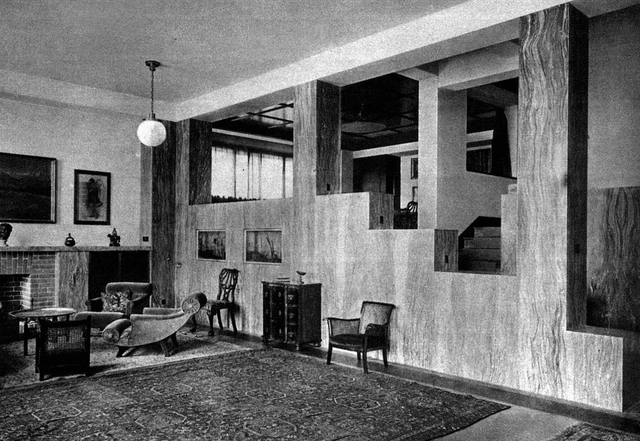
Welcome to the fourth installment of The Long(ish) Read: an AD feature which presents texts written by notable essayists that resonate with contemporary architecture, interior architecture, urbanism or landscape design. Ornament and Crime began as a lecture delivered by Adolf Loos in 1910 in response to a time (the late 19th and early 20th Centuries) and a place (Vienna), in which Art Nouveau was the status quo.
Loos used the essay as a vehicle to explain his distain of "ornament" in favour of "smooth and previous surfaces," partly because the former, to him, caused objects and buildings to become unfashionable sooner, and therefore obsolete. This—the effort wasted in designing and creating superfluous ornament, that is—he saw as nothing short of a "crime." The ideas embodied in this essay were forerunners to the Modern movement, including practices that would eventually be at core of the Bauhaus in Weimar.
The 2016 Lisbon Architecture Triennale, which opened last week, is comprised of a constellation of exhibitions and satellites. One such show—eponymously named The Form of Form—is both an exhibition and a structure in itself – a sequence of rooms designed collaboratively by Mark Lee of Johnston Marklee, Kersten Geers of Office KGDVS, and Nuno Brandão Costa. If "one of architecture’s fundamental legacies is its own form," the curatorial statement declares, "this exhibition [builds] a dialogue that challenges notions of authorship and the limits of form."
In the latest edition of Section D, Monocle 24's weekly review of design, architecture and craft, Henry Rees-Sheridan visits Oslo to speak to Hanna Dencik Petersson, Director of the 2016 Oslo Architecture Triennale, and Alejandra Navarrete Llopis and Ignacio González Galán – two members of its curatorial team, the After Belonging Agency. The show explores the concept behind the exhibitions of the Triennale, what it means to be located in Norway's capital, and how the event's trajectory is both a symptom and cause of Oslo’s development as a design city. ArchDaily's James Taylor-Foster weighs in on After Belonging's significance.
In the canon of great Dutch architects sit a number of renowned practitioners, from Berlage to Van Berkel. Based on influence alone, Rem Koolhaas—the grandson of architect Dirk Roosenburg and son of author and thinker Anton Koolhaas—stands above all others and has, over the course of a career spanning four decades, sought to redefine the role of the architect from a regional autarch to a globally-active shaper of worlds – be they real or imagined. A new film conceived and produced by Tomas Koolhaas, the LA-based son of its eponymous protagonist, attempts to biographically represent the work of OMA by “expos[ing] the human experience of [its] architecture through dynamic film.” No tall order.
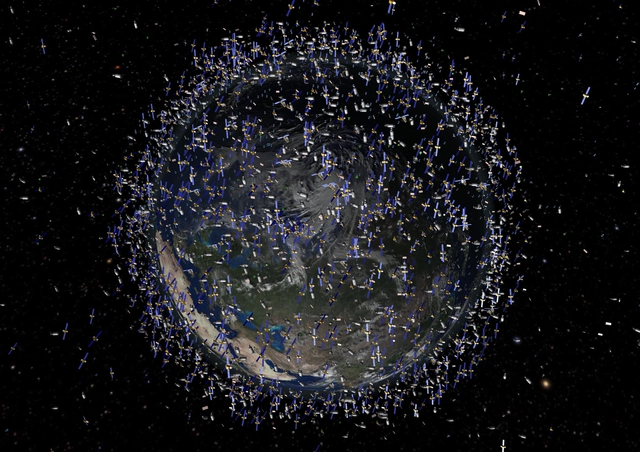
The European Space Agency's vizualisation of space debris orbiting Earth. Image Courtesy of "Are We Human" / 3. Istanbul Tasarim Bienali
The 3rd Istanbul Design Biennial, which will officially open on the 22nd October 2016 and last for four weeks, will ask the question: Are We Human? Encompassing a wide range of ideas related to The Design of the Species, from timeframes of 2 Seconds to 2 Days, 2 Years, 200 Years and 200,000 Years, the international show will revolve around one pressing provocation: that design itself needs to be redesigned. It will do so by exploring the intimate relationship between the concepts of "design" and "humanity."
Five primary venues—the Galata Greek Primary School, Studio-X Istanbul and Depo in Karaköy, Alt in Bomonti, and the Istanbul Archaeological Museums in Sultanahmet—will house more than 70 projects by designers, architects, artists, historians, archaeologists and scientists from thirteen countries. In order to "rethink design from the very beginning of humanity," the Biennial will be organised into four overlapping “clouds” of projects: Designing the Body, Designing the Planet, Designing Life, and Designing Time.
With UNESCO's recent announcement that 17 buildings by Le Corbusier are to be added to the World Heritage List, Monocle 24's Section D speaks to a number of organisations—including the Twentieth Century Society, devotees of Frank Lloyd Wright in Arizona, London's Victoria Albert Museum, and the Cooper Hewitt Smithsonian in New York City—in order to understand why architectural preservation is important, and who decides what’s worth saving.
Dream of Venice Architecture, the second in a series by Bella Figura Publications, has brought together a collection of contemporary architects and architectural writers to share their personal experiences of La Serenissima: the great Italian city of Venice. "Water runs through her veins," Editor JoAnn Locktov writes. "Bridges, palaces, churches – every structure is a testament to the resiliency of imagination."
A new collection of five minute-long Tall Stories—developed by the team behind The Urbanist, Monocle 24's weekly "guide to making better cities—guide the listener through the condensed narratives of a series of architectural projects from around the globe, encompassing their conception, development, use and, in some cases, eventual demise. We've selected eight of our favorites from the ongoing series, ranging from London’s Casson Pavilion to Honolulu's Waikiki Natatorium War Memorial, and the Estadio Centenario stadium in Montevideo.
Update: On June 24, 2016, 52% of eligible voters in the United Kingdom voted to leave the European Union. This article was published prior to the referendum announcement.
In 2003 George Steiner—a Paris-born, American, UK-based literary critic, philosopher and essayist—gave a lecture in Tilburg, a small Dutch city on the Belgian border. His talk, which he titled “The Idea of Europe,” made some waves in certain circles but, ultimately, wasn't widely discussed. Years later I found a copy of the transcript in Amsterdam’s Athenaeum[1], who had tucked it in the corner of a sunken room on a shelf devoted to "Brexit." I read it the following day while on a train to Brussels.
As I trundled across the Flemish hinterland Steiner’s words, delivered with judicious insight and a reassuring cautionary edge, served as a reminder of one irrevocable fact: that Europe is a continent “of linguistic, cultural, [and] social diversity;” a “mosaic”[2] of communities that have never been united with the same scale and ambition as that of the European Union. But before the contemporary Euro-project, came European café culture.
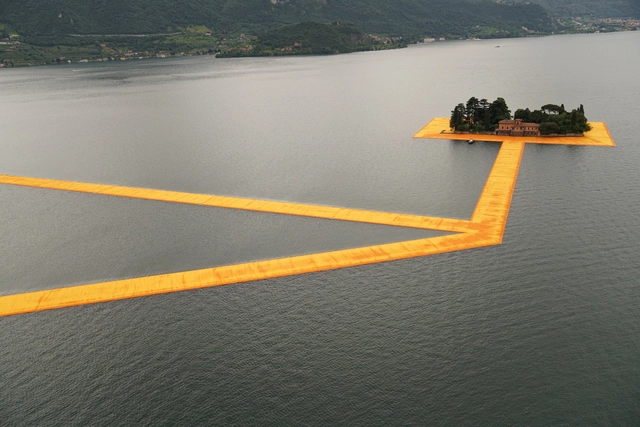
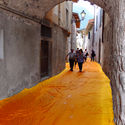
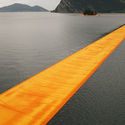
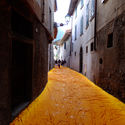
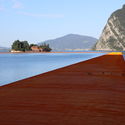
Beginning this week, and lasting for only sixteen days, visitors to the Italian Lake Iseo can "walk on water." The Floating Piers is the work of Christo and Jeanne-Claude, based on an idea first conceived in 1970. Built using 100,000 square meters of shimmering yellow fabric, carried by a modular floating dock system of 220,000 high-density polyethylene cubes, the installation—which sits just above water level—undulates with the movement of the lake.
According to Italian news source, Leggo, two people were "seriously injured" and the installation was "evacuated" on its opening day due to the quantity of visitors and inclement weather conditions.
Those who experience The Floating Piers will feel like they are walking on water – or perhaps the back of a whale.
Wolfgang Buttress’ The Hive, a Gold Medal-winning UK Pavilion originally built for the 2015 Milan Expo, has been relocated to the Kew botanical gardens in central London. The striking (and photogenic) "beehive" was designed by the British practice to provide visitors with a glimpse into the life of a working bee; its 169,300 individual aluminium components—reaching 17-meters tall and fitted with hundreds of LED lights—created a multi-sensory experience that shed light on the importance of the pollinator. Following its relocation, photographer Laurian Ghinitoiu has turned his lens to this installation and its new home.
In a short film exploring some of the National Participations at this year's Venice Biennale, Monocle Films take a considered look at how different countries have responded to the Biennale theme, Reporting From the Front in both explicit and more indirect ways. Visiting the Austrian Pavilion, the Nordic Pavilion, the Turkish Pavilion, the British Pavilion, the Irish Pavilion, the Australian Pavilion and the Romanian Pavilion, the film studies what discourses are being waged in the compressed geo-political world of the Giardini di Biennale.
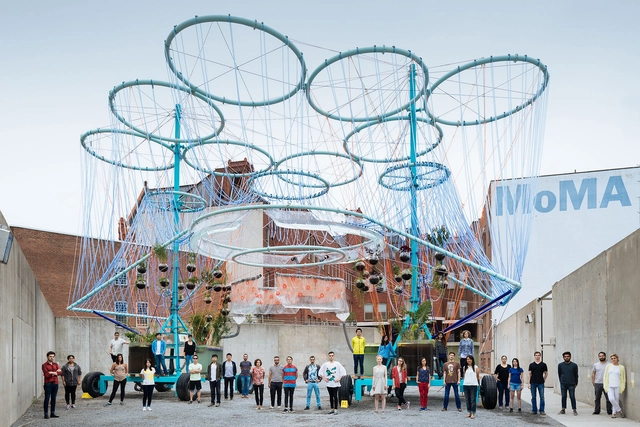
Spanish, New York-based architect Andrés Jaque (Office for Political Innovation) has been awarded the 10th Kiesler Architecture and Art Prize by the Mayor of Vienna, citing Jaque’s "capacity to go beyond assumptions about traditional practice and urban life." In 2015 Jaque was declared the MoMA PS1 YAP (Young Architects Programme) winner for COSMO – a complex, and beautiful, water purifying prototype that has been installed in Brooklyn. He and his office are also collaborating with Mark Wigley and Beatriz Colomina on the design for the upcoming Istanbul Design Biennial, Are We Human?










.jpg?1466282992&format=webp&width=640&height=580)
.jpg?1466283164 "© Laurian Ghinitoiu")
.jpg?1466283287 "© Laurian Ghinitoiu")
.jpg?1466283005 "© Laurian Ghinitoiu")
.jpg?1466282831 "© Laurian Ghinitoiu")
.jpg?1466282992)