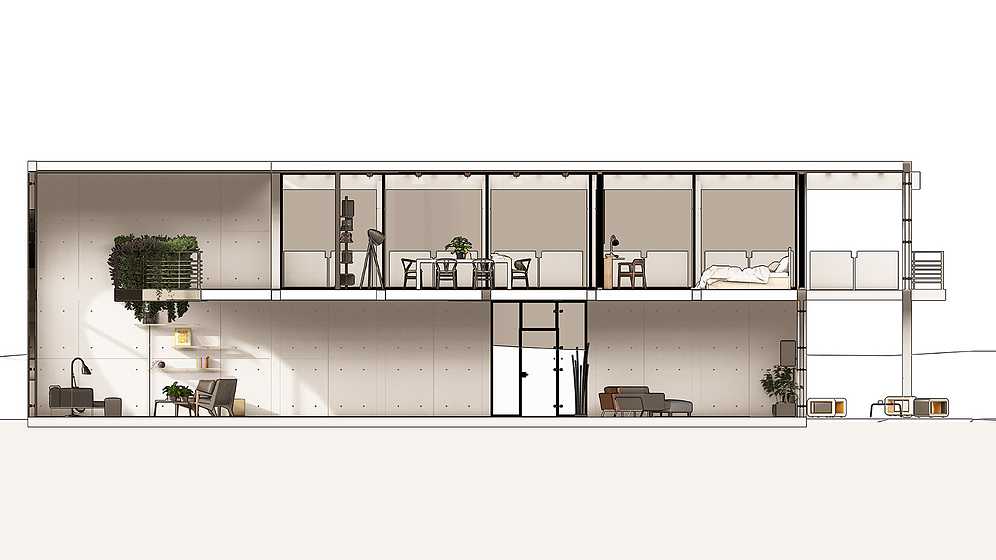
Produce personalized presentation boards that distill complex concepts into simple visual representations with a few helpful tools and effects.


Produce personalized presentation boards that distill complex concepts into simple visual representations with a few helpful tools and effects.
Imagine napping in a big hammock on the Greenway during your lunch hour. Designed and led by Hansy Better Barraza AIA, a team has woven The Big Hammock, the world’s largest portable relaxation/napping/hangout device, at the Fort Point Channel Parks. Take a turn in the hammock and enjoy activities from noon to 8:00 pm daily through September 4.
To find out more about The Big Hammock, click here. See more images after the break.

Housing, retail, hotels, restaurants, offices and even a library. You’ll find everything in the fourth part of our previously featured mixed use projects selection. Check them all after the break.
Bumps / SAKO Architects ‘BUMPS in Beijing’ is an integrated project with four residences as well as a commercial building. The traditional residence buildings in China are oriented south and north. With the increase in the density of the buildings, the traditional method causes buildings too close to each other and the rooms facing to the north can hardly get sunshine (read more…)
We’re so happy to share this video BIG passed along to us highlighting their contribution to the 2010 Venice Biennale. Entitled the LOOP City, the exhibition focuses on a new Metro loop that become the catalyst for development for the cross border region as different programs grow around the new stations. The loop will connect areas around the Øresund Strait in a sustainable spine of public transport, energy exchange and electric car infrastructure. The design introduces a new “vein of true urbanity” that will weave it was through the suburbs. This new loop will create a new realm by uniting specific points, yet activating each interstitial segment.
More about the project after the break.

Photographer Patricia Parinejad sent us great pictures of Frank O. Gehry’s building for LUMA at the Parc des Ateliers, which was presented by The Luma Foundation at the Venice Biennale. The project will be located in the centre of Arles, France. See many more images after the break.

The finalists of the International Highrise Award have been selected. In Frankfurt/Main an international jury of architects, engineers and property specialists chose five projects for the final shortlist. They will compete for the award and EUR 50,000 in prize money, which is bestowed by the city of Frankfurt/Main, Deutsches Architekturmuseum and DekaBank in a ceremony on 5 November 2010 in Frankfurt‘s renowned Paulskirche.
See the five finalists after the break.

It has been a busy few months for Steven Holl Architects. Just hours ago, we shared his Daeyang Gallery which is in construction in Korea. We’ve received tons of feedback after sharing pictures of his Horizontal Skyscraper in Shenzhen, China, not to mention his Nanjing Museum of Art & Architecture, which is currently in progress. And, the firm has just recently been asked to design the New Queens Library at Hunters Point. So, it doesn’t come as too much of a surprise that Holl was awarded by the Royal Institute of British Architects as this year’s recipient of the 2010 Jencks Award!
Could this be the year for Holl?

We’ve just received some news from our friends at Steven Holl Architects regarding the progress of their latest private gallery and residence. Situated in the hillside of the Kangbuk section of Seoul, Korea, the project’s geometry is an experimental reaction to a 1967 sketch for a music score by the composer Istvan Anhalt, “Symphony of Modules,” discovered in a book by John Cage titled “Notations”. This strategy, which runs parallel to a research studio on “the architectonics of music,” results in three separate pavilions connected by a sheet of water that establishes the plane of reference from above and below.
More construction photos, renderings and of course, Holl’s infamous watercolors after the break.

Vladimir Zotov, a young Ukrainian architect, shared his family house with us which is located in the village of Konopnitsa. The lot was especially difficult to build on as the village lacks developed infrastructure, causing all necessary systems to be placed on site. Working within the confines of a relatively small lot size, the home’s outer skeleton is twisted and contorted, bringing a strong angular language to residence.
More about the residence after the break.

Peruvian architect Carlos Bartesaghi Koc shared with us his project Systemic Agro-Tourism, for which he received an Award of Merit in the 2009 URBAN-SOS Competition. More images and architect’s description after the break.

Only a few days left till we reach 25,000 photos on our Flickr Pool. And with a lot to choose from, here’s our 18th selection of the best. Check the other 17 right here. As always, remember you can submit your own photo here, and don’t forget to follow us through Twitter and our Facebook Fan Page to find many more features.
The photo above was taken by jmhdezhdez in Barcelona, Spain. Check the other four after break.
This documentary film explores the fascinating life and complex legacy of architect and city planner Daniel Hudson Burnham, famous for designing the Flatiron Building in New York, Union Station in Washington D.C., and the 1909 master plan for Chicago, among others.

I recently paid a visit to the smallest office I have ever set foot in. It was actually a tiny one-bedroom apartment overlooking a pool. Its location, and the maneuvers I had to make to gain access, gave it the ambiance of secrecy. This must be what it feels like to visit a safe house, I thought.
Significant things are going on here. You may learn of them soon enough so, excepting one thing, I will not break the mystery. On one wall, in the very center of the wall, there hangs a small oil painting. The subject: a shipwreck in turbulent seas. It was done in blues with a very purposeful, skilled hand. It is not famous but could have been had it gotten into the right hands. It reminded me of Fitz Henry Lane’s “A Smart Blow (Rough Sea, Schooners),” 1856.
I asked the architect if he had done this. No, he said. He then told me the story of how this painting was the first beautiful thing that had ever transfixed him. When he was five or six, he used to sit and stare at it endlessly. This reminded me of how I used to stare out at the thunderstorms from my grandmother’s window, feeling like I was in the midst of them. As a child, he must have felt transported by this painting the way I was by that surrounding sky.

Photographer Patricia Parinejad shared with us some photos of the French Pavilion at the Venice Biennale designed by Dominique Perrault Architecture. You can see more images after the break.

Peaking above some contemporary New York favorites – such as Gehry’s IAC Building and Field Operations + DS+R’s High Line – Jean Nouvel’s 100 Eleventh Avenue adds yet another touch of character to Manhattan’s West Side. ArchRecord‘s great pieces on curtains walls gave us a better look at Nouvel’s textured glass curtain wall.
More about the curtain wall after the break.

Italian photographer Marco Zanta shared with us some great photographs of the exhibitions currently showed at the Venice Biennale.

Yaohua Wang shared with us his project An Open Appeal for China, designed along with Scott Chung, Jiaohao Lu, Xiaoxuan Lu, and Lennard Ong. They recently received 2nd Prize in the AIM International Architecture Competition. More images and architect’s description after the break.

WORK ac was one of the first practices we interviewed here at ArchDaily. When we visited their office they were working in P.F.1 (Public Farm 1), their awarded entry for the 2008 P.S.1 summer installation – one of the best installations I’ve seen so far.
An interesting part of the conversation was on how they worked with a mixed group of experts for this project, bringing more into the discussion and finally into the installation. This becomes the central part of the book, with over 150 pages dedicated to a series of interviews with the parties involved, from structural engineers to growing soil experts, telling the story of the process behind P.F.1. This section is structured as a story, but you can still read it picking from any random page. Interesting interview format with no questions, just “answers” that become the narrative of the project.
On the appendix we found a series of recipes for the vegetables that grew on the urban farm, and also a foreword with an interview by Winy Maas with Dan Wood and Amale Andraos.
WORK ac has also edited 49 Cities, a highly recommended guide to unrealized urbanism.
More info on the book after the break.

The jury for the Museum of the Second World War Competition in Poland have recently announced the winner. Studio Architektoniczne Kwadrat received 1st Prize and will design the new museum in Gdańsk, the city where the war broke out. 2nd Prize was awarded to Polish architects Piotr Płaskowicki & partnerzy Architekci and 3rd Prize to Greece-based BETAPLAN S.A.
See more images and justification of the jury for the winner after the break.

d3 is pleased to announce the winners of the Natural Systems international architectural design competition for 2010. The program, developed by co-directors Gregory Marinic and Mary-Jo Schlachter, invites architects, designers, engineers, and students to collectively explore the potential of analyzing, documenting, and deploying nature-based influences in architecture, interiors, and designed objects.
The competition calls for innovative proposals that advance sustainable thought and performance through the study of intrinsic environmental geometries, behaviors, and flows. By identifying, examining, and applying their structural order on form and function- -bottom-up, performance-based solutions for limitless building typologies, functional programs, and material conditions may be realized.
The competition awarded four prizes and eight special mentions. You can see the four prizes after the break. For complete list of special mentions, go to the competition’s official website.

Continuing our coverage of Kazuyo Sejima’s exciting 2010 Venice Biennale, the International Jury of the exhibition has recently awarded a Golden Lion for the best project of the ‘People Meet in Architecture’ Exhibit to Junya Ishigami+ Associates, a Golden Lion for the best National Participation to the Kingdom of Bahrain, and a Silver Lion for a promising young participant to OFFICE Kersten Geers David Van Severen + Bas Princen. We’ve featured Ishigami + Associates’ work previously on AD, and his Venice exhibit explores similar ideas about transparency and structure evident in his elegantly simplistic Kanagawa Institute of Technology.
More about the project, including a video from Domus about Ishigami’s project and beliefs.

Pezo von Ellrichshausen Architects shared with us their exhibition at the Venice Biennale, showing two buildings with a similar size are located in two different contexts. A light grey concrete piece rests in the middle of a natural scene. A cooper oxide green concrete prism stands in the middle of a suburban setting. Two opposite conditions which are presented by a disproportionate relationship between figure and background. The proposed constructions are reproduced as small sculptural models. The landscape is recorded in a huge panoramic backlight photograph. The objects, autonomous from their location, seem insignificant in front of the monumental effort of trying to capture most of the details and complexities of the surroundings.


Great projects often come from competitions. You don’t believe me? Check our fourth part of our previously featured awarded competition projects after the break.
3LHD to design private medical center in Croatia Close surrounding and historical site of Firule area are one of the most enjoyable Split’s living, working and recreation environments. Extraordinary location for the polyclinic is one of its greatest advantages. Placed near existing hospital complex on Firule, close to the sea and fresh air gives it even more importance and value (read more…)

1 October 2010 will see the starting signal fired for registrations for the 8th International Design Award 2011. Students of architecture and design have to submit their entries by 31 January 2011. The re-structured concept for the largest student design competition simplifies participation and rewards universities setting and submitting a term/semester project assignment.
But you can browse the last one: 417