Support on the -- Click here to nominate us for Best Online Magazine!Close
Become a fan of ArchDaily on Facebook!

The New York High Line officially open

By Karen Cilento — Filed under: Featured , Infrastructure , Landscape , News , Urban Planning , , , , ,


Photos © Iwan Baan

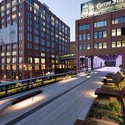
In May 2003, James Corner Field Operations with Diller Scofidio + Renfro competed against 720 teams from 36 countries to win the infrastructure conversion project of the New York City High Line.  More than half a decade later, the High Line’s transition to a public park is almost complete.  On June 8th, architects, elected officials, and advocates watched as Mayor Michael Bloomberg cut the ceremonial red ribbon, officially announcing the opening of the first of three sections.  The new park offers an alluring break from the chaotic city streets as users have an opportunity to experience an elevated space with uninterrupted views of the Hudson River and the city skyline.

More info about the park, including an incredible set of photos by architecture photographer Iwan Baan and a video by Brooklyn Foundry after the break.

UPDATE: We corrected some credits of this project. You can see the full list here.

YouTube Preview Image
Video by Brooklyn Foundry

The High Line, which is under the jurisdiction of the Department of Parks & Recreation, was the former West Side industrial railway.  It is a 1.45 mile-long elevated, steel structure built in the 1930s for freight trains; the last train ran on it in 1980.  Stretching across the west side of the city, it runs from Gansevoort Street, in the Meatpacking District, through the West Chelsea gallery neighborhood, and ends at 34th Street, next to the Jacob Javits Convention Center. In 2003, an open competition was held to convert the existing infrastructure into a public park.

The winning proposal by James Corner Field Operations with Diller Scofidio + Renfro includes over a dozen access points to the elevated park.  Whichever entrance is activated, a key component will attract users to spend time and explore the complete park.  For instance, enter a little past 14th St. and enjoy the sundeck and water feature; enter close to 23rd St. to lounge on the open lawn and seating steps; or enter past 26th St. to enjoy the viewing area.

Inspired by the wild seeded landscape left after the line had been abandoned, the team created a paving system that encourages natural growth which creates a ‘pathless’ landscape.  ”Through a strategy of agri-tecture - part agriculture, part architecture – the High Line surface is digitized into discrete units of paving and planting which are assembled along the 1.5 miles into a variety of gradients from 100% paving to 100% soft, richly vegetated biotopes,” explained DS + Renfro.  This undefined and unobtrusive environment allows the public to meander and experience the park as they wish.

Before the new landscape could take form atop the High Line, every component of the structure was tested and treated to ensure its structural strength.  As each piece of rail was removed, it was marked and mapped so that later, it could be returned to its original location as an integrated planting piece.  Energy-efficient LED lights gently illuminate the park’s pathways and allow the eyes to adjust to the ambient light of the surrounding city sky.  Lights installed on the underside of the High Line illuminate the sidewalk below.  For the vast garden, soil was delivered and distributed to specific areas and more than one hundred different species of plants, selected from nurseries along the East Coast, were planted by a team of horticulturists to match the plans created by landscape architects James Corner Field Operations and planting designer Piet Oudolf.

Mr. Bloomberg called the High Line, “an extraordinary gift to our city’s future….It really does live up to its highest expectation.”  The promenade has initiated more than 30 new projects in the nearby neighborhood, including Renzo Piano’s new satellite for the Whitney Museum of American Art.   The new space will offer greening opportunities, alternative transportation options, and social benefits to meet changing needs in urban environments.  It is expected that the radical infrastructure conversion will attract thousands from around the world in its opening season.

© Iwan Baan

To read more visit The Highline official website.

Design Team (2004-2009)

The High Line design team is led by landscape architecture and urban design firm James Corner Field Operations.

James Corner Field Operations (Design Lead)
Principal-in-Charge: James Corner
Lead Project Designers: Lisa Tziona Switkin, Nahyun Hwang
Project Team: Sierra Bainbridge, Tom Jost, Danilo Martic, Tatiana von Preussen, Maura Rockcastle, Tom Ryan, Lara Shihab-Eldin, Heeyeun Yoon, Hong Zhou
View Web site

Diller Scofidio + Renfro
Partners: Elizabeth Diller, Ricardo Scofidio, Charles Renfro
Project Designer: Matthew Johnson
Project Team: Robert Condon, Tobias Hegemann, Gaspar Libedinsky, Jeremy Linzee, Miles Nelligan, Dan Sakai
View Web site

READ COMPLETE LIST OF CREDITS


53 comments »

DiaphanousAbyss says:

Thank you Iwan!

 
# June 9, 2009 at 13:58
DiaphanousAbyss says:

Better yet, thank you Iwan MaaN!

 
# June 9, 2009 at 13:59
kc says:

lets turn all highways to this =P

 
# June 9, 2009 at 14:24
Nathan says:

Field Operations led the design team, why is Diller Scofidio Renfro getting all the credit?

 
# June 9, 2009 at 14:43
DiaphanousAbyss says:

Field Operations = Landscape architects. Ds+R = DESIGN ARCHITECTS.

 
# June 9, 2009 at 14:55
Nathan says:

Field Operations is credited in almost all materials I’ve seen – including the High Line Blog, which I would take to be an authority on the matter – as the lead designer for the project. With limited building interventions, it is a bit unclear what the actual role DS+R had in the project.

 
# June 9, 2009 at 15:16
Matt says:

Are we all designers so we can get our names in magazines or on websites?? Why do we care about who is called the lead designer and who worked on the TEAM. Here we have a beautifully designed infrastructure-renewal project (which we don’t see many of in this country) and people are all caught in who gets credit. What happened to designing for design sake rather then being a star-chitect?

 
# June 9, 2009 at 15:30
    Kayser says:

    I believe it is an issue of ethics rather than an issue of being a “star-chitect”

     
    # July 13, 2009 at 06:07

GREAT !

 
# June 9, 2009 at 15:39
public eye says:

aHHHH, Terrible, superficial architecture!
What a waste of money!

 
# June 9, 2009 at 15:49
aw says:

public eye – you’re a moron.
get outside and go for a walk.

 
# June 9, 2009 at 15:53
cb says:

DS+R designed all the access points for the project (staircases, elevators, etc.) as well as a few specific points along and underneath the park (cafes, amphitheaters, the likes)

 
# June 9, 2009 at 16:21
toro says:

It’s nice! lets hope people are willing to shlep their way up and actually use it! Have to say, I’m going to miss those graffiti trains…

 
# June 9, 2009 at 16:37
2MACoff says:

НЕ Я СЧИТВЮ ЭТО ПРАВИЛЬНО И ВАЖНО И НРАВЯТСЯ МНЕ ЭТИ КУДРИ…

 
# June 9, 2009 at 17:06
interested says:

I agree that crediting Diller Scofidio + Renfro as the lead consultant team is poor reporting at best or disengeneous at its worst. Field Operations has been widely credited as the lead designers on the project and from my understanding the prime contract holder with the client. If anything the posting should read “designed by landscape architects James Corner Field Operations, with architects Diller Scofidio + Renfro” as is done on the high line website.

 
# June 9, 2009 at 17:30
Robert says:

Can I grow carrots and runner beans on it? Would have a made a great linear allotment for New Yorkers.

I do appreciate the way it has become a wild flower park. Often abadoned railways blossom into areas of biodiversity even in cities like New York.

Great photos I may add. The twilight shot is really good.

 
# June 9, 2009 at 17:45
E says:

The big effort of the project is done – publicizing a new way of regarding old infrastructures in a city. A new effort must be done – pay attention to whom and how much will use this place, analyze and learn with it. My experience is that the more architecture fulfill the eyes, the less social and used as supposed it is… Let’s hope this doesn’t happens here… Although this is not a great architecture project – it is just a great investment with great marketing with some “designy” stuff! Anyway…

 
# June 9, 2009 at 19:57
panamArq says:

so resourceful and inventive. The typical city would have just demolished this and melted down the scrap metal. what a great public space, I can’t wait to visit.

 
# June 9, 2009 at 20:22
Tuf-Pak says:

Don’t discount Field Operations…they were the driving force behind the design.

 
# June 9, 2009 at 21:46
Fino says:

Pretty neat idea. Very out of the ordinary project that can be beneficial to promote a moment of well being or tranquility in an otherwise bustling environment. Very nice.

that is all.

 
# June 9, 2009 at 22:12
INawe says:

so glad its finally done. seems like it took forever. love the concrete forming and transition into wild flowers. so going to do that if i ever get a property with a yard. lol

 
# June 9, 2009 at 22:47
Ladzono says:

Great!!!

 
# June 10, 2009 at 02:01
ZipZap says:

very interesting

 
# June 10, 2009 at 03:34
Mary Hill says:

It would be nice if DiaphanousAbyss disappeared into the last part of their name.

Yes, I really think Arch Daily should properly credit Field Operations. Its completely inappropriate to have DS+R’s name at the forefront of this blog.

 
# June 10, 2009 at 03:35
Macho says:

I agree with 2macoff…completely on the money!

 
# June 10, 2009 at 03:52
David says:

NYC rocks

 
# June 10, 2009 at 04:58
GMan says:

Eh, I think Field Operations did a wee bit more than pick the plants!

 
# June 10, 2009 at 12:38
MC says:

INCREDIBLE!

 
# June 10, 2009 at 12:40
otis says:

*swoon*

 
# June 10, 2009 at 19:28
Partick Bateman says:

Field Operations = Landscape architects. Ds+R = DESIGN ARCHITECTS.
————-

well done…a typical “arrogant architect” response.

arsecandle.

 
# June 11, 2009 at 03:17
RQH says:

Sorry Bateman, but that’s just how it is. Ds+R designed the form and structure so they get the design credit. End of story.

Paving materials & plant selection do not earn you design credit because that isn’t design, it’s decoration.

 
# June 11, 2009 at 08:23
rossi says:

Well you could argue about that. I’d say paving materials and plant selection are a big part of the design. But it doesn’t matter, really. This is beautiful.

 
# June 11, 2009 at 10:34
Paula H. says:

What an amazing park for the city and the people.

The contrast w/ the past into the present with the relation with nature it’s inspiring… The design is simply beautiful!!

Congratulations to the neighbors that turn this idea into reality ;)

 
# June 11, 2009 at 10:55
K says:

I just was there yesterday. Truly amazing, a great contribution to Chelsea, NY and the whole architectural world. And I was surprised how many people were there already, of ALL ages and social groups, with kids, strollers, locals, tourists, construction workers, businessmen, teens, on their dates…
+++
Looking at the design proposal, I was interested in how the project is responding to the local context, eg adjacent buildings, rooftops, etc. Some conditions where the line penetrates through the existing structures are used to create the environment different from the outdoor parts of the line. However, I feel that in most cases neighboring structures are dramatically underestimated, even though initial design was responding to those conditions. I wonder whether this is a result of legal issues.

 
# June 11, 2009 at 13:56
Mr. Viscous says:

RQH and others. Pull yer heads out. You may note that the form and structure are existing. You do us all us disservice trying to create some sort of tortured hierarchy between design of spaces that are plastic and design of places that are spatial. Grow up. BTW you’d label me a “form and structure” architect.

 
# June 11, 2009 at 14:24
Partick Bateman says:

thats bollocks RQH,

the landscape architects did way more than paving and plants… thats like saying an architect just designs the facade of the building.

what form and structure did the architects design by the way?

 
# June 12, 2009 at 03:02
RQH says:

If you watch the video you’ll see that the architects both added to and removed from the existing structure. Landscape architects aren’t capable of doing that.

Maybe you should research the different requirements for landscape architecture school vs. arch. school and passing the A.R.E. vs. the L.A.R.E. if you’re unsure as to why there’s hierarchy among landscape architects and real architects.

 
# June 12, 2009 at 06:52
Mary Hill says:

RQH, its a shame that a joker like you feels they have to contribute to a serious blog like this.

Grow up pal.

 
# June 12, 2009 at 07:32
Partick Bateman says:

Really?
i think landscape architects are just as capable as architects of using a structural engineer.

 
# June 12, 2009 at 07:41
Brutalist says:

I think RQH is going to have to include some oversize doors in his next design to accommodate his massive head during client-designer site visits.

 
# June 12, 2009 at 07:44
Partick Bateman says:

“real architects” haha!
you do realise that landscape architecture is a totally different discipline to architecture dont you?… it’s not a step in becoming an architect or as it’s now known “unemployed architect”.

 
# June 12, 2009 at 07:45
Lasse says:

What are you idiots debating? “who’s best” – Architects vs. landscape architects….? No wonder you are unemployed:)

 
# June 12, 2009 at 19:01
Lasse says:

But Scorfidio and Diller are awsome… The landscape guys in this case clearly are’nt.. Oh you mixed some plants, good for you little buddy….

 
# June 12, 2009 at 19:05

I’ve got some more pictures of The High Line Park at my flickr.

http://www.flickr.com/photos/franparente/

Very nice project!

 
# June 15, 2009 at 21:18
Benjamin says:

This is by the far the most innovative and influential BUILT project in the last few years. Congrats for the overall team of the project. Great contribution to New York City and also innovation on infrastructure, landscaping, and architecture.

 
# June 15, 2009 at 22:24
Alex says:

Beautiful!!! this is good Architecture!!

 
# July 14, 2009 at 07:03

Links to this article »

Leave a Reply »

Want to have your own avatar? Get yours at Gravatar.

Latest Comments »

Too much is going on here… Too many stories...[+]
i thought it was a post office so lame the nightlife is...[+]
a bold project. has a lot to say about...[+]
beautiful project. very generous interior...[+]
Are there any lists that go deeper than 10? I...[+]
here’s a suggestion: how about if...[+]
i think it would be inappropriate to say...[+]
Mmmh, is this is 1993 and this is Culver City?...[+]
I like the intervention. The previous building was a dog...[+]
Beautiful landscaping. The house has a nice...[+]
I want to take a bottle of tomato...[+]
How beautiful this project is!pure!Less is...[+]

Browse by category »

Our partners »

Browse by date »

Friends »

Proudly hosted at »