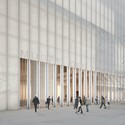
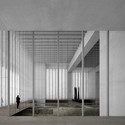
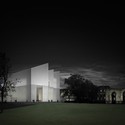
Henning Larsen Architects has won the competition for developing a 150,000 sqm area in the second-largest city in the Faroe Islands, Klaksvík. The area will comprise a cultural house, a museum, residences, offices and shops. 154 competition proposals were submitted in the open, international competition. More images and architect’s description after the break.
In the past decade New York City’s government, along with numerous organizations and design teams, have taken the initiative to revive the city’s public spaces and reclaim underutilized areas that have long been associated with the city’s manufacturing past. We’re all familiar with the High Line, a project that takes over the elevated rail lines of Chelsea and Meat Packing District that until several years ago stood as a desolate and eroding piece of infrastructure, which was beautiful in its own way but largely underutilized. Then there is the Brooklyn Navy Yard, which has become a mecca for designers, fabricators and research companies and has recently acquired a museum to celebrate its history. And of course, there are the city’s waterways, which, since New York City’s early history, have served its manufacturing and trade economy, have become parks along the waterfront as part of the Hudson River Greenway and the FDR Drive. Manufacturing has long been replaced by Wall Street, but there are parts of the city that still retain the industrial past along the historic waterfront and continue to operate some of the most important facilities that allow the city to function. Now it is time to reintroduce a public use among these industrial zones.
‘What is proposed is like a monstrous carbuncle on the face of a much loved and elegant friend.”
It’s easy to see why British Architects get their hackles raised when it comes to Prince Charles. The oft-quoted gem above, said in reference to a proposed extension to the National Gallery in 1984, is one of hundreds of such Architectural criticisms Prince Charles has made over the years. Which wouldn’t matter of course, if, like any average Architectural layman’s opinions, his words didn’t have much weight.
His do. They’ve resulted in the intervention, squelching, and/or redesign of at least 5 major plans over the last twenty years. But let’s not write off Charles just yet.
Chevrolet Volt. Electric when you want it, gas when you need it. The Chevrolet Volt is unique among electric cars because it runs on two sources of energy. You have an electric source – a battery – that allows you to drive gas-free for an EPA–estimated 35 miles. And there's also an onboard gas generator that produces electricity so you can go farther. So if you want to drive using only electricity, you can. If you want to drive using electricity and gas, you can do that, too. Feeling all revved up? Check out what this current Chevy Volt driver has to say about her unique driving lifestyle…A typical day for Kelly Hendricks involves running around town, meeting with clients, visiting jobsites, and shopping for materials. It’s no wonder why the car she drives is so important to her since she spends a good portion of her day sitting in it. After her 11-year-old SUV was rear-ended and totaled, she decided it was time for a new start. “Being an eco friendly interior designer in San Diego, I loved the thought of driving purely on electricity, but at the same time I wanted to feel at ease knowing I won't get stranded because once I go beyond the battery range the car transitions to a gasoline power source,” she says. She found her ideal vehicle in the Chevy Volt.Hendricks is pleased with her driving experience so far, but also with how much money she is saving on fueling costs. “With as much driving as I do, I'm only having to purchase gas once a month and it averages out to be $27-$30. And my electricity bill has only gone up about $25 per month,” she reports. She does nearly all of her charging up from her own garage, and looks forward to the day when charging stations are more readily available. By charging regularly, Volt owners are averaging about a month between fill-ups.In the meantime, Hendricks says she gets a kick out of the questions people ask her about her Volt. In fact, a recent trip to her Chevy dealership had her upstaging the sales team. “I stopped by the Chevy dealership to pick something up and there was this guy standing out front along with some sales people and he started asking me questions about my Volt. His first question was how much money am I spending on gas a week,” she says. “You should have seen the look on his face when I told him I only buy gas once a month, compared to the $50 per week my former SUV used to cost. He was so stunned and surprised -- I love when that happens!”As for a final fringe benefit, Hendricks says her decision to be a Volt owner makes her feel good about her role in helping the environment, as well as the country. “I like that I am helping to support jobs in America.”The 2012 Chevy Volt offers an EPA-estimated 35 miles on a full charge based on 94 MPGe and an additional 340 miles with a full tank based on 35 city, 40 MPG highway . Actual range varies with conditions.Volt is available to order at participating dealers.Has your Volt ownership reinvented your driving experience? Tell your amazing story here.
Cannon Design, a leading international architectural, engineering and planning firm, recently announced that it has joined forces with Peter Ellis New Cities, expanding the firm’s urban planning and city design practice. Currently, they have been working on a master plan for the new Sports City in India, a comprehensive city plan for 1,000,000 inhabitants on 5,000 acres. Ellis and his New Delhi staff will be an integral part of Cannon Design’s planned expansion in India while his U.S. based team has joined the firm’s office in Chicago. More images and architects’ description after the break.
Recently, we visited the Meulensteen gallery to hear an update on Steven Holl’s latest project in Virginia - the Institute for Contemporary Art at Virginia Commonwealth University. Slated for completion in 2015, the project was presented in a series of Holl’s trademark watercolors and models, complete with a slideshow given by project architect Dimitra Tsachrelia who previously worked on the Glasgow School of Art for the firm. As we shared earlier, the project’s formal gestures are a reaction to its site context along the busy intersection of Richmond at Broad and Belvidere, with the intention to create an open gateway with a building that forks in the X-Y direction to illustrate the “non-linear” path of art, and torques in the Z direction to shape a dynamic volume of circulation. Although the weather was quite unforgiving, those who packed into the gallery enjoyed Tsachrelia’s friendly demeanor as she walked us through the process and progress of the project.
2DEFINE Architecture, with local partner Dalian Urban Planning & Design Institute, recently won an assignment to lead the design of an extraordinary new convention center in Yingkou, China. The project consists of a four-story, 70,000-square-meter (750,000-square-foot) facility in a city of 2.2 million people located in the northwest province of Liaoning on the Bohai Sea. A unique, sea urchin-shaped building created to reflect its natural environment, the facility will be the centerpiece of a new harbor created off of a satellite central business district in the port city. More images and architects’ description after the break.
This year’s Daylight Award, a prestigious prize awarded by the Living Daylights Foundation that honors projects that reach an optimum result in combining daylight, artificial light and design, has been given to the Kaap Skil, Maritime and Beachcombers’ Museum on the Dutch island of Texl. Designed by Mecanoo Architecten, one can almost feel the weather because of the transparency of the building, according to the jury. “Sun, clouds, thunder and rain: outdoors comes inside as perception and emotion and this is a core quality for a building with the Wadden Sea at your doorstep.” More images and architects’ description after the break.
The design by davidclovers for the Bama Eco Resort includes two key areas of an eco-tourist resort project that intends to be a flagship project for China demonstrating how architecture can both re-work and reinvigorate sensitive habitat sites. Using innovative construction methods and design processes, both projects “farm” the existing terrain of the site finding its latent potentials. More images and architects’ description after the break.
GRAPHISOFT recently announced the release of the next upgrade to its BIM design software; ArchiCAD 16. This version of ArchiCAD provides solutions that respond to some of the most dynamically developing segments of the BIM industry. They are building components, freedom of design and energy efficiency.
The value of BIM software can be measured only by how well it is used, within a given workflow and how well a team accurately generates and shares data across project teams; ultimately managing that data throughout the building lifecycle. On June 19th, in a live webinar, GRAPHISOFT will cover the basics of ArchiCAD and give attendees a foundation to make the most of the new tools found in ArchiCAD 16.
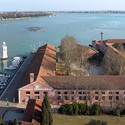
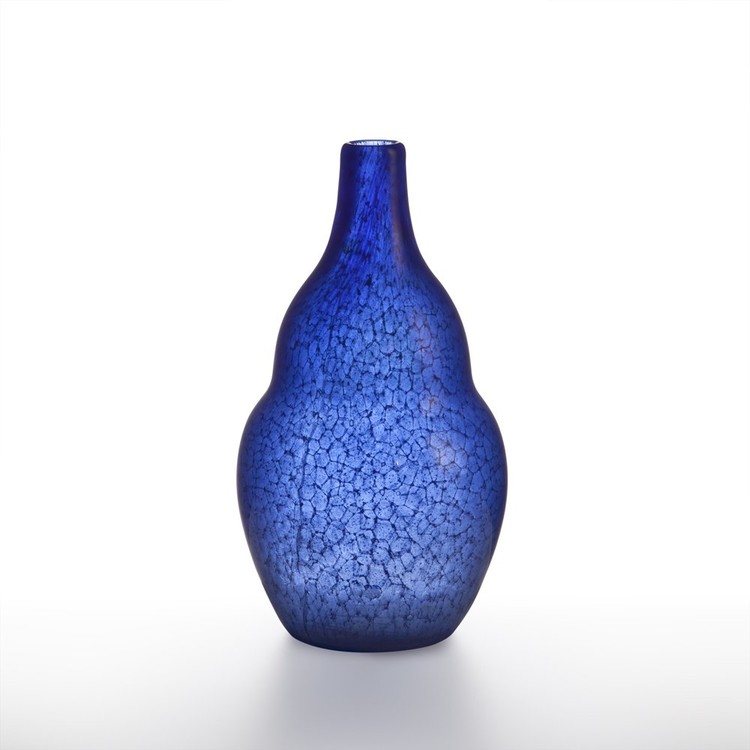
The new exhibition space Rooms for Glass (Le Stanze del Vetro) in Italy, designed by Selldorf Architects, will open this summer in August 2012. The first exhibit to inaugurate the space will be Carlo Scarpa. Venini 1932–1947, a collection of over 300 glassworks by architect Carlo Scarpa. The exhibit will run until November 29, 2012, after which Rooms for Glass will continue showcasing the art of Venetian glassmaking in the 20th century with other exhibits.
The city of Colmar, France is undertaking the expansion of The Unterlinden Museum with the annexation of an Art Nouveau building that once housed the city’s municipal baths. The 1906 building stands just meters away from the current museum. Its addition will bring the current museum to an area of 8,000 square meters, which will allow works that are currently stored in the museum’s vaults to be displayed to the public. The design team is led by Herzog & de Meuron and is scheduled for completion in September, 2013.
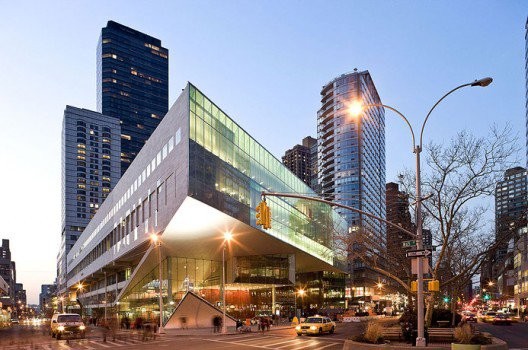
During the summer months, The Municipal Art Society will be leading over two dozen urban design and architecture tours throughout New York. MAS is a non-profit membership organization committed to making New York a more livable city through education, dialogue and advocacy for intelligent urban planning, design and preservation. Since 1956, MAS has been offering such tours as a way to share knowledge and spread appreciation for New York’s varied cityscape. The tours are conducted by architectural, urban, and art historians, urban geographers, architects, teachers and writers, and offer a way to explore historic, evolving and “renewed” neighborhoods, the waterfront and specific residential and commercial projects. The tours will explore some neighborhoods we have featured on ArchDaily, such as Gansevoort with a look at apartments designed by Asymptote, the High Line and the construction site for the new Whitney Museum of American Art. And, even older gems such as New York’s Art Deco buildings from the 1950s.
Well known for their visionary architecture that people love to visit and go back to time and again, The Jerde Partnership has set out to attract more people through a realistic framework by transforming Atlantic City into the preferred coastal resort destination of the Northeastern United States. By creating a clean, green, safe city that pays homage to its storied history and takes advantage of its unique island setting, the new Atlantic City Tourism District master plan will offer a wide range of attractions and experiences for all ages. By promoting a strategy for redevelopment, phasing, and district-wide improvements, the master plan will serve as a catalyst for Atlantic City’s economic and social uplift. More images and architects’ description after the break.
In cooperation with engineers LB Consult, CEBRA recently won the competition for 48 new student housing units in Esbjerg, Denmark’s 5th largest city. The eye-catching proposal consists of 26,910 sq. ft. apartments spread across ten floors and outdoor areas with terraces and activity zones such as a street basket field. The project is commissioned by the housing association Ungdomsbo and they expect that the first students can move in in January 2014. More images and architects’ description after the break.
As part of the cycle of competitions, Think Space is calling for entries in its Blur Building themed competition. “It is too soon to know whether Blur was a barometer of early 21st Century sentiment or a neutral response to the conditions of the site. The lack of program allowed us to make our own which had nothing to do with a World’s Fair and everything to do with our own practice. It allowed Diller and Scofidio to bridge the worlds of high art, installation art, and architecture, continue to research threads significant to the practice at the same time it presaged the change of the firm name from D+S to DS+R.” – Charles Renfro. More on the juror’s description of the project for the competition after the break.
Heroic. Contemplative. Grieving. Victorious. The rebirth of the former World Trade Center site in lower Manhattan has engendered significant public reaction and reflection. With implications as complex as they are profound, it is not surprising that it has taken more than a decade to heal the urban scars of September 11, 2001.
I had the rare opportunity to sit down with three architects working on the site, Santiago Calatrava, David Childs, and Daniel Libeskind, at the recent American Institute of Architects convention in Washington, D.C., where they were honored along with four others, as “Architects of Healing.” We discussed their experience of reshaping one of the most culturally significant sites in the history of the United States.
This week we will propose the first documentary of the list within our section of Films & Architecture. There is not much to say about the figure of Kahn, since it has been worldwide recognized. Nevertheless this is a film that captures in a magnificent way the greatness of Kahn’s work through his son’s journey. I guess everyone related somehow with architecture will feel touched by this extraordinary recording. Let us know in the comments what is (or was) your experience watching the film.
In the design industries, sustainable ratings are too often parsed for single structures. What makes this approach inefficient is precisely that it fails to account for a more comprehensive approach to promoting sustainable strategies. Moreover, what comprises “sustainable” in one rating system may be completely ignored by another. Rather than implementing such piecemeal methods, the design and building industries need to consider a ratings system that accounts for categories ranging from resource allocation to quality of life issues.
Enter the Zofnass Program for Sustainable Infrastructure at Harvard’s Graduate School of Design. It grew out of a studio from 2008, but the program has long since grown beyond its original vision. The program has created Envision, a voluntary certification system. Envision helps cities and infrastructures deploy sustainable strategies “for the design, delivery, and operations of large-scale urban developments and infrastructures.” To help users navigate all its features, there is a downloadable manual.
Arising from the historic town fortifications, David Chipperfield Architects’ new Musée des Beaux-arts is situated on the periphery of a long green space in between the old and new parts of Reims, France. The Gallo-Roman gate and the modernist market hall, located in its vicinity, are evidence of Reims’s architectural history from antiquity to modern times. Clad with marble slabs and glass ceramic panels, the translucent Musée des Beaux-arts building shares a site with an excavation area filled with mediaeval findings.
Continue reading to learn more about the Musée des Beaux-arts.
The general wisdom is that the Olympics create billions in revenue, an incalculable amount of publicity, and an excuse to get massive urban renewal projects off the ground. Cities invest millions – and that’s just to be considered by the Olympic Council. And yet, more often than not, the Olympics engender debt, questionable planning decisions (like razing poor neighborhoods to the ground), and massive, expensive structures that end up vacant and unused when the Games end.
Jon Pack and Gary Hustwit have decided to undertake a photography project to capture post-Olympic cities – both the successes and the failures. From the auditorium turned Korean Mega-Church in L.A. to the weeded, empty venues in Athens, The Olympic City, currently fundraising on Kickstarter, will chronicle each city’s post-Olympic “rebirth or decay.”
For us, the project raises some interesting questions: What choices can cities make to make urban rebirth an inevitable Olympic consequence? Or, at the very least, how can cities avoid the fate of post-Olympic decay?
Sydney is once again illuminated by the fourth annual Vivid’s Festival of Light 2012 that celebrates the creative industries with light shows, music, design ideas conferences and entrepreneurship conferences. The seventeen-day festival, which started on May 25 and will run until June 11th, features light shows and graphics projected on buildings, concerts, lectures and conferences. This round of light projections will have over 50 installations and includes cityscapes, street furniture, monuments and emblematic buildings like the Sydney Opera House.
The new Yongsan International Business District (YIBD), which will be the new heart of Seoul, will be comparable only to a few other city centers on the global stage. As part of the district, the Block C1-20 building, designed by Tange Associates, is a metaphorical expression of the dynamic energy created by the Retail Valley and the building’s own diverse program. More images and architects’ description after the break.