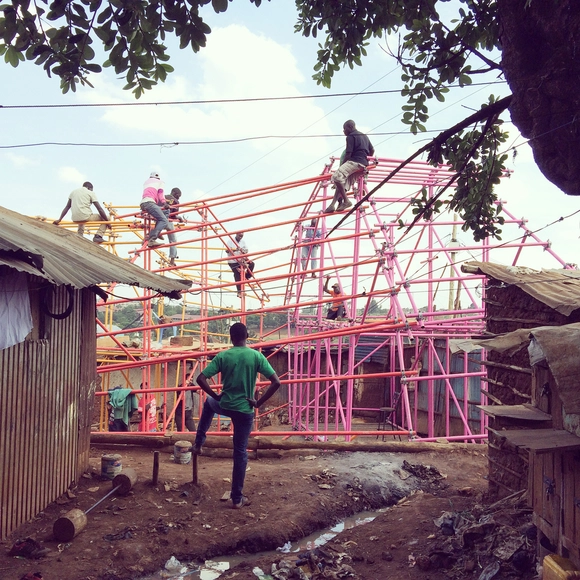
Image: Kibera Hamlets School by SelgasCano, Helloeverything, and studio.14, photo credit: helloeverything
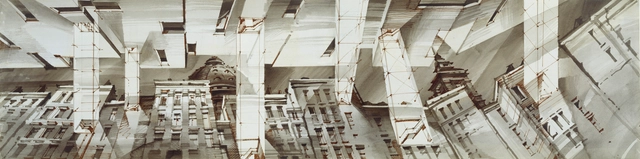
Scaffolding curated by Greg Barton, examines the extraordinary applications of scaffolding as a kit-of-parts technology to provide novel forms of inhabitation and access. Through an installation designed by Shohei Shigematsu and OMA New York with graphic design by MTWTF, Scaffolding will disrupt the architectural space of the Center for Architecture, instilling a new appreciation of scaffolding and its transformative potential.
The Museum of Contemporary Art Chicago presents the first-ever museum exhibition of breakout Chicago artist Amanda Williams, featuring a new addition to her highly acclaimed project, Color(ed) Theory, which debuted at the first Chicago Architecture Biennial. The bright, monochromatic houses painted as part of Color(ed) Theory bring attention to the overwhelming number of vacancies on Chicago’s South Side, reflecting Williams’ perspective that architecture serves as a microcosm for larger social issues. Together with new works such as A Dream or Substance, a Beamer, a Necklace or Freedom? -- where Williams invited Englewood-based collaborators to gild a room in imitation gold leaf in the same proportion of a Chicago lot, and then sealed off the room with just a small gap for viewing the gleaming interior -- Williams’ solo debut creates an experience that comments on race, class, and urban space. Chicago Works: Amanda Williamsis organized by MCA Curatorial Assistant Grace Deveney and is on view from July 18 to December 31, 2017.
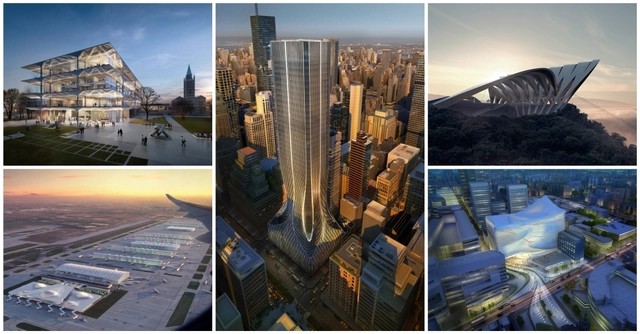
Now on display at the Jaroslav Fragner Gallery as part of the third Prague Experimental Architecture Biennial is “ZHA: Unbuilt,” an in-depth look into some of the firm’s best projects that could have been.
Arranged within the space by typological concepts (towers, atriums, stadiums, shells, masterplans, ribbons, and bubbles), the exhibition serves as an exploration into the evolution of the work of Zaha Hadid Architects, showing how earlier research and innovations have become the foundations of the firm's architectural projects currently in development.
By God, don’t walk by me, I am an architect. I am trying to show you something. Look at it! - Morris Lapidus
Never before there were so many distinctive and original voices and visions in architecture. Multiplicity of voices is the defining feature of architecture’s current moment. Architecture of distinction and originality is being produced all around us. Our built environment is growing ever more diverse and complex. Is architecture oversaturated with ideas? How many architectures do we need? How can we remain critical by being exposed to such a proliferation of voices? Do architects need common ground? Should architects’ voices be amplified? Should architecture be ego-driven? Is iconic and signature-style architecture still relevant?
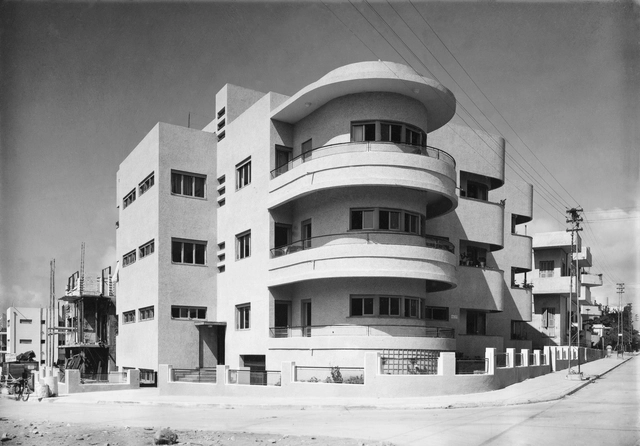
The exhibition Social Construction: Modern Architecture in British Mandate Palestine, tracing the influence of international Modernism on the architectural vernacular that developed in Palestine during 1917–48, is on display at the Yale Architecture Gallery from August 31to November 18, 2017. Originally organized by the Israel Museum, in Jerusalem, the show draws inspiration from the extensive research of architects Ada Karmi-Melamede and Dan Price, whose accompanying book, Architecture in Palestine during the British Mandate, 1917–1948, explores not only the functional aspects of this new architecture but also the social values that shaped the defining language of this new architectural style. The original exhibition was curated and designed by Oren Sagiv, chief of exhibition design at the Israel Museum, with Eyal Rozen.
The city of Los Angeles manufactures the myth of its own aspirational promise with cult-like fervor showcasing both spectacular virtuosity and deep social myopia - at once its glory and its menace, as Frank Lloyd Wright might have said. LA often stands apart as the urban sing-song of denial replete with clenched eyes and muffled ears. Thus, an illustration of homeless architecture which draws from the same artistic tools and idealism that typically supports the other end of the housing spectrum satirizes the ubiquity of the illusion machine and asks viewers to consider their place on the assembly line of fantasy.
Munich’s Oktoberfest, the Kumbh Mela pilgrimage in India (or the largest gathering of humans on the planet), the Burning Man Festival in Nevada, and other major events demonstrate that flexible architectural configurations are temporarily deployed around the globe to provide medium-term shelter, often to enormous crowds. Such structures fulfill a range of functional tasks and are used in religious and cultural festivals or can take the form of military camps, refugee camps, or even temporary mining towns. This show traces a global phenomenon that has become increasingly topical given today’s current state of mass migration triggered by climate change, political strife, and natural disasters.
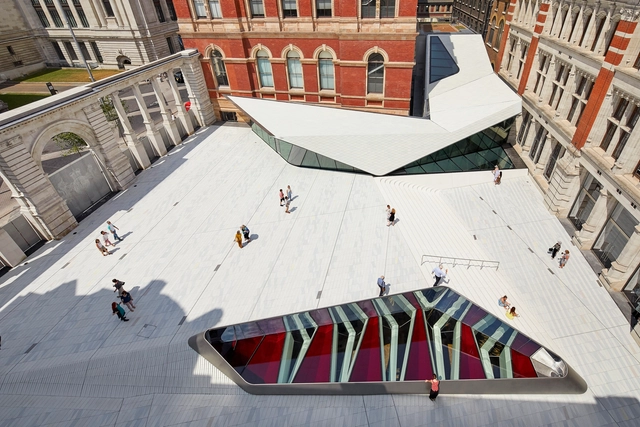
Entrance to the Visitors Center at the Chhatrapati Shivaji Maharaj Vastu Sangrahalaya (CSMVS), formerly known as the Prince of Wales Museum, Mumbai. Photo: Rajesh Vohra
As a point of entry and exit, a threshold has a dual coding in society as both a physical and symbolic marker of separation and connection. Thresholds are often explicitly hard-edged or even brutal in their expression, demarcating rigid boundaries, as in the definitive lines of walls, barricades, and security checkpoints in buildings, around cities, or across larger territories. Too often, thresholds also divide human activity or communities according to social, ethnic, national, or economic characteristics. Architecture and planning can unwittingly contribute to these different forms of physical separation, especially in ways made visible through their practitioners’ interpretations of culture, religion, or legislation. As the academic disciplines that inform spatial practices, architecture and planning are themselves often similarly separated by disciplinary thresholds, inhibiting porosity between fields of research. By definition, an individual discipline necessarily is organized around a self-referential center of discursive production, but this often happens at the expense of the richness found at the intersection of multiple disciplinary perspectives. Is architecture, in its compulsive drive to create the autonomous object, inherently hardening the thresholds separating it from other disciplines and, by extension, reproducing those schisms within the built environment? Can architecture and planning intentionally construct soft thresholds―lines that are easily traversed, even temporarily erased―thereby allowing for multiple perspectives across different modes of research and practice and catalyzing disciplinary and social connections? What, then, is the physical expression of a soft threshold―a space that is visually and physically porous, plural in spirit, encompassing of its context, and yet rigorous in its expression?
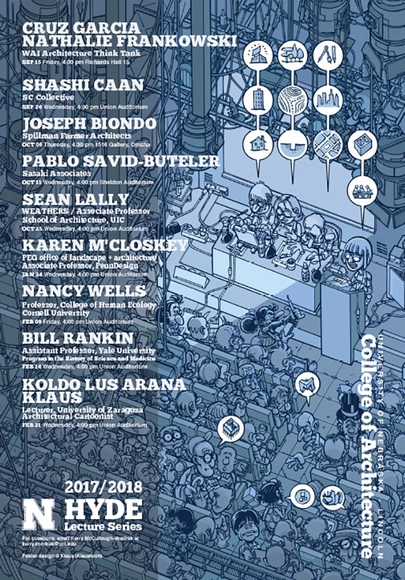
2017/2018 Hyde Lecture Series opens another exciting chapter for the design and planning disciplines as speakers take a fresh, in-depth look at the latest developments in their respective fields.
Organized by Frieze Academy on Friday 6 October, from 10am – 4.30pm at The Royal Institution in London, this full-day conference will be hosted by Alice Rawsthorn with:
The story of master architect Louis Kahn (1901 – 1974) is intrinsically connected to Philadelphia, where he spent most of his life and career. Louis Kahn: The Power of Architecture is the first major retrospective of Kahn’s work in two decades, encompassing over 200 objects related to Kahn’s buildings and projects in the form of architectural models, plans, original drawings, photographs, and films. With complex spatial compositions and a choreographic mastery of light, Kahn created buildings of archaic beauty and powerful universal symbolism. The Fabric Workshop and Museum is proud to be the final venue of the international tour.
Earn up to 7.5 continuing education credits in one power-packed day of educational sessions and networking opportunities at the 19th annual ALA Midwest Architecture Conference, to be held Oct. 3 at the Drury Lane Conference Center, Oakbrook Terrace, IL.
The 19th annual conference, hosted by the Association of Licensed Architects (ALA), features a keynote address by Noah Biklen, AIA, LEED AP, Principal at Deborah Berke Partners. His talk, “Pushing the Envelope,” will focus on the recent work of Deborah Berke Partners, with particular attention to the firm's unique approach to the building envelope and how it enables the firm to make and remake enduring places that are inclusive and public.
Nine Toronto architecture studios and artist groups have been invited to propose ideas and prototypes in model form that foster analytical, conceptual, physical and tectonic frameworks for inhabiting and constructing urban space and the public sphere. They are: CN Tower Liquidation; LAMAS; Lateral Office; Nestor Kruger and Yam Lau; Mitchell Akiyama and Brady Peters; Public Studio; studio junction; Terrarea; and UUfie.
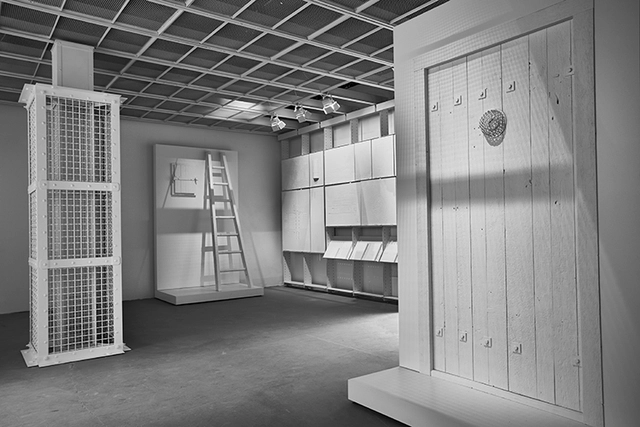
Interior perspective of The Evidence Room with models of Auschwitz gas column and gas-tight hatch, plaster casts, and model of gas-tight door. Photo by Fred Hunsberger, University of Waterloo School of Architecture.
Widely acclaimed as a critically important work on its debut at the 15th International Architecture Exhibition of the 2016 Venice Biennale, The Evidence Room examines the chilling role architecture played in constructing the Auschwitz death camp.
The Australasian Student Architecture Congress (ASAC)—titled Agency 2017—will be held in Sydney from the 28th of November to the 2nd of December. It will be the first congress held in Sydney since 1999 and student-led by ASAC Inc., a non-profit student body based in NSW, Australia.









.jpg?1503515565&format=webp&width=640&height=580)