Using a magnetic plastic compounds, magnets and simple gravity, Jólan gives birth to the Gravity Stool, an expressive piece of furniture that is like a frozen moment of physics exposing the forces in action. You can see the full process on the above video by Miranda Stet.
The following is Alejandro Aravena's response to the Shigeru Ban's Pritzker win. Aravena is the executive director of the firm ELEMENTAL S.A and a member of the Pritzker Jury who selected Ban as this year's Pritzker Laureate.
Shigeru Ban has expanded the field of architecture in unexpected ways. He has proved that the inspired artist and the skilled designer is not inevitably condemned to work for a privileged elite, but that innovation can take place while working for the majority, particularly those historically underserved, forgotten or neglected. In order to do that, he redefined the approach to deal with difficult, urgent and relevant challenges, replacing professional charity by professional quality. Ban has shown that no matter how tough the circumstances or scarce the means, good design far from being an extra cost carries the added value of sharp efficiency, power of synthesis and an uplifting feeling.
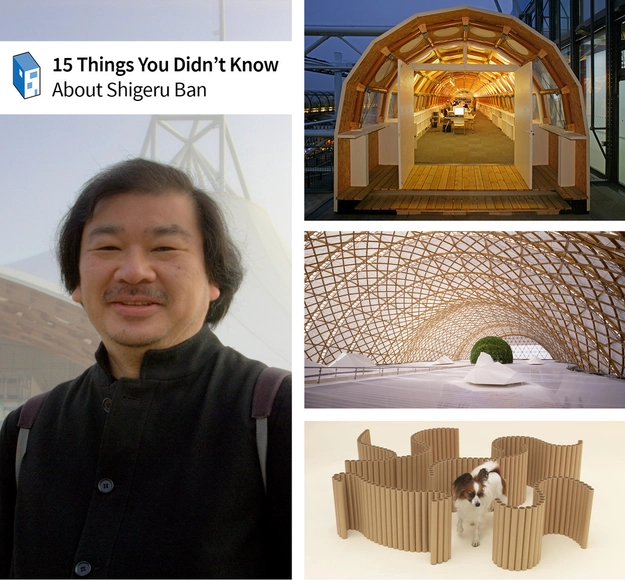
You probably know by now that Shigeru Ban has won this year's Pritzker Prize, but did you know he almost went to university to play rugby? Or that he constructed his home without pulling down a single tree? These and many more fun facts on the 38th Pritzker laureate, after the break.
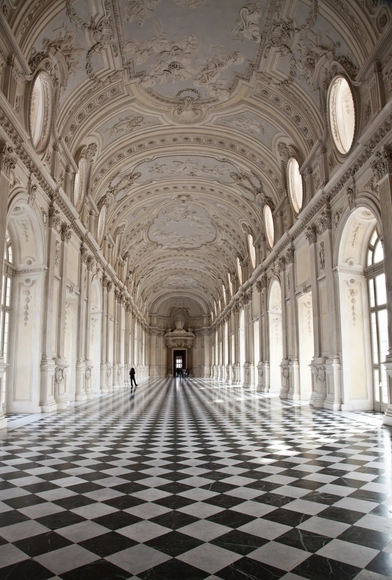
Galleria di Diana in Venaria Royal Palace, an example of Classical architecture. The Classical Language is an example of an "extremely successful form language". Image Courtesy of shutterstock.com
As you may have seen, ArchDaily has been publishing UNIFIED ARCHITECTURAL THEORY, by the urbanist and controversial theorist Nikos A. Salingaros, in serial form. However, in order to explain certain concepts in greater detail, we have decided to pause this serialization and publish three excerpts from another of Salingaros’ books: A THEORY OF ARCHITECTURE. The following excerpt, the first, explains the terms “Pattern Language” (as well as“antipatterns") and “Form Language.”
Design in architecture and urbanism is guided by two distinct complementary languages: a pattern language, and a form language.
The pattern language contains rules for how human beings interact with built forms — a pattern language codifies practical solutions developed over millennia, which are appropriate to local customs, society, and climate.
A form language, on the other hand, consists of geometrical rules for putting matter together. It is visual and tectonic, traditionally arising from available materials and their human uses rather than from images. Different form languages correspond to different architectural traditions, or styles. The problem is that not all form languages are adaptive to human sensibilities. Those that are not adaptive can never connect to a pattern language. Every adaptive design method combines a pattern language with a viable form language, otherwise it inevitably creates alien environments.
Architectural design is a highly complex undertaking. Heretofore, the processes at its base have not been made clear. There have been many attempts to clarify the design process, yet we still don’t have a design method that can be used by students and novices to achieve practical, meaningful, nourishing, human results.
In the absence of a design method and accompanying criteria for judging a design, things have become very subjective, and therefore what is built today appears to be influenced largely by fashion, forced tastes, and an individual’s desire to garner attention through novel and sometimes shocking expressions.
This Chapter puts forward a theory of architecture and urbanism based on two distinct languages: the pattern language, and the form language.
I am standing with Christine Binswanger, senior partner of Herzog & de Meuron, a few hours before the Perez Art Museum Miami opens it doors to the public for the first time. All around us, construction workers are making last minute adjustments, while troublesome clusters of VIPs take their first peak into the museum's airy, austere galleries. The excitement is palpable.
And yet I can't unpeel my eyes from the huge, hurricane-proof window before us. They offer enormous views of resplendent Biscayne Bay and the six-lane, 5.6km Macarthur Causeway that crosses it. Throbbing with traffic, the causeway is the kind of thing that, I imagine, people come to museums to forget. So I ask Binswanger, the museum's project architect, how her team approached this design problem.
"Problem? What problem?" says Binswanger. "That is what Miami is about. Anyway, I find it beautiful. Don't you?"
Suddenly I do. Or at least I find beautiful the building's wide-open embrace of Miami, causeways and all. And I suspect that this visual (and programmatic) permeability to the city's realities—natural and manmade—will define PAMM's institutional success.
Last June, we published our first list of must-see Instagram feeds to follow, but we knew it was only the tip of the iceberg. Once again we’ve scoured the web (and followed your excellent suggestions) to track down the 25 Instagrammers who will be sure to inspire – including dare-devil adventurer raskalov, up-and-coming architecture photographer nicanorgarcia, and our very own editor-in-chief.
See the 25 awesome architecture instagrammers, after the break…
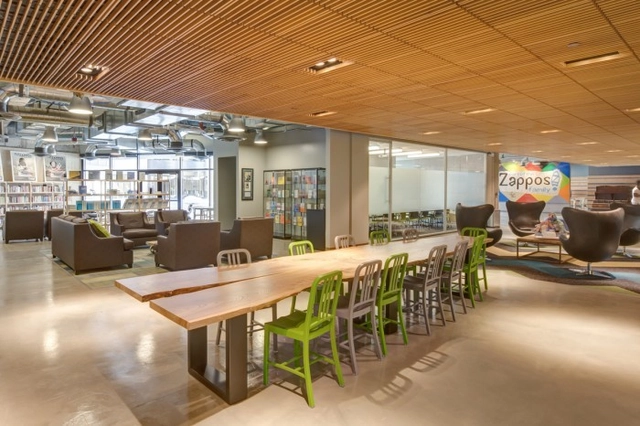
Zappos is one of the biggest companies to function as a ‘holocracy’ (without a fixed staff hierarchy). Their Las Vegas headquarters utilizes communal furniture to increase team-based collaboration (according to Business Insider, ‘desks are linked but can be easily disconnected or moved, the walls are movable as well. So if a team needs to work a different way, or a new product team is formed, the space can be changed, and changed again until it works’). Image Courtesy of Zappos, via OfficeSnapshots.com
What can architecture learn from Zappos? Yes, we’ve all heard about vegan cafés, yoga rooms, playing commando games indoors, and wearing Crocs in the office, but - more importantly - Zappos is transforming office culture in a meaningful, far-reaching way: it’s put an end to staff hierarchy.
According to The Washington Post, Zappos is the largest company to have adopted the Holocracy principle, the brainchild of software entrepreneur-turned-management-guru Brian Roberston. Guru would be the right word because, at first glance, and maybe second or third glance, Holocracy does come off as somewhat of a cult, albeit a business management cult. It creeps me out just a little bit, but having pushed through their website, I feel a little better now, not in the least like I’ve been L. Ron Hubbarded.
In a Holocracy, authority and responsibility are distributed across an organization in a way that is more goal-centered. As they say, “Everyone becomes a leader of their roles and a follower of others.” Still not making any sense? Old hierarchies that rely on “leaders” at the top, “followers” at the bottom, and “managers” in the middle are done away with completely. So, no more “bosses.” No more “staff.” No more “junior designer” or “senior designer.”
Courtesy of Strelka Institute for Media, Architecture, and Design, via Flickr
In this interview, originally published in The Architectural Review, Andrew Mackenzie sits down with OMA founder Rem Koolhaas to discuss the Venice Biennale, the extinction of national identities, his fascination with Asia, the link between De Rotterdam and Delirious New York, and the future of the profession.
Your proposition for this year’s Venice Architecture Biennale asks whether national identity has been, as you say, ‘sacrificed to modernity’. Some might view this as a project of reclamation, not unlike Frampton’s regionalism. How would you differentiate your proposition from Frampton’s?
Well, Kenneth Frampton is a smart guy, but the problem is that he looked at regionalism as an antidote to cosmopolitan development. In so doing he perverted the cause of regionalism, because suddenly regionalism was mobilised as a private cause that it couldn’t sustain. However, the question of national identity is an open one. For instance, at first sight the Netherlands is a very internationalist country, but looking closely you can see an enormous return of, not vernacular, but quasi-vernacular architecture and quasi-old fortresses that are newly built with a national flavour. Look at Zaandam, and that huge assemblage of so-called vernacular buildings.
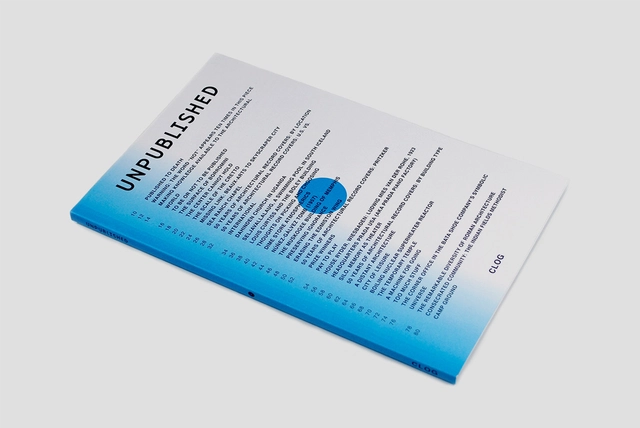
Each edition of CLOG poses a particular challenge to the reader: by showcasing such a variety of distinct view points, teasing out the central, connective themes is far from an easy task. It requires analysis, thought, and most of all time - which is, of course, entirely the point. CLOG seeks to “slow things down” so that the greater issues of architectural discourse are mulled over and explored.
The latest CLOG, however,Unpublished, has two central points that quickly, easily emerge. Pick up CLOG: Unpublished if you want to learn two things: (1) about how and why certain publications choose the architecture they publish (ArchDaily included); or (2) about works that have, for their geographical location or problematic nature, been forgotten from the “idealized narratives” of architecture
The following essay, written by Magda Mostafa, is an excerpt from the book "Learning from Cairo: Global Perspectives and Future Visions,"a collection of reflections from a three-day symposium of the same name. Here, Mostafa focuses on the need to accept informal communities as a reality, not an exception, and argues that conventional architecture practice and education must begin equipping architects to "address the potentials and problems of such parallel modes of existence in our built environment."
It would be a disservice if the debate spurred at the "Learning from Cairo" symposium were to remain confined to the hypothetical. It is our responsibility to extend it to both the professional realm as well as the academic. The purpose of this discussion is just that.
How can architectural academia respond to this shifting climate? A climate where the majority of the built environment is conceived and implemented outside of the construct of conventional practice? Where the majority of the architectural product in our city exists without architects? How can we further propagate a singular top-down mode of practice in our teaching when it’s malfunctioning at best and corrupt or absent at its worst? When this conventional mode is only viable in neatly packaged projects with clear financing, educated clients and formal frameworks? How can we continue to teach our students, the architects of the future generation, to only be equipped to operate within a small portion of the built environment- ignoring the massive built environment and user groups often represented on maps as solid black “informal areas”.
This phenomena can no longer be blacked-out, and it is time for academia to begin educating its architects-to-be at least to be minimally aware, if not proficiently trained, to address the potentials and problems of such parallel modes of existence in our built environment.
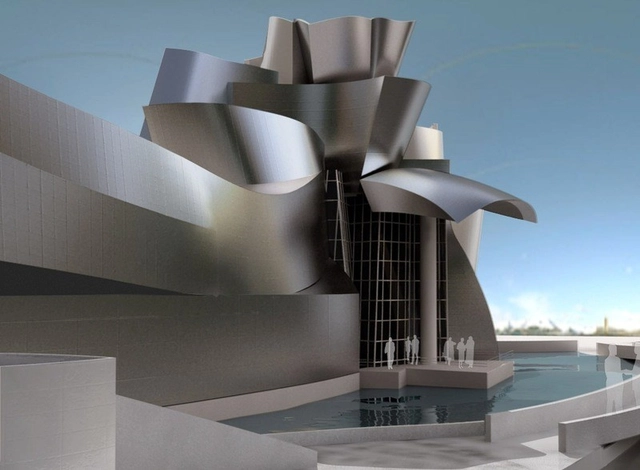
Frank Gehyr's Guggenheim Museum Bilbao. Rendered/Modeled in Rhino by Neguin. Image Courtesy of rhino3d.com
It used to be that when an architect needed a physical facsimile of his/her project, a draftsman would individually draw the schematics by hand. Blueprints were revolutionary in that they streamlined reproduction through technology, yet they were based on a publishing model that was repetitive — not iterative. Computer Aided Design software, or CAD, streamlined the process even further; however, unlike blueprints, CAD was not based on publishing models, but rather on “technological science.” As such it evolved in a very different way. CAD technology that was initially developed in the 1960s as a proprietary tool for heavy industries—aerospace, automotive and super-computer processing centers— became consumer-oriented in the 1980s when it met the UNIX open platform. The key in its rapid development, dissemination and democratization was exactly this: open technology.
Today, we have 3D modeling software that can pack an exponential cache of information, render designs visible with incredible fidelity, and make those designs easier to adapt. BIM technology (building information modeling) has entered the workplace, too, improving coordination and productivity of all trades involved in project construction, effectively revolutionizing the manufacturing sector. This is technology that, like CAD, has undeniably been pushed forward via the open development and integration of components.
And yet, architects continue to depend on closed distribution models in the face of so much technology that makes design shareable and easy to manipulate. 3D modeling software has evolved and created a competitive market with ever more accessible, cross-border, cross-disciplinary design software. While the blueprint, a “published” medium, came with requisite copyright issues that appealed to the architect-as-artist, today, as a “technological” layer, blueprints cannot afford to stay locked in.
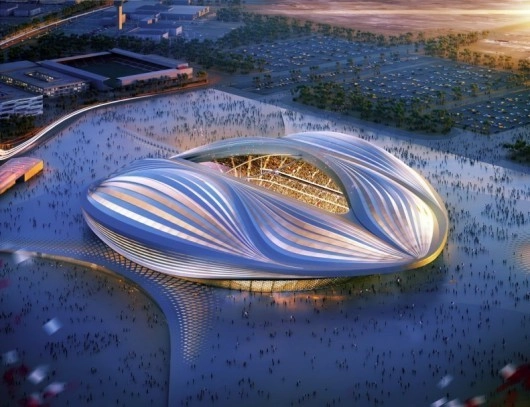
Zaha Hadid Architects' design for al-Wakrah stadium, the main stadium for the 2022 Qatar World Cup. Image Courtesy of ZHA
Zaha Hadid’s unfortunate comments in response to worker deaths on construction sites for the 2022 World Cup has made Qatar the eye of a storm that has been raging globally for decades. But it’s not just about Qatar. This has been an issue for as long as there have been construction sites and for as long as poor people have swarmed to them for a chance at a better life.
Construction booms and migrant construction workers have always been two sides of the same equation, both dependent on the other, and, by the twisted logic of the global economy, both are the reason for the other’s existence. No migrant labor pool = no global city = no fantastic architecture, or something to this effect.
The migrant workers are the silent collaborators in global architecture, the invisible, faceless, “untouchables” who make the cost-effective construction of these buildings possible.
While interest in tall timber buildings continues to grow, there still remains one obvious concern: combustibility. So how safe are timber structures really? Arup Connect spoke with Robert Gerard, a fire engineer in Arup’s San Francisco office, to find out how high-rise wood buildings take fire safety into account.
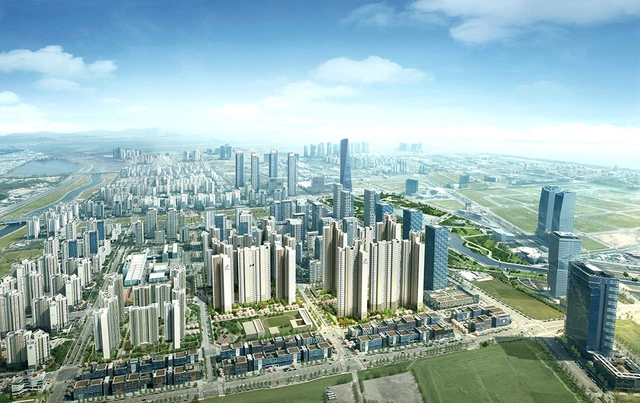
The New City of Songdo in South Korea. Image Courtesy of Cisco
Originally published by Metropolis Magazine as "Big Data, Big Questions", this article by Alex Marshall examines what is arguably the most important aspect of smart city design: not how they will be created, but who will create them. He finds that, though an apparently new phenomenon, smart cities are just like their forebears in that they are built primarily by political will, not microprocessors.
Not long ago, I bought a beetle-shaped piece of silicone and metal that slips into my pocket and keeps track of how much I walk. Called a Fitbit One, it’s essentially a glorified pedometer. The device’s shell is jammed with hard- and software that lets it talk to my computer and iPhone. It sends me attaboys! on its tiny screen and, most importantly, the gadget talks with my spouse’s Fitbit, which allows us to compete with each other.
The Fitbit is not on anyone’s list of smart-city phenomena, but I would argue for including it, because it’s changing my relationship with the streets I walk in New York City. It also illustrates the pervasiveness of smart technology, and its limitations. For all its coolness—and it is cool—my device is doing something digitally that had already been done well mechanically, and at a lower price. A lot of the smart-cities technology is like this—it’s changing how we do things, but often not what we do.
Read on for more about the changes brought about - or not brought about - by smart cities after the break
There are few topics that stir up more controversy on ArchDaily than that of women in architecture. From those of you who vociferously advocate for women in the field to those who steadfastly purport that gender has no place in architecture at all, you, our readers, represent a wide spectrum of viewpoints and opinions on the subject.
And so, in honor of International Women's Day, we've decided to take a look back at some of our past comment-stirring articles (even more after the break):
In this article originally published by Metropolis Magazine as "Urban Hopes, Urban Dreams", Samuel Medina reviews a new book on the work of Steven Holl in China. Focusing on five major projects, the book places Holl's work in the wider context of his urbanistic influences - including ideas from his own early paper architecture that are just now resurfacing.
Steven Holl is the rare architect whose concepts are equally known as his buildings. Chalk that up to Holl’s prolific output, in both buildings and monographs, and his knack for branding his ideas. Urban Hopes: Made in China (Lars Müller, 2014), a condensed reader on Holl's latest work in China, is the latest in a stream of small books that have continually repackaged the architect's growing body of work.
Anchoring and Intertwining appeared in 1996 and expounded on architectural themes and spatial notions only partially evinced by his work up until that time. In both, the buildings were few and far between, scattered between pages imprinted with “paper architecture,” the primary outlet for Holl’s creative energies in the prior decades since his move to New York in 1976. These and more titles were followed up by Parallax in 2000, a blend of philosophical, scientific, and poetic references that invest the architecture with the aura of the Gesamtkunstwerk. Holl’s idea of “porosity” made its debut here, if prematurely, where it was applied rather literally to Simmons Hall at MIT and its sponge-like facade. It wasn’t until a few years later, when the architect first got his feet wet in China, that the concept would be baptised as a core tenet of 21st-century urban design. 2009’s Urbanisms advances as much, while further recapitulating the big ideas of the previous book installments.
Read on after the break for the review of Urban Hopes
Videos
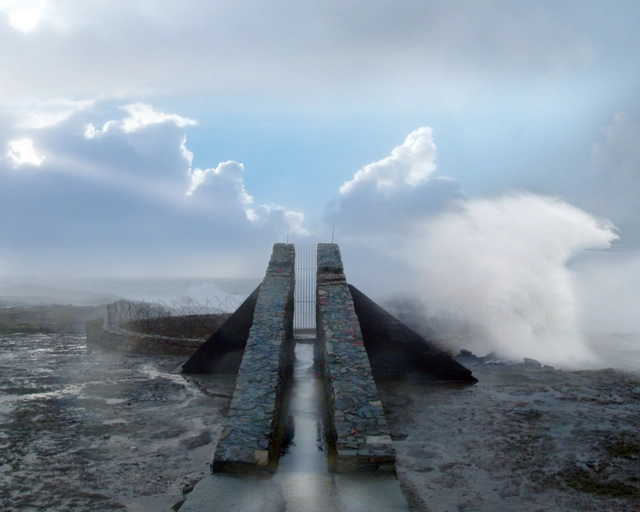
Doonamoe, County Mayo Ireland. Town of Belmullet. The Thin Places are Irish places where time past, present, and future converge. This project envelops a 100 ft deep blowhole by the Atlantic Ocean. The waves are thrusting up over a 100 ft into the air and the thin place walk is aligned to the equinox. Image
Originally published by The Huffington Post as "The Problem With Architecture Today (and the Solution)", Monica Gray documents the work of Travis Price, an architect and professor who works with his students to produce singular works all over the world which fight against the soulless architecture of our age.
According to Travis Price, an award-winning architect and philosopher whose work is rooted in ecology and mythology, most architecture today is just plain soulless. "You go into malls and they float all kinds of Roman columns and fake images. It's Disney. It's superficial. It's mass produced. It's empty."
Price, a fellow of the American Institute of Architects, focuses on restoring the "spirit of place" to modern design by providing an alternative to the "sprawl, mall and tall" trend of generic suburban architecture today, or, as he puts it, "a slow moving Pompeii blanketing us with the pursuit of loneliness and homogeneity."
Read on after the break to find out how Price is in his own way combating this problem
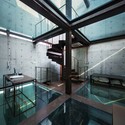
The Vertical Glass House (2013), built at the West Bund Biennale of Architecture and Contemporary Art, Shanghai. Image Courtesy of Atelier FCJZ
In this article, originally published by Metropolis as "Houses Without Windows: Meditative Respites or Architectural Straightjackets?", Komal Sharma looks into the architectural oddity that is the completely enclosed house. While many would shudder at the idea, there is a rich history of houses which, in exceptional circumstances and with exceptional clients, make sense without windows.
The Vertical Glass House by Chinese architects Atelier FCJZ is disingenuous to say the least. Its name suggests a vertical derivative of Philip Johnson's canonical house, and in fact its architects describe it as a 90-degree rotation of the typical modernist glass house. Instead, what welcomes visitors at Shanghai's Xuhui waterfront is a four-story concrete house without any windows. Where is all that promised glass, you might ask?
The answer is inside. The house's textured concrete walls give it the appearance of a bunker, but the interiors are actually light-filled. The architects accomplish this through an inverted sense of space. Where one expects walls of glass, yielding a platonic prism that brazenly exposes inhabitants to the outside world, the house instead delivers a surprising twist: the 7-cm-thick floor slabs are completely transparent, endowing users with a Superman-like sense of see-through vision. The experience of looking up through all of the house's spaces, even the most private spaces like the bathroom, is breathtakingly novel.
Read on for more about the phenomenon of window-less houses







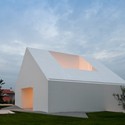
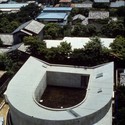
.jpg?1393936939 "The source of illumination for the Ryunsenji House (2008) in Japan, is a light well on the roof. Image Courtesy of Uno Tomoaki")
