As part of ArchDaily's coverage of the 2016 Venice Biennale, we are presenting a series of articles written by the curators of the exhibitions and installations on show.
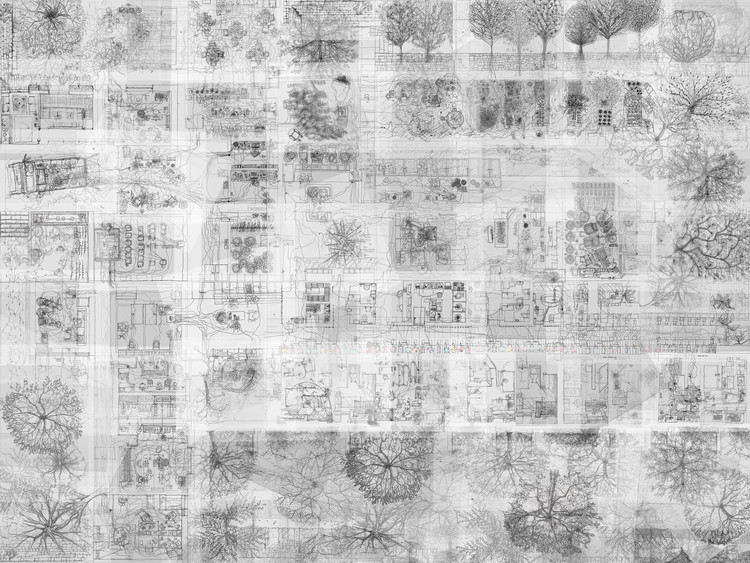
Architecture deals not only with form. It is about data and material flows, the organization of resources, the mobilization of capacities; it organizes not only static things, but it is also a design of processes. It would be great to understand architecture as an agent with which to communicate processes of material space for the public in a coherent way. Architecture has great tools to present and explain assemblies in sections – plans, maps; architects are capable of processing quite complex flows of information.
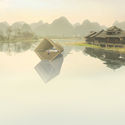
On June 11th, the European Biennial of Contemporary Art, also known as Manifesta, began its 100-day stint in this edition's host city, Zurich, Switzerland. The festival's center-piece is a timber raft floating on Lake Zurich, known as the Pavilion of Reflections. The temporary structure was designed and realized by Studio Tom Emerson and a team of thirty students from ETH Zurich. Constructed primarily of timber, Christian Jankowski, curator of Manifesta 11, describes the exhibit “as a floating multi-functional platform with a giant LED screen, a stand for spectators, a swimming pool and a bar.”
Commissioned by the Danish Foundation for Culture and Sports Facilities, Andersen & Sigurdsson Architects’ Light Pavilion design is open and transparent, encouraging participation. With an area of 1,200 square meters, the multi-purpose structure will house a range of planned and spontaneous activities. The architects’ vision was to create a space in which a multitude of events could take place in and around it.
While the actual structure is currently under construction, a model of the building is on display at the Danish Pavilion for the Venice Biennale, alongside 15 other models of buildings that are deemed to be a source of national pride. The theme for this year’s Danish pavilion focuses on "architecture that benefits local communities," a quality the Light Pavilion encapsulates.
David Adjaye is set to release a vinyl record with his brother Peter, a composer and musician with whom David has been formally collaborating for over a decade, reports The Spaces. The record, Dialogues, presents a collection of 10 of Peter's sonic responses to David's architectural projects. "When I see architecture I hear sounds – I respond to the visual. David responds to sound – he creates with a soundtrack in his mind," Peter said of their creative dynamic.
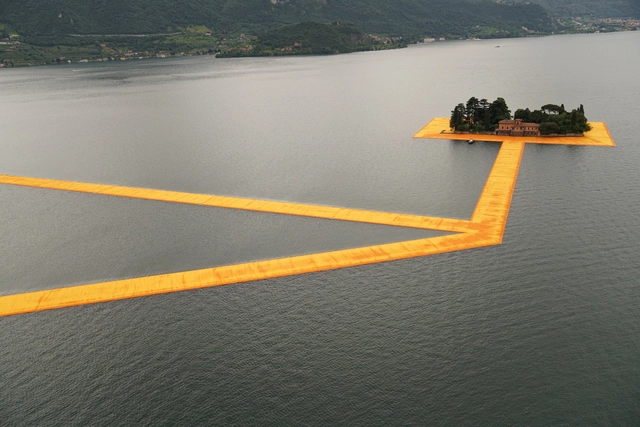
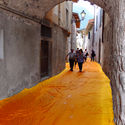
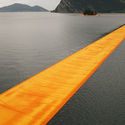
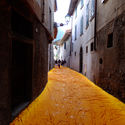
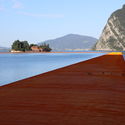
Beginning this week, and lasting for only sixteen days, visitors to the Italian Lake Iseo can "walk on water." The Floating Piers is the work of Christo and Jeanne-Claude, based on an idea first conceived in 1970. Built using 100,000 square meters of shimmering yellow fabric, carried by a modular floating dock system of 220,000 high-density polyethylene cubes, the installation—which sits just above water level—undulates with the movement of the lake.
According to Italian news source, Leggo, two people were "seriously injured" and the installation was "evacuated" on its opening day due to the quantity of visitors and inclement weather conditions.
Those who experience The Floating Piers will feel like they are walking on water – or perhaps the back of a whale.
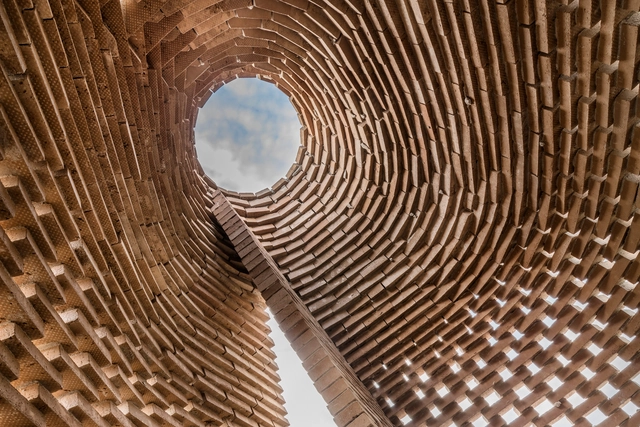
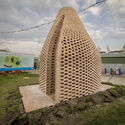
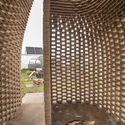
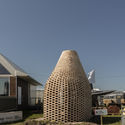
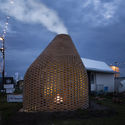
Studioninedots have designed a new pavilion, “The TrueTalker,” to generate a space for open communication and storytelling. The pavilion is one of approximately fifty at Amsterdam's temporary Fab City, an initiative organised by Europe by People to promote self-sustaining, innovative cities. The project also comes as a reaction to Amsterdam hosting the European Union this spring, where rigid and official conversation will be scrutinised and recorded from every angle. In contrast, Studioninedots said that "The TrueTalker" creates a space where “everyone is invited to sit down, relax and share warming, unreasonable, crazy, unimaginable and hilarious ideas.”
Wolfgang Buttress’ The Hive, a Gold Medal-winning UK Pavilion originally built for the 2015 Milan Expo, has been relocated to the Kew botanical gardens in central London. The striking (and photogenic) "beehive" was designed by the British practice to provide visitors with a glimpse into the life of a working bee; its 169,300 individual aluminium components—reaching 17-meters tall and fitted with hundreds of LED lights—created a multi-sensory experience that shed light on the importance of the pollinator. Following its relocation, photographer Laurian Ghinitoiu has turned his lens to this installation and its new home.
Courtesy of Flickr user Chris Maidlow, licensed under Creative Commons 2.0
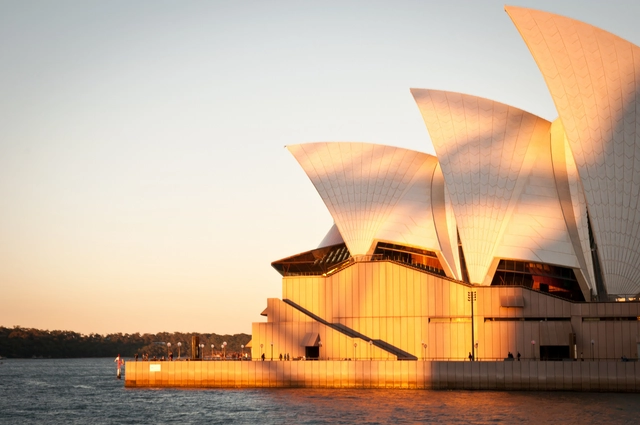
The Sydney Opera House is one of the most iconic buildings in the world. A momentous achievement in design and engineering, the building quickly cemented itself as a defining feature of the Australian cultural landscape. But the realization of the building was not a straightforward one, and almost immediately after the project was awarded it became fraught with controversy and uncertainty. At the center of this controversy was the architect, Jørn Utzon, who eventually resigned after mounting conflict with the state government. Now, this period of Utzon's life will be chronicled in a new feature length film, Utzon, The Man Behind the Opera House, reportsThe Guardian.
As part of ArchDaily's coverage of the 2016 Venice Biennale, we are presenting a series of articles written by the curators of the exhibitions and installations on show.
As a response to the 15th International Architecture Exhibition’s challenging theme, Portugal presents a “site-specific” pavilion, occupying an urban front in physical and social regeneration on the island of Giudecca: Campo di Marte. In actual fact, the installation of the pavilion on-site triggered the completion of Campo di Marte’s urban project designed by the Portuguese architect Álvaro Siza thirty years ago.
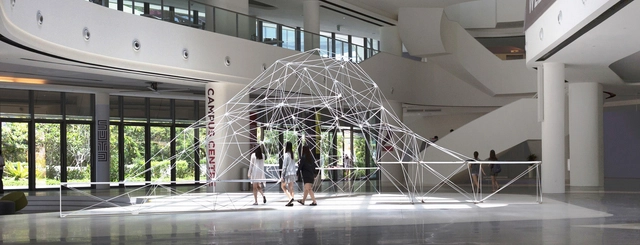
Professors Felix Raspall and Carlos Bañón from SUTDSingapore have designed a 14.5-meter-long fibrous mesh made out of metal and nylon 3D printed nodes and aluminum bars for the SUTD Open House 2016.
Rather than utilizing 3D printing to create a scaled model, the pavilion project applied 3D printing technology directly to functional architectural components at a large scale.
In a short film exploring some of the National Participations at this year's Venice Biennale, Monocle Films take a considered look at how different countries have responded to the Biennale theme, Reporting From the Front in both explicit and more indirect ways. Visiting the Austrian Pavilion, the Nordic Pavilion, the Turkish Pavilion, the British Pavilion, the Irish Pavilion, the Australian Pavilion and the Romanian Pavilion, the film studies what discourses are being waged in the compressed geo-political world of the Giardini di Biennale.
Earlier this week, the temporary sea wall that had been separating the Louvre Abu Dhabi from the seawater of the Persian Gulf was removed, creating a new harmony between site and structure as envisioned in the original project renderings. The building, which was conceived in 2007 and designed by Jean Nouvel, is set to open later this year.
In a recent interview with the BBC, Rem Koolhaas (OMA) has spoken out against the campaign seeking to remove the United Kingdom from the European Union, upon which the British people will vote in a referendum next week. Reflecting on his time spent at London's Architectural Association (AA) in the 1960s and '70s, Koolhaas fears that advocates for withdrawal may be looking at the past through rose-colored glasses.
If you look at the arguments to leave you can see this is a movement of people who want to fundamentally change England back into the way it supposedly was before.
Urban design and landscape firm West 8 has released images of a newly designed sculpture park for Duke University. To be known as Three Valleys Sculpture Park, the 140 acre design will be set within the sprawling Duke Forest, alongside the Olmsted Brothers’ designed Campus Drive, and will help to strengthen the link between Duke’s east and west campuses.
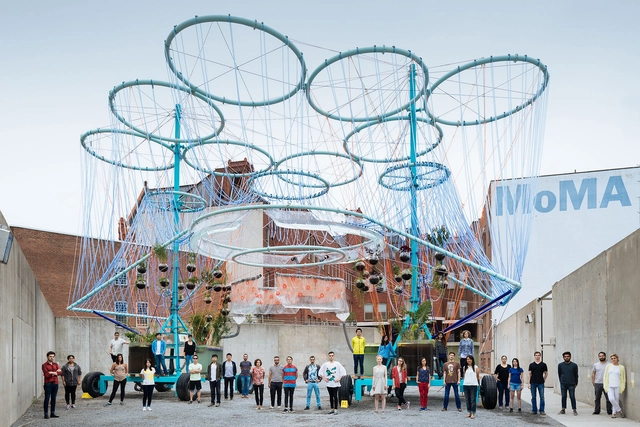
Spanish, New York-based architect Andrés Jaque (Office for Political Innovation) has been awarded the 10th Kiesler Architecture and Art Prize by the Mayor of Vienna, citing Jaque’s "capacity to go beyond assumptions about traditional practice and urban life." In 2015 Jaque was declared the MoMA PS1 YAP (Young Architects Programme) winner for COSMO – a complex, and beautiful, water purifying prototype that has been installed in Brooklyn. He and his office are also collaborating with Mark Wigley and Beatriz Colomina on the design for the upcoming Istanbul Design Biennial, Are We Human?
"Woodokan" by Hajima Yoshida, Japan. Image via University of Southern California and the American Academy in China
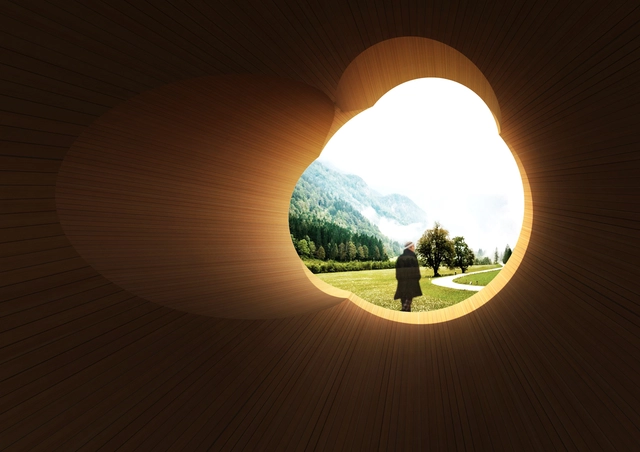
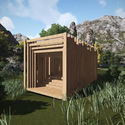
The University of Southern California's American Academy in China (AAC) has announced the seven winning designs for the international Napavilion Competition. Entrants had to design prefabricated wood structures with the sole function of providing space for guests to nap in. The winning designs will be built at Jade Valley Winery outside of Xi’an in western China, with three to be completed in time for the Napavilion Festival in July.
The Australian Institute of Architects has announced the winners of the 2016 International Chapter Architecture Awards, which honor Australian architects working on projects abroad.
Chosen from a field of 16 entries across five categories, the seven winners were notable for their size, scale, and locations.
The seven winners of the 2016 International Chapter Architecture Awards are:
As part of ArchDaily's coverage of the 2016 Venice Biennale, we are presenting a series of articles written by the curators of the exhibitions and installations on show.
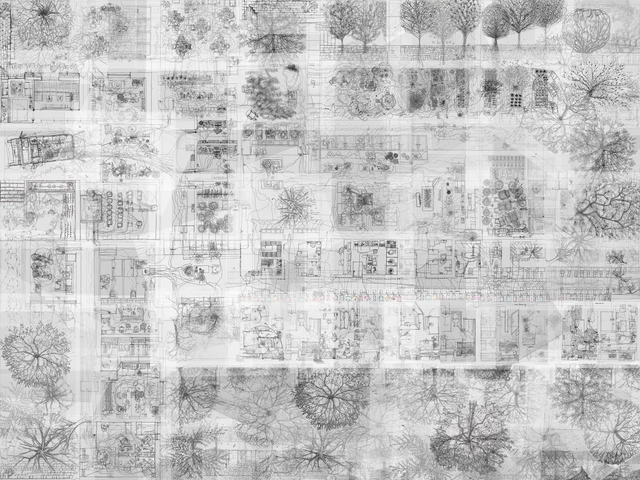
Our report is a reflection on the lessons learnt through designing and revisiting buildings for people with dementia. Visitors enter our space at the end of the Arsenale through a gap in the partition walls. The room is darkened, in contrast with the projected brightness on the floor. The floor accommodates a 4.8m x 6.4m animated drawing of the Alzheimer’s Respite Center. The drawing is dynamic, with multiple projected hands moving across the plane of the floor as they create fragments of a plan. They merge and overlap. These hands represent sixteen individuals inhabiting a series of rooms at the Alzheimer’s Centre. The projection consistently labours towards the clarity of a completed plan but falls short of achieving it.


.jpg?1466413535&format=webp&width=640&height=580)
.jpg?1466413708 "© Laurian Ghinitoiu")
.jpg?1466413694 "© Laurian Ghinitoiu")
.jpg?1466413544 "© Laurian Ghinitoiu")
.jpg?1466413583 "© Laurian Ghinitoiu")
.jpg?1466413535)
.jpg?1465734933&format=webp&width=640&height=580)
.jpg?1465734808 "© Laurian Ghinitoiu")
.jpg?1465734849 "© Laurian Ghinitoiu")
.jpg?1465734925 "© Laurian Ghinitoiu")
.jpg?1465734980 "© Laurian Ghinitoiu")
.jpg?1465734933)


.jpg?1466282992&format=webp&width=640&height=580)
.jpg?1466283164 "© Laurian Ghinitoiu")
.jpg?1466283287 "© Laurian Ghinitoiu")
.jpg?1466283005 "© Laurian Ghinitoiu")
.jpg?1466282831 "© Laurian Ghinitoiu")
.jpg?1466282992)
.jpg?1464585711&format=webp&width=640&height=580)
.jpg?1464585654 "NEIGHBOURHOOD: Where Alvaro meets Aldo / Curators Nuno Grande and Roberto Cremascoli. Portuguese Pavilion at the 2016 Venice Biennale. Images © Laurian Ghinitoiu.")
.jpg?1464585766 "NEIGHBOURHOOD: Where Alvaro meets Aldo / Curators Nuno Grande and Roberto Cremascoli. Portuguese Pavilion at the 2016 Venice Biennale. Images © Laurian Ghinitoiu.")
.jpg?1464585726 "NEIGHBOURHOOD: Where Alvaro meets Aldo / Curators Nuno Grande and Roberto Cremascoli. Portuguese Pavilion at the 2016 Venice Biennale. Images © Laurian Ghinitoiu.")
.jpg?1464585648 "NEIGHBOURHOOD: Where Alvaro meets Aldo / Curators Nuno Grande and Roberto Cremascoli. Portuguese Pavilion at the 2016 Venice Biennale. Images © Laurian Ghinitoiu.")
.jpg?1464585711)
.jpg?1466175054&format=webp&width=640&height=580)